
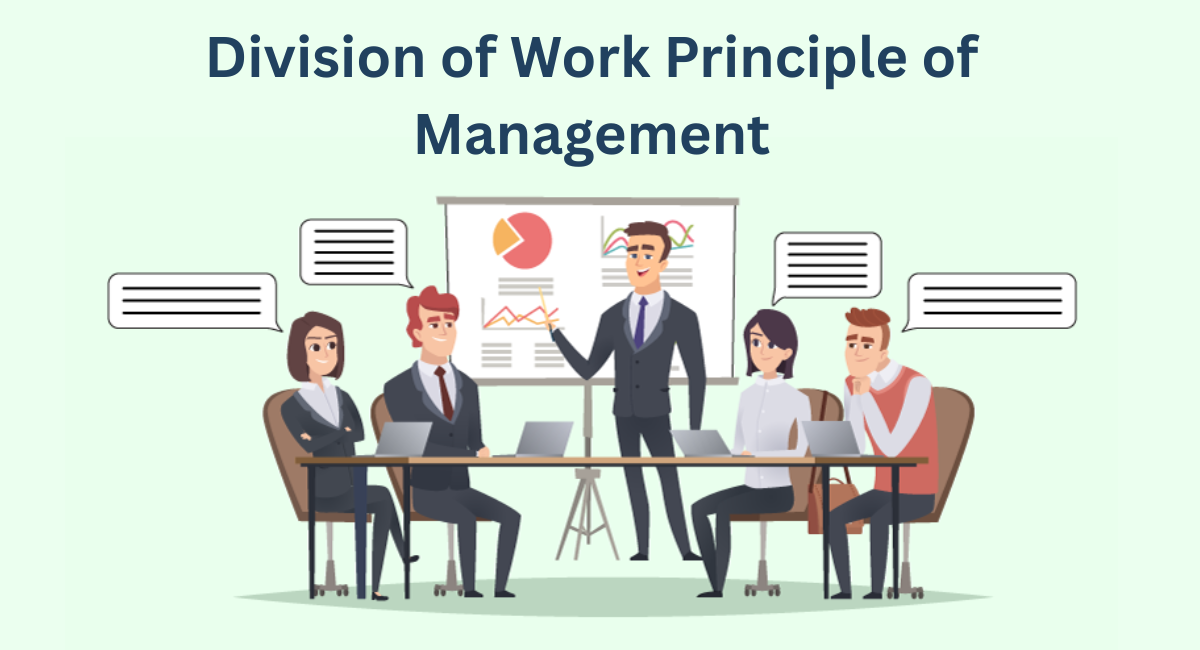
Why is one worker who does a single task all day faster than one who does a bit of everything? Henri Fayol answered that question over a century ago — and his answer still runs every factory, hospital, and office you’ve ever seen.
The division of work principle says that splitting a big job into smaller, specialised tasks — and giving each to the person best suited for it — makes an organisation far more efficient. It’s the first of Henri Fayol’s 14 principles of management, and the logic is simple: do one thing repeatedly, and you get faster, sharper, and better at it.
What Is the Division of Work Principle?
The division of work principle is the idea that work should be divided among individuals and groups based on specialisation, so each person focuses on a narrow set of tasks rather than doing everything. It was formalised by Henri Fayol, widely called the father of modern management, as the first of his 14 principles.
The idea goes back even further, to economist Adam Smith and his famous division of labour — the pin factory where workers who each did one step produced thousands of times more pins than workers doing the whole job alone. Fayol took that insight and built it into management. The principle applies to both technical and managerial work: specialise, and output soars.
What Does Division of Work Lead To?
Division of work leads to one thing above all: specialisation. And specialisation is what drives every benefit below. When someone repeats a focused task, three things happen — they get faster through practice, they make fewer mistakes, and they develop real expertise. Multiply that across a whole workforce and the organisation as a whole becomes dramatically more productive.
Advantages of Division of Work
- Higher productivity — repetition breeds speed and skill. A specialist finishes a task in a fraction of the time a generalist would.
- Better quality — when you do one thing over and over, you master it, and the standard of the output climbs.
- Less training time — teaching someone one narrow task is far quicker and cheaper than training them to do everything.
- Room for innovation — deep familiarity with a task means specialists spot better ways to do it that a generalist would miss.
- Clearer roles — everyone knows exactly what they’re responsible for, which reduces overlap and confusion.
Disadvantages of Division of Work
Push specialisation too far, though, and it bites back:
- Monotony and boredom — doing the same narrow task all day drains motivation and can wear people down.
- Over-dependency — if one specialist is absent and nobody else can do their job, the whole chain stalls.
- Loss of the big picture — people focused on one slice can lose sight of how the whole thing fits together.
- Less flexibility — a workforce of narrow specialists is harder to shift around when priorities change.
- Coordination costs — the more you split work up, the more effort it takes to join it all back together.
Example of Division of Work
Picture a busy restaurant kitchen. One chef doesn’t cook each dish from start to finish. Instead, one person preps vegetables, another works the grill, a third plates and garnishes, and a fourth handles desserts. Each masters their station, the line moves fast, and dozens of meals go out at once. That’s the division of work in action — and it’s exactly why a well-run kitchen outpaces one cook trying to do it all.
The same logic runs a car assembly line, a hospital, and a marketing team. It’s a cornerstone of good management, and it works hand in hand with Fayol’s other principles — like authority and responsibility and the scalar chain that keep a specialised organisation coordinated.
Frequently Asked Questions
What is the division of work principle in simple words?
It’s the idea of splitting a big job into smaller, specialised tasks and giving each to the right person. Doing one task repeatedly makes people faster and better at it, which boosts the whole organisation’s efficiency.
Who gave the division of work principle?
Henri Fayol, the father of modern management, made it the first of his 14 principles of management. The underlying concept traces back to economist Adam Smith’s idea of the division of labour.
What does the division of work lead to?
It leads to specialisation — which in turn brings higher productivity, better quality, faster training, and clearer roles. In short, people who focus get more done, and do it better.
What are the disadvantages of division of work?
Taken too far, it causes monotony, over-dependency on individual specialists, loss of the big picture, less flexibility, and higher coordination costs.
Specialise, but Don’t Overdo It
The division of work is one of the oldest and most powerful ideas in management for a reason: focus makes people better. Split the work smartly, and productivity, quality, and expertise all rise together.
But the principle has a ceiling. Slice jobs too thin and you trade efficiency for boredom, rigidity, and fragile teams. The best managers get the balance right — enough specialisation to gain the speed, enough variety to keep people sharp and engaged. Master that balance, and you’ve unlocked one of the quiet engines behind every high-performing organisation.



2 Comments on “What Is the Division of Work Principle of Management?”