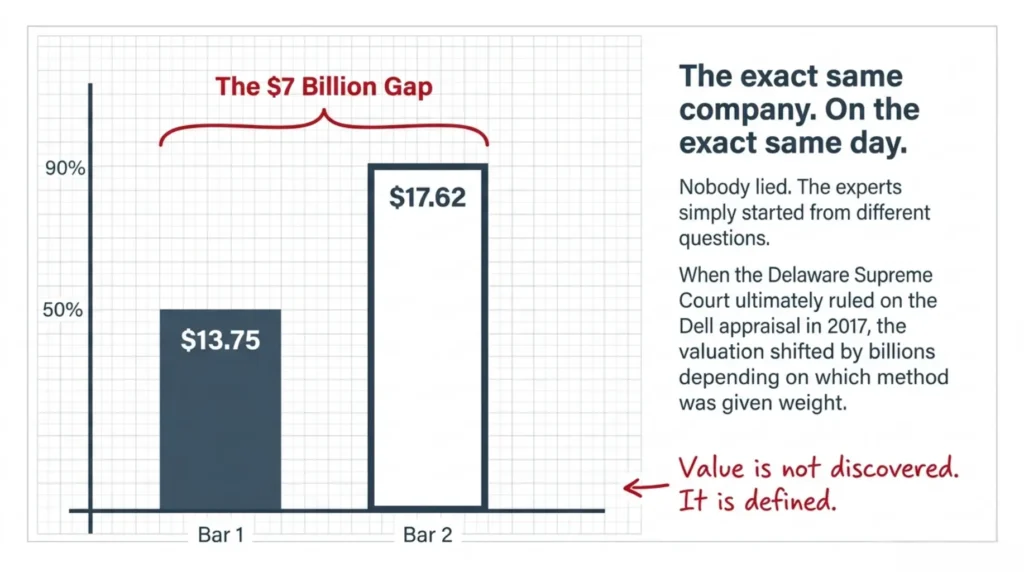
Dell’s shareholders were paid $13.75 a share when the company went private in 2013. Three years later, a Delaware court ruled the shares had actually been worth $17.62 — a gap of roughly $7 billion on the same company, on the same day.
Nobody was lying. The experts simply started from different questions.
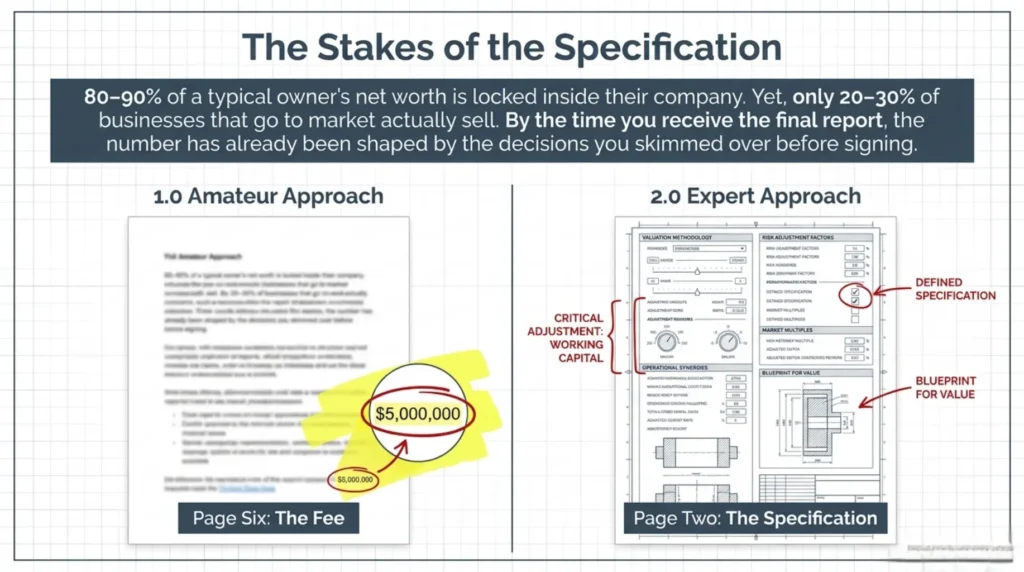
That’s the part owners miss about a valuation proposal. By the time you get the report, the number has already been shaped — by decisions made on page two of the document you skimmed before signing.
You skipped to the fee, didn’t you?
A valuation firm sends you six pages. There’s a section about their credentials, a paragraph or two of methodology you half-understand, a timeline, and a price.
So you check the price, check the delivery date, and sign.
Six weeks later the report lands. Then your bank says it can’t rely on it. Or your business partner’s lawyer says it’s inadmissible. Or the tax authority opens a file. You paid for a real piece of work and got something you can’t actually use.
The report didn’t fail. The proposal did — because nobody defined what question the valuation was supposed to answer.
And the stakes aren’t small. The Exit Planning Institute’s owner readiness research puts 80–90% of a typical owner’s net worth inside their own company, while only 20–30% of businesses that go to market actually sell. Most people’s largest asset gets valued properly once, under pressure.
Value isn’t discovered. It’s defined.
Here’s the idea that makes everything else in this article make sense: a business doesn’t have one value, it has several, and the valuation proposal is where you choose which one you’re buying.
Change the purpose, and the number changes. Change the standard of value, and it changes again. Change whether the buyer is hypothetical or a specific strategic acquirer, and it can move by 40% or more — with no dishonesty anywhere in the process.
The valuation proposal is not paperwork. It’s the specification. Get it wrong and you’ll receive a perfectly competent answer to a question you didn’t ask.
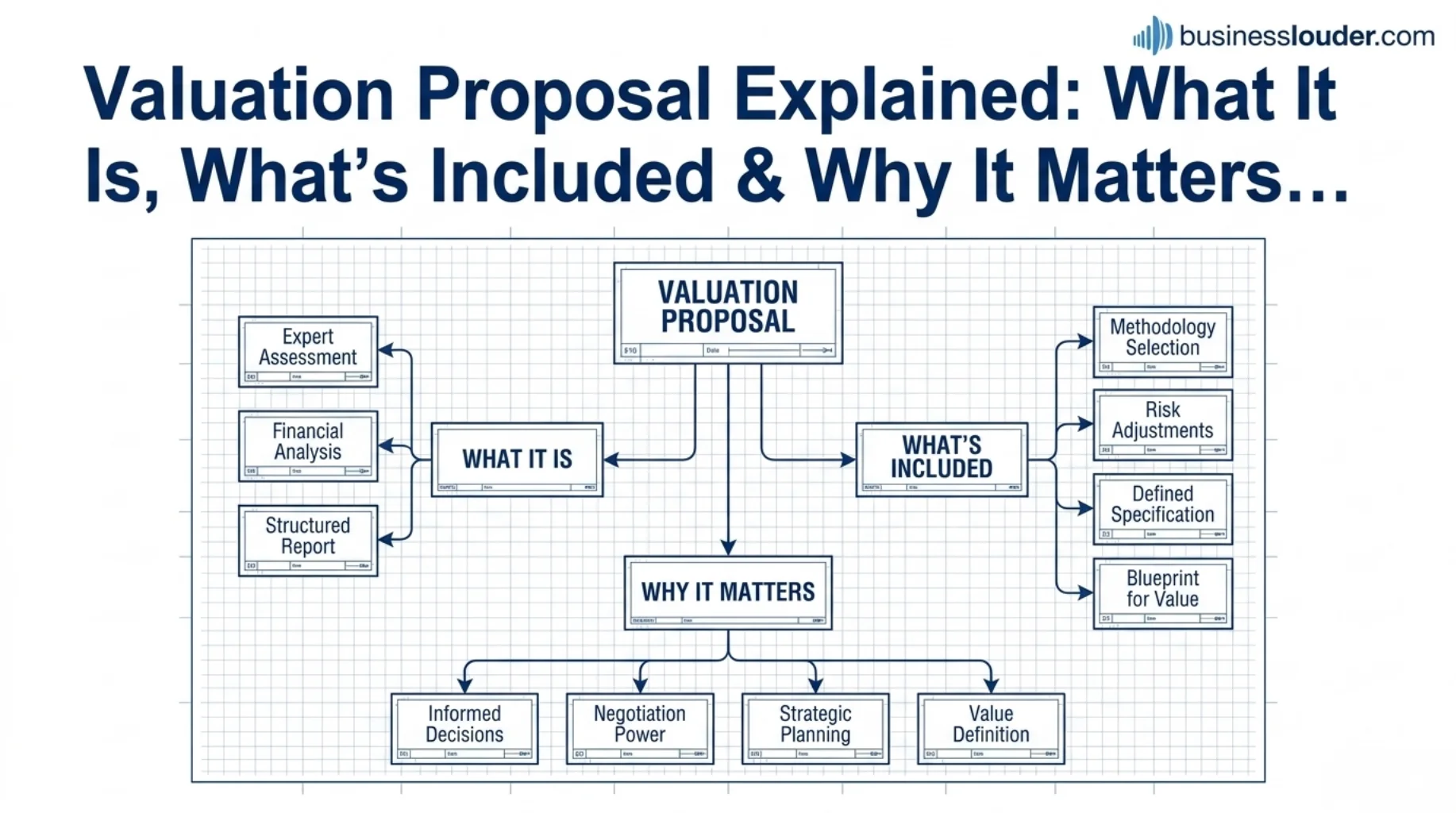
What a valuation proposal must actually specify
1. Purpose and intended users
Why does this valuation exist, and who is allowed to rely on it? A number prepared for internal planning is not the same number a lender, tax authority, court, or buyer will accept.
Common purposes: selling the business, buying out a partner, raising growth capital, issuing employee equity, estate and gift planning, divorce, shareholder disputes, or separating a division from the parent business.
If the proposal names one purpose and you intend to use the report for another, you have a problem before day one.
2. Standard of value
This is the single most consequential line in the document, and most owners skip it.
- Fair market value — the price between a hypothetical willing buyer and willing seller, neither under compulsion, both reasonably informed. This is the tax standard, defined in the US by IRS Revenue Ruling 59-60, issued back in 1959 and still the most-cited authority in the field.
- Fair value — a statutory standard used in shareholder disputes and financial reporting. It often strips out the discounts that fair market value permits, which can make the same shares worth noticeably more.
- Investment value — what the business is worth to one specific buyer, including the synergies they’d bring. Usually the highest number of the three.
A strategic buyer’s offer and a tax valuation are answering different questions. Neither one is “the real number.”
3. Premise of value
Going concern or liquidation? A profitable business valued as an operating enterprise and the same business valued as a pile of sellable assets produce wildly different results. The proposal should say which one applies and why.
4. Engagement type — the sleeper clause
This is where quiet, expensive mistakes live. Under the AICPA’s Statement on Standards for Valuation Services — known as VS Section 100 or SSVS — there are two very different engagements:
- A valuation engagement produces a conclusion of value. The analyst considers all three approaches (income, market, asset) and applies whichever they judge appropriate. More work, more cost, far more defensible.
- A calculation engagement produces a calculated value. You and the analyst agree upfront on limited procedures. It’s cheaper and faster — and under the standard, a calculation report is never permitted to describe its result as a conclusion of value.
Calculations have legitimate uses: early planning, a ballpark before you commit, an internal sanity check. But if a third party has to rely on the number — a court, a lender, a tax authority, a buyer’s diligence team — a calculation is usually the wrong instrument.
Read the engagement type before you read the fee. That one word explains most of the price difference between quotes.
5. The effective date
Value is a snapshot, not a running total. The proposal must fix an “as of” date, and the analyst may only use information knowable at that date. This matters enormously in disputes, where one side always wants a date that flatters them.
6. Scope, approaches, and exclusions
What’s in, what’s out. Which approaches will be considered. Whether a site visit and management interviews are included. Whether a real estate or equipment appraisal is part of it or a separate cost.
The exclusions section protects you as much as them. Vague scope is how a fixed fee becomes an invoice with add-ons.
7. Fees, timeline, deliverable, and independence
You want a fixed fee or a clearly capped range, the report format (detailed, summary, or calculation), the number of revision rounds, and what expert testimony would cost if it comes to that.
One rule with no exceptions: the fee must never be contingent on the value reached. A valuer paid more for a higher number isn’t independent, and every court and tax authority knows it.
Where the number really comes from
Under the income approach, your business is worth the cash it will produce, discounted for risk and time. Which means the valuation is only as good as the forecast underneath it — and that forecast is usually yours.
Optimistic projections don’t fool a competent valuer. They get discounted, and the discount is a judgement call you don’t control. You’re far better off walking in with a defensible financial model built on drivers you can evidence.
Before you hand over your numbers, stress-test them yourself. A pre-mortem or an inversion exercise on your own forecast will find the weak assumption faster than the valuer will — and it’s cheaper to fix it in your spreadsheet than to argue about it in a report.
What it costs, and why the quotes vary so much
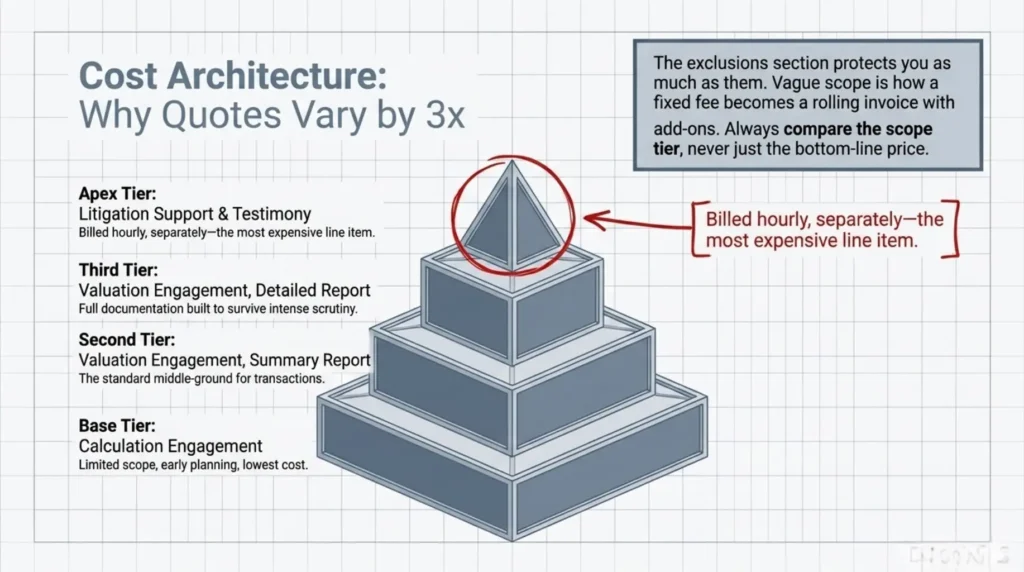
Fees for private company work vary by jurisdiction, complexity, and engagement type, but the shape is consistent:
- Calculation engagement — the cheapest option, often a few thousand dollars, limited scope, not for third-party reliance
- Valuation engagement, summary report — the common middle for transactions and planning
- Valuation engagement, detailed report — full documentation, built to survive scrutiny, priced accordingly
- Litigation support and testimony — billed separately, usually hourly, and the most expensive line you’ll ever see
Timelines typically run three to eight weeks once you’ve handed over complete records. The delay is almost always on the client side — missing financials, unreconciled accounts, no documentation for owner add-backs.
If two quotes differ by 3x, they’re almost certainly not the same engagement. Compare the scope, not the price.
Why the number is arguable even when everyone is competent
Back to Dell. In May 2016, Delaware’s Court of Chancery rejected the deal price entirely, ran its own discounted cash flow analysis, and put fair value at $17.62 per share — about 28% above what shareholders received.
In December 2017, the Delaware Supreme Court reversed it, holding that the lower court had been wrong to disregard the market price from what it found to be a robust sale process. The Harvard Law School Forum on Corporate Governance analysis is worth reading if you want the full reasoning.
Here’s the lesson for a business a thousand times smaller than Dell. Two sets of qualified experts, one of the most sophisticated courts in the world, and years of litigation — and the answer still moved by billions depending on which method got weight.
Any valuer promising you certainty is either inexperienced or selling. What you should want is a defensible range and clear reasoning, not false precision.
Red flags in a valuation proposal
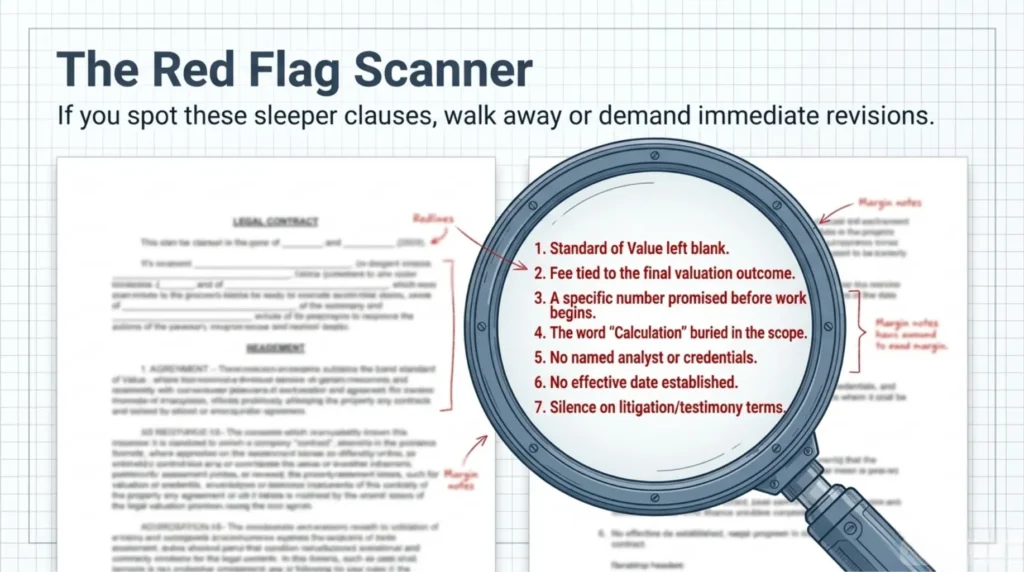
Walk away, or at least ask hard questions, if you see:
- No standard of value stated. The most important variable, left blank.
- A fee tied to the valuation outcome. Disqualifying.
- A number promised before the work starts. They’re selling you a conclusion, not an analysis.
- The word “calculation” buried in the scope while the sales conversation implied a full valuation.
- No named analyst or credentials. You want to know who signs it — ASA, CVA, ABV, CFA, CA/CPA, or your jurisdiction’s equivalent.
- No effective date.
- Silence on litigation. If there’s any chance of a dispute, testimony terms belong in the proposal.
One caveat about jurisdiction
Most of the specific standards above — SSVS, Revenue Ruling 59-60, Delaware appraisal law — are American. The underlying logic travels, but the rulebook doesn’t.
In the UK and much of the Commonwealth, valuers work to International Valuation Standards, with RICS Red Book rules for property. India has ICAI valuation standards and registered valuer requirements. Australia has APES 225.
The principle holds everywhere: the proposal must name which standard applies. If it doesn’t, ask.
FAQ
What is a valuation proposal? A document from a valuation professional setting out the purpose, standard of value, engagement type, scope, methods, effective date, timeline, deliverable and fee — before any work begins.
Is a valuation proposal legally binding? Once signed, it usually functions as the engagement agreement. For litigation or tax work, a separate engagement letter is common. Check which document actually governs.
Calculation or full valuation — which do I need? Calculation for internal planning and rough direction. Full valuation whenever a third party has to rely on the number.
How long is a valuation good for? It’s tied to its effective date. Most users treat one older than 12 months as stale, and a material change in the business ages it immediately.
Can I just use an online calculator or an industry multiple? For curiosity, sure. Rules of thumb ignore your customer concentration, owner dependence, margin quality and growth profile — the exact things that decide whether a buyer pays 3x or 7x.
Most owners get a valuation once, in a hurry, because a deal, a dispute or a death forced it. That’s the worst possible time to be learning what a standard of value is.
The proposal in front of you is not admin. It’s the moment you decide what question gets answered — and you only get to ask it properly once.
Read page two before you read the price.