About $78,000. That’s the average annual advertising budget of a US small business, according to a survey of more than 1,000 owners and marketing leaders by Intuit SMB MediaLabs.
More than nine out of ten of those owners said they can measure the return on that money.
The best experimental evidence in advertising suggests most of them can’t. And that gap — not a shortage of Instagram posts — is the real reason to ask what does a digital marketing agency do for small businesses, and whether you need one.
You’re the owner. You’re also the marketing department.
You know the pattern. You’re writing captions at 11pm. You boosted a post because the platform told you to. Someone said you need a blog, so there’s a blog, half-updated since March.
None of it is connected. Nothing has a number attached to it. And when a month is quiet, you can’t tell whether the marketing failed or the weather did.
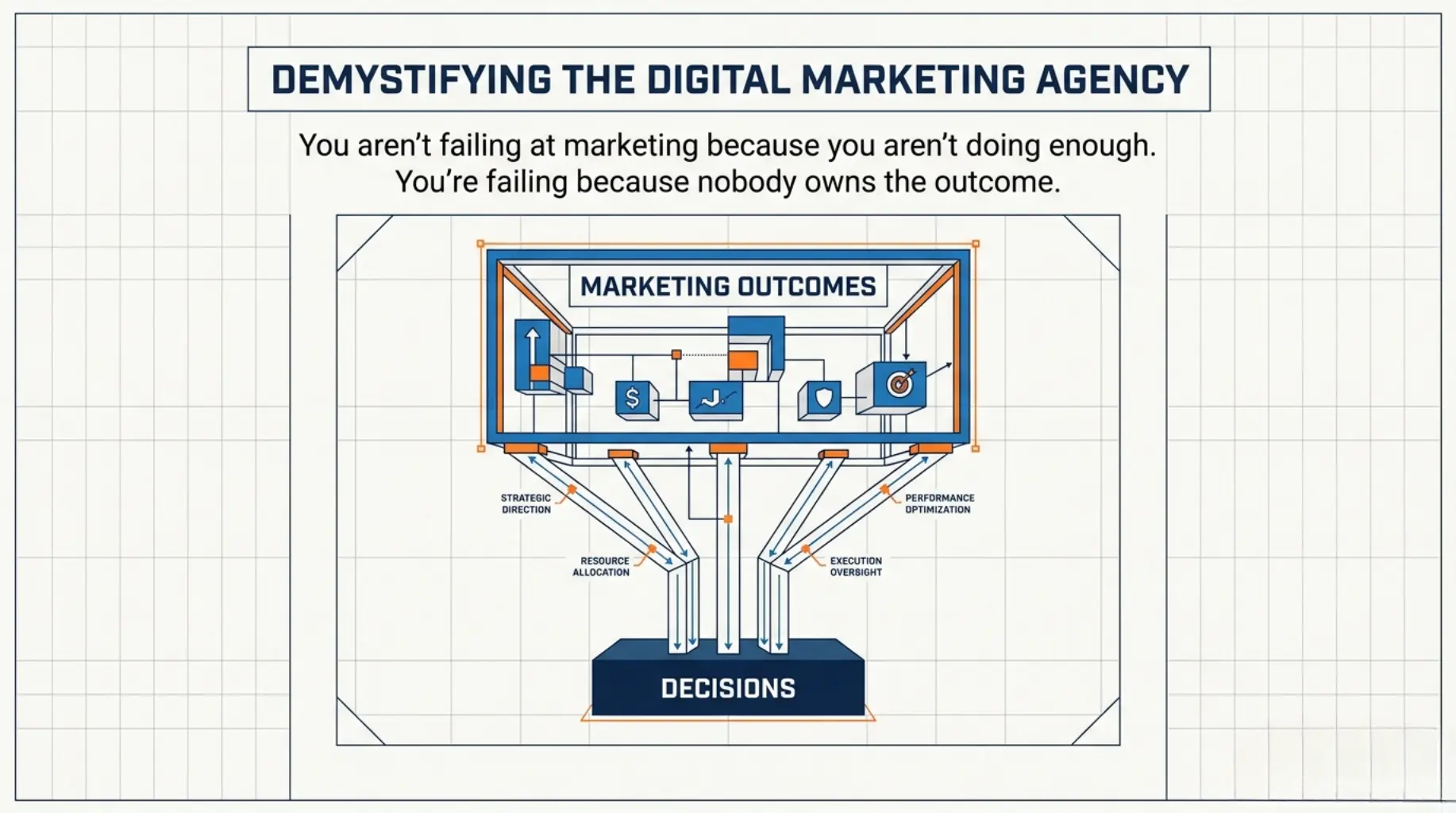
The problem isn’t that you’re not doing enough marketing. It’s that nobody owns the outcome.
The one thing you’re really paying for
Here’s the answer to what does a digital marketing agency do for small businesses, stripped of the pitch deck: you’re not buying tasks, you’re buying decisions.
Ads, posts, emails, landing pages — those are the visible deliverables. They’re also the cheapest part. The expensive, valuable part is somebody deciding where your next $1,000 goes, being accountable for that call, and getting to the truth faster than you could alone.
An agency that sells you deliverables will keep you busy. An agency that sells you decisions will make you money. Most owners never learn to tell the two apart before they sign.
What a digital marketing agency does for small businesses: the seven jobs
1. Positioning and strategy
Before anything gets built, someone has to answer three questions: who are we for, what do we do better than the alternative, and why should anyone pay us instead of the guy down the road?
Weak agencies skip this and go straight to channels. Strong ones spend the first month here, because every ad after it either compounds or wastes money based on this answer. If your foundations are shaky, revisit the core concepts of marketing before you hire anyone — you’ll ask far better questions in the pitch.
If an agency doesn’t ask about your margins and your best customers in the first meeting, they’re selling you tactics, not strategy.
2. Audience and targeting
Small businesses lose more money to bad targeting than to bad creative. Spending $2,000 reaching the wrong people beautifully is worse than spending $500 reaching the right people clumsily.
A good agency defines the segment narrowly enough to be useful — geography, life stage, job title, buying trigger — and can explain in plain English why they picked it. This is market segmentation in practice, not theory.
3. The website and conversion
Traffic without conversion is a very expensive hobby. Most small business sites lose people at obvious places: slow load, no clear next step, a contact form nobody answers, no phone number on mobile.
Fixing the site usually returns more than any ad campaign in the first 90 days. It’s also the least glamorous line item on any proposal, which is exactly why it gets skipped.
4. Search — SEO and local
SEO means earning traffic you don’t pay for per click. For a local business, most of the value sits in unsexy places: a fully completed Google Business Profile, consistent name and address details, real reviews, service pages that name actual towns.
SEO is compounding and slow. Ads are instant and rented. You need to know which one you’re buying.
Be sceptical of anyone promising rankings by a specific date. Nobody controls Google’s index.
5. Paid advertising
This is where agencies earn or destroy their fee. In Intuit’s survey, three in four small businesses named social media as their most effective advertising channel, with search advertising cited by about half.
A competent agency runs paid ads as a series of experiments with a stated hypothesis and a kill switch — not as a permanent monthly spend that only ever goes up.
6. Content, email and retention
Content earns attention. Email converts it. Email is still the cheapest channel a small business owns, because you’re not renting the audience from a platform that can change the rules on Tuesday.
Retention is the part almost every SMB agency underinvests in, because acquisition looks better in a report.
7. Reporting, tracking and handoff
Leads that nobody calls back aren’t leads. They’re expensive noise. The agency should be tracking what happens after the click — who answered, who quoted, who bought — which means their work touches your sales management process, not just your ad account.
What it actually costs
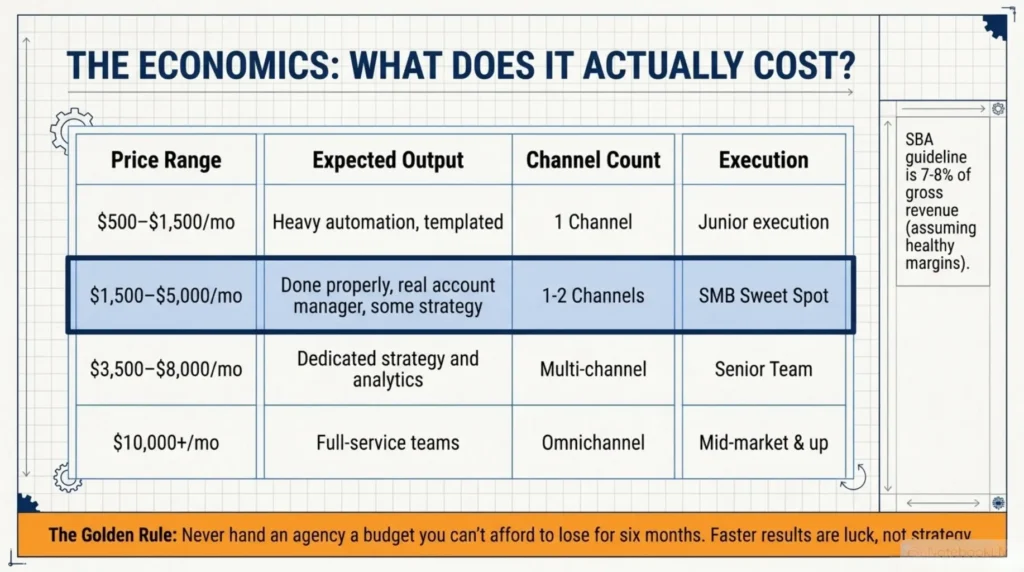
Across 2026 agency pricing guides, the ranges are fairly consistent, and small businesses generally land in the first two tiers:
- $500–$1,500/month — one channel, mostly templated, heavy automation, junior execution
- $1,500–$5,000/month — one or two channels done properly, some strategy, a real account manager
- $3,500–$8,000/month — multi-channel with dedicated strategy and analytics
- $10,000+/month — full-service teams, generally mid-market and up
For context, Gartner’s CMO Spend Survey puts enterprise marketing budgets at around 7.7% of revenue, and the U.S. Small Business Administration’s widely cited guideline is 7–8% of gross revenue for businesses under $5 million. But that percentage assumes healthy margins. On thin margins, the honest number is lower.
One rule worth holding: never hand an agency a budget you can’t afford to lose for six months. Anything faster is luck, not strategy.
The measurement problem nobody puts in the proposal
Now the part most articles on this topic leave out.
In a series of large-scale field experiments at eBay, economists Thomas Blake, Chris Nosko and Steven Tadelis switched off paid search ads and watched what happened. Their finding, published in Econometrica in 2015, was blunt: brand keyword ads produced no measurable short-term benefit, because organic search absorbed nearly all the traffic. For non-brand keywords, returns were a fraction of what standard attribution reported — and on average, negative, because most of the spend landed on customers who were going to buy anyway.
The study is a decade old and eBay is not your business. The mechanism still is. Platform dashboards credit ads for sales that would have happened regardless, and small businesses have less organic brand recall than eBay, which cuts both ways.
A great agency doesn’t just report the numbers the platform gives them. It looks for what the spend actually caused.
In practice, that means holdout tests, geographic splits, pausing a channel deliberately to see what changes, and asking every new customer how they found you. It’s cheap. Almost nobody does it. Ask a prospective agency how they’d measure incrementality — the answer will tell you more than any case study.
When you shouldn’t hire an agency
Three situations where the honest answer is “not yet.”
You haven’t proven anyone wants this. Agencies amplify. If the offer doesn’t convert when you sell it yourself, an agency will just help you lose money faster.
Your budget is under about $1,000 a month. At that level you’re usually buying automation with a human logo on it. A skilled freelancer on one channel typically beats a cheap full-service package.
You can’t say what success looks like. If you can’t write down the number the engagement has to hit, you’ll spend a year approving deliverables. Get clear on what a real business objective looks like first.
And it’s worth remembering that some of the best-known consumer brands of the last decade grew without one. Gymshark was started in 2012 by 19-year-old Ben Francis, screen-printing gym wear in his parents’ garage in Birmingham while delivering pizzas at night. Instead of buying advertising, he sent free product to fitness YouTubers who weren’t famous yet — Lex Griffin, Nikki Blackketter — and built relationships with them over years. By 2020, General Atlantic’s £200 million investment valued the business at around £1 billion.
Gymshark’s advantage wasn’t budget. It was knowing precisely who the customer was and committing to one channel long enough for it to compound. That clarity is exactly what you should be hiring an agency to give you — and if they can’t, don’t pay for it.
How to hire one without getting burned
Ask these five questions before you sign anything:
- What would you not do for us in the first 90 days? A strategist has a stop-doing list. A salesperson doesn’t.
- Who is actually doing the work? Pitch teams and delivery teams are often different people. Ask to meet the person who’ll touch your account daily.
- How would you know if this isn’t working? You want a specific leading indicator with a specific timeline.
- Who owns the ad accounts, domain and data? The answer must be you. This is where relationships turn ugly.
- What happens if I want to leave in month four? Read the notice period before the pitch flatters you into skimming it.
Then set a 90-day test. Pick one primary metric — qualified leads, booked jobs, revenue from new customers — plus one leading indicator like cost per qualified lead. Agree a baseline in writing before day one. Review at 30, 60 and 90 days.
Ninety days is long enough for paid channels and website fixes to show something real. It’s not long enough for SEO, so judge that separately on inputs: pages published, technical fixes shipped, reviews collected.
One thing to keep in perspective: the 2025 ANA/4As study on client-agency tenure found average relationships now run about seven years, more than double the 3.2 years reported in 2016 — and clients without constant formal reviews stayed longest, at 8.1 years. That research covers large brands with agency-of-record contracts, not corner shops, so don’t over-apply it. But the direction is useful: the relationships that work are the ones given time to compound, not the ones re-pitched every spring.
FAQ
What does a digital marketing agency do for small businesses in simple terms? It takes ownership of getting you customers online — strategy, website, search, paid ads, content, email and reporting — and decides where your budget goes each month.
How much should a small business pay an agency? Most land between $1,500 and $5,000 a month for one or two channels done well. Below $1,000, expect templates and automation.
How long before I see results? Paid ads and website fixes can move within 30–90 days. SEO and content typically take 6–12 months.
Agency, freelancer, or in-house hire? Freelancer for one channel on a small budget. Agency when you need several channels coordinated. In-house when marketing is a core competitive advantage and you can afford a senior person.
Most small businesses don’t get burned because they picked a bad agency. They get burned because they hired one to make a decision they’d never made themselves — who the customer is, and what a good month looks like.
Write those two answers down this week. Then go find someone to help you hit them.