Business LouderBusiness Louder
  • Home
  • Business
  • Management
  • Marketing
  • Communication
  • Blog
  • Contact Us
Business LouderBusiness Louder
  • Home
  • Business
  • Management
  • Marketing
  • Communication
  • Blog
  • Contact Us
Follow US
Business Louder > Blog > Blog > What is Management? Definition, Objectives, Scope, Nature
BlogManagement

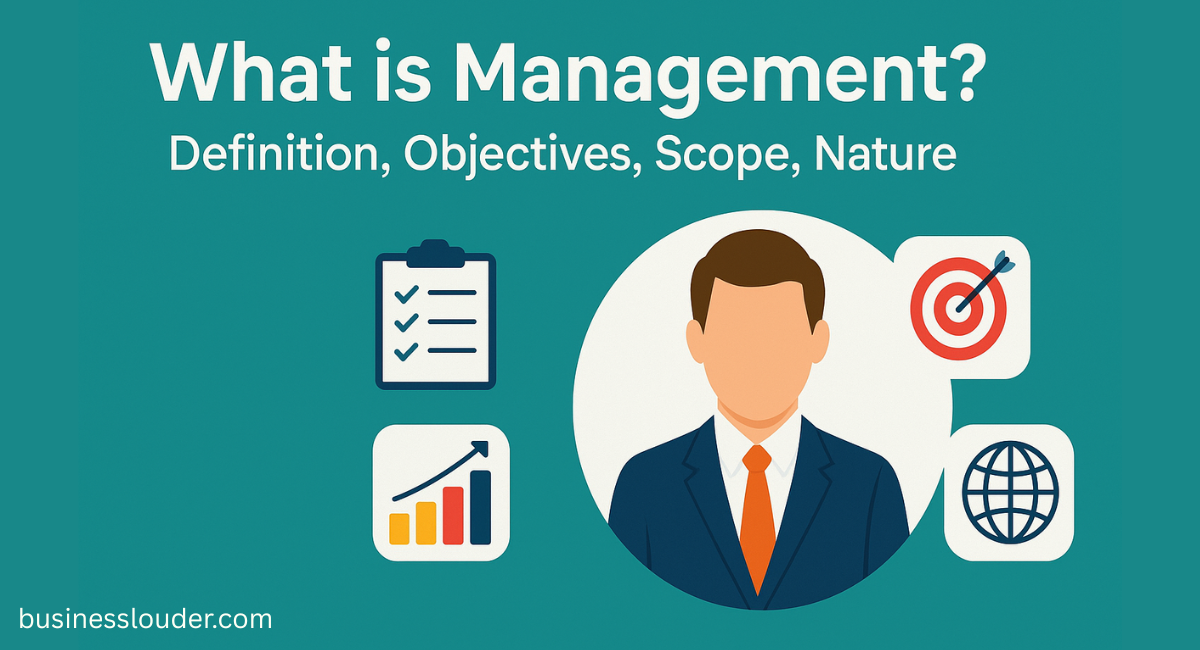
What is Management? Definition, Objectives, Scope, Nature

Last updated: 2025/11/12 at 2:22 PM
Uzair  - Marketing Specialist
Share
10 Min Read
What is Management
What is Management
SHARE

Management Meaning: Management refers to how businesses organize and direct their workflow, operations, and employees to meet company objectives.

Contents
What is Management in Business?Definition of ManagementObjectives of Management1. Optimize Resources2. Improvement of Efficiencies3. Maximizing Profits4. Promoting Personal Development5. Generating Business StrategiesNature of Management1. Goal Oriented2. Continuous Process3. Social Process4. Group Activity5. Distinct Process6. Both Science and ArtScope of ManagementFunctions of Management1. Planning2. Organizing3. Staffing4. Directing5. ControllingThe Final Word

The primary goal of every management is to create an environment that lets employees work productively and efficiently. A solid organizational management serves as a guide for its employees and establishes the tone and focus of their work.

Here in this blog post we have explain about what is management, objectives of management, scope of management, nature of management, and functions of management.

Let’s first understand meaning and definition of management.

What is Management in Business?

Management, in business, is the process of planning and organizing the resources and activities to achieve specific goals in the most efficient and effective manner possible.

Management helps in harmonizing the 5Ms, namely – men, money, materials, machines, and methods towards the achievement of business goals and objectives.

It is the basis for every business organization. An organization cannot run for a long time if all its devices are not suitably managed.

Definition of Management

Definition of Management: In the words of Robert L. Trewelly and M. Gene Newport, Management the process of planning, organizing, controlling, and actuating an organization’s operations,

to achieve coordination of the human and material resources that are essential in the effective and efficient attainment of objectives.

Objectives of Management

The significant objectives of management from the business point of view are as follows:

1. Optimize Resources

Management puts an effort in a business to make efficient use of available resources to generate the most feasible amount of output. This factor makes it possible to improve profits by lowering the resource expenses with respect to earnings in the business.

Management teams implement various logistic methods and procedures to detect and cut back on excessive and over-utilization of resources that result in wastage.

2. Improvement of Efficiencies

Boosting the effectiveness of production, operations, and services leads to increased output, revenue, and ultimately, profits. Management systems observe the activities, their length of time, and flow in the workplace to ascertain the procedures that result in productive outputs.

3. Maximizing Profits

Management teams aim to balance increasing revenues and creating a positive working environment for workers.

To ensure maximum profits, it is necessary to collaborate with various leaders and departments, such as accountants, executives, and supervisors, to identify areas that need adjustments and modifications.

Finding costs that are not needed and developing innovative procedures that make operations more effective are two of the important tasks for managers who want to accomplish their goals of maximum profit.

4. Promoting Personal Development

An efficient management team takes care of their employees’ personal development as well as professional advancement. Employees gain new skills and improve their careers when opportunities like seminars, training resources, mentoring programs, and internal promotions are available in the organization.

The growth and development of workers on a personal level will not only assist management in accomplishing numerous goals at once, but also contribute to the work’s expansion, improvement, and effectiveness.

5. Generating Business Strategies

Management teams frequently engage in higher-level critical thinking as well as abstract strategy when trying to enhance their operations and revenues. Together with CEOs, leaders, and other stakeholders, the team pitches, develops, and implements overarching company plans and frameworks.

Nature of Management

The nature of management from the business point of view are as follows:

1. Goal Oriented

Every firm has its own distinct objective. Management is that instrument or system which contributes to the efficient use of human and other resources to achieve such objectives. Every management’s main objective is to maximize productivity with optimum use of human effort.

2. Continuous Process

Management is a continuous process up to the very existence and functioning of the organization. Management is ongoing and never ends; it exists as long as the business organization exists. A manager has to manage every decision of the business effectively, in order to perform best in the present and future.

3. Social Process

Management is also a part of the social process. Management employs human resources for the achievement of the organization’s defined goals and objectives. It has to, therefore, consider not only the organizational but also social objectives. It needs to fulfill the necessities of its workers within the organizational supplies.

4. Group Activity

The concept of management is non-functionable when there is only one person or titleholder. Management signifies a team, class, or section of people involved with multiple managerial duties. It defines the responsibility, authority, and procedures to perform specific work.

5. Distinct Process

The management process involves various types of functions, and every function of management is connected with one another. Management does not consider the trial and error approach, it clearly defines the specific process of work that will help to achieve predetermined goals.

6. Both Science and Art

Management is both science and art. It is a ‘Science’ as it is based on basic principles of universal application. It is also ‘Art’ because skills and ability are required for performing managerial functions.

Scope of Management

In an organization, different managers are assigned for different tasks, according to their specialization, so that there is efficiency in the tasks. These specific tasks are termed as the scope of management.

These tasks are clubbed into Finance Managers, Marketing Managers, Production Managers, Human Resource Managers, Research & Development, Core Operations, etc.

  • Human Resource Management
  • Financial Management
  • Marketing Management
  • Production and Operation Management
  • Risk Management
  • Strategic Management
  • Cost & Accounting Management
  • Quality Management

Functions of Management

When managers of an organization have a solid grasp of the functions of management, they can direct their efforts in a better way toward the activities and produce great outcomes. The following are the core responsibilities of effective management.

1. Planning

The first important function of management is Planning. It helps in deciding what to do in the future to achieve the defined goals and objectives. Every manager’s task is to firstly make the most effective plan so that objectives can be achieved in the most cost-efficient and easiest way.

Planning should be carried out in a proper, systematic way to avoid wastage of resources and time. A detailed plan of action minimizes risk, confusion, wastage and uncertainty. The more effective the planning , the more fruitful will be its results in the future.

Also Read:

  • Types of Planning in Management
  • 15 Principles of Planning in Management (With Examples)

2. Organizing

Organizing is to nurture a relationship between the personnel, financial and physical resources of the company. Well-planned organizing provides the course of action that meets all the parameters for success. Organizing involves identification and classification of business activities, delegation and coordination.

3. Staffing

Staffing means giving a person a job that best compliments his/her skills, knowledge, experience, and competencies. It is placing the right person for the right job so that the person could bring the best possible results. This is an important function of management for the achievement of organizational goals.

4. Directing

Supervising, guiding, and motivating the staff is central to the functions of a manager. Directing involves taking the necessary steps to put the work in motion and maintain productivity so as to achieve company goals.

Directing is considered the course through which managers advise,  train, and monitor employees’ overall performance for reaching set goals and objectives.

Directing requires excellent leadership, interpersonal and business communication skills to drive the team towards completing organizational objectives.

5. Controlling

Controlling is conducting an assessment to determine the extent of success in attaining objectives, enhancing performance, and acting.

Businesses function on some pre-established standards of performance. It is the manager’s duty to ensure that the staff’s collective output meets quality and quantity benchmarks set by the company.

Control at each level prevents overall deviation from the prescribed quality specifications.

The Final Word

So these were some of the basic concepts regarding Management in Business. Companies and organizations surely need effective management to achieve their business goals. There are different levels of business management that aim to coordinate and organize the business functions of a company.

Share This Article
Facebook Twitter Copy Link
What do you think?
Sad0
Love0
Sleepy0
Angry0
Surprise0
By Uzair Marketing Specialist
Follow:
Uzair is an MBA graduate and Marketing Specialist with over 5 years of experience in business strategy, marketing, and organizational management. As a Senior Writer at Business Louder, he has written hundreds of in-depth guides and frameworks covering everything from competitive strategy and market positioning to leadership and business communication. His academic background combined with real-world marketing experience gives him a unique ability to break down complex business concepts into practical, actionable insights for entrepreneurs and professionals worldwide.
Previous Article important Steps in Decision Making Process Top 7 Important Steps in Decision Making Process
Next Article What is Communication Network What is Communication Network? Types, Importance
8 Comments
  • Pingback: Artificial Intelligence in Business Management - Business Louder
  • Pingback: Top 7 Contributing Disciplines to Organizational Behavior (OB) - Business Louder
  • Pingback: Top 5 Models of Organizational Behavior (OB) - Business Louder
  • Pingback: What is Human Geography? Definition, Scope, Nature - Business Louder
  • Pingback: What Is Human Resource Development? Definition, Role, Impact - Business Louder
  • Pingback: Workers Participation in Management - Business Louder
  • Pingback: Is Management an Art or Science? - Business Louder
  • Pingback: 7 Types of Organizational Structure Explained with Diagrams

Leave a Reply Cancel reply

Your email address will not be published. Required fields are marked *

Recent Posts

Bootstrapped Startup Financial Model image
How to Build a Financial Model for a Bootstrapped Startup (Step by Step)
Business
Comcast split image
Comcast Is Breaking Itself in Two. The Bundle Era Is Officially Over.
News
Claude Fable 5 Is Back image
Claude Fable 5 Is Back — Here’s What the Hype Skips
Ai & Tech
What Are Business Improvement Techniques image
What Are Business Improvement Techniques? 5 Proven Methods That Actually Work
Business
figure ai job applications 176k image
Figure AI Got 176K Job Applications and Hired 425 of Them — Here’s What That Says About AI Job Applications in 2026
News
5 Top Free Personal Finance Software to Unlock Your Financial Potential in 2026 image
5 Top Free Personal Finance Software to Unlock Your Financial Potential in 2026
Ai & Tech
Consumer Company Divests Business Unit
When a Consumer Company Divests a Business Unit, the Real Story Is Almost Never What It Seems
Business
Brand Name Normalization Rules image
Brand Name Normalization Rules: Why Your Data Is Quietly Sabotaging Your Business
Management Blog
Company Objectives or News of None image
Company Objectives or News of None: The Silent Strategy Killer Most Businesses Ignore
Blog Business
Business Vertical Classification Categories image
Business Vertical Classification Categories: The Complete Guide for 2026
Business Marketing

Categories

  • Ai & Tech2
  • Blog45
  • Business5
  • Communication7
  • Management21
  • Marketing8
  • News2

You Might Also Like

Brand Name Normalization Rules image
ManagementBlog

Brand Name Normalization Rules: Why Your Data Is Quietly Sabotaging Your Business

3 months ago
Company Objectives or News of None image
BlogBusiness

Company Objectives or News of None: The Silent Strategy Killer Most Businesses Ignore

3 months ago
Types of Organizational Structure
ManagementBlog

7 Types of Organizational Structure Explained (with Diagrams)

1 week ago
Artificial Intelligence in Business
BlogManagement

Artificial Intelligence in Business Management

5 days ago
© 2026 Business Louder All Rights Reserved
  • Home
  • Business Calculators Tool
  • About Us
  • Disclaimer
  • Privacy Policy
  • Add us on Google
  • Contact Us
Welcome Back!

Sign in to your account

Lost your password?