For most companies, the single biggest line on the budget isn’t rent, or software, or marketing. It’s people — what you pay them. And yet plenty of large organisations still manage that enormous number with a tangle of spreadsheets, gut feel, and crossed fingers.
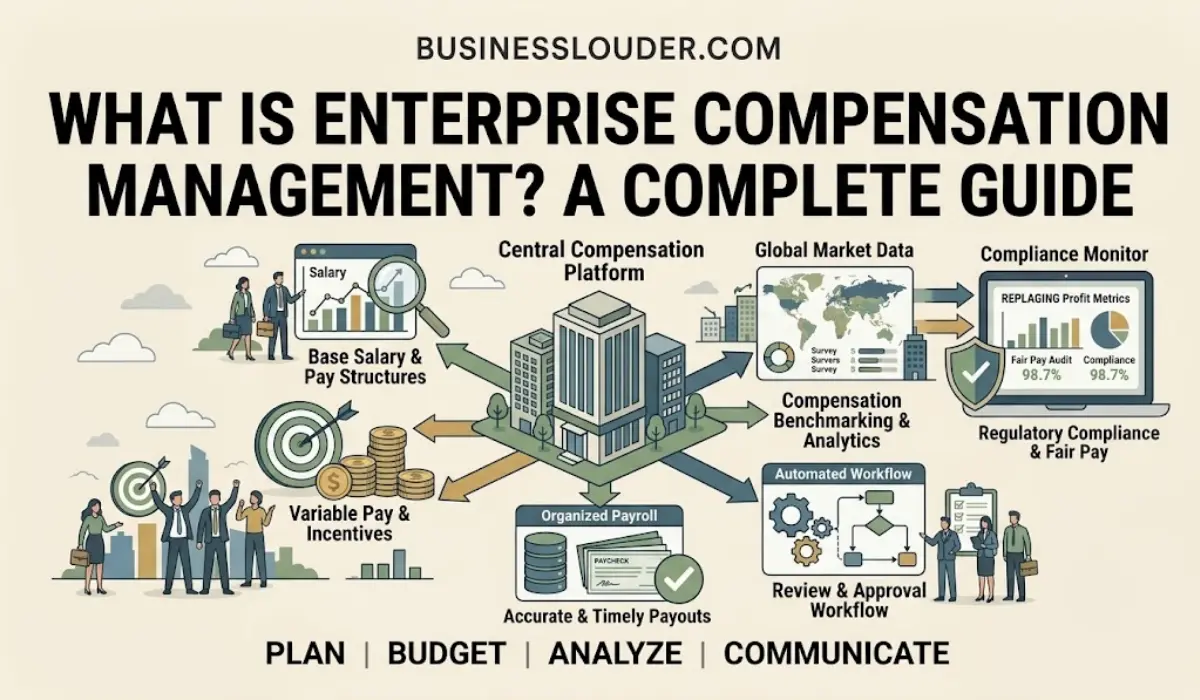
Enterprise compensation management (ECM) is the strategy, processes, and software large organisations use to plan, administer, and analyse all employee pay — base salary, bonuses, incentives, and equity — consistently, fairly, and in line with business goals. It turns paying people from guesswork into a disciplined, data-driven system.
And the pressure is on. With 2026 salary budgets projected to rise just 3.5% — flat versus 2025, according to Mercer — every dollar of pay has to work harder. When budgets are tight, spending them well is the whole game.
What Is Enterprise Compensation Management?
Enterprise compensation management is the coordinated way a large organisation designs and runs everything to do with employee pay. The word “enterprise” is the key: this is compensation at scale — thousands of employees, multiple roles, locations, and pay types, all needing to be handled consistently and fairly.
It pulls together the strategy (how you decide what to pay), the process (how you run pay reviews and approvals), and increasingly the software (the platform that automates it all). Done right, ECM makes sure two people doing the same job aren’t paid wildly differently for no reason, that raises reward the right things, and that the whole pay bill stays aligned with what the business is trying to achieve.
What Enterprise Compensation Management Covers
ECM is broader than just salaries. It spans the full range of how people get rewarded:
- Base pay and salary structures — the pay grades and ranges that define what each role should earn.
- Merit and annual increases — how the yearly raise budget gets divided fairly across the workforce based on performance.
- Bonuses and variable pay — short-term incentives, commissions, and performance bonuses tied to results.
- Long-term incentives and equity — stock options, RSUs, and other rewards that tie people to the company’s future.
- Pay equity — checking that pay is fair across gender, race, and other groups, and fixing gaps before they become a problem.
- Benchmarking — comparing your pay against market data so you stay competitive without overpaying.
- Compliance — keeping up with a growing wave of pay-transparency laws across US states and the EU.
Together, these make up what’s often called total rewards — the complete picture of what an employee gets in return for their work.
Why Compensation Management Matters
Get compensation right and it becomes one of your most powerful tools. Get it wrong and it quietly bleeds money and talent. Here’s what’s at stake:
- It’s your biggest cost. Payroll typically dwarfs every other expense, so even small improvements in how it’s managed move real money.
- It drives retention. People leave when they feel underpaid or treated unfairly. Smart, transparent pay keeps your best people from walking — and pay is one of the strongest levers on employee motivation.
- It protects fairness. A structured system catches pay gaps and bias that ad-hoc decisions create and hide.
- It keeps you legal. With pay-transparency and pay-equity laws spreading fast, sloppy compensation is now a genuine compliance risk.
- It aligns pay with strategy. Done well, ECM makes sure you’re rewarding the behaviours and results that actually move the business toward its objectives.
ECM Software vs. Spreadsheets
At a small company, you can run compensation in a spreadsheet. At enterprise scale, that breaks down fast — too many people, too many approvals, too much risk of error. That’s why “enterprise compensation management” often refers to dedicated software.
An ECM platform automates the annual pay-review cycle: it hands managers their budgets, enforces the rules, flags anything out of range, models the cost of different scenarios, routes approvals, and keeps a clean audit trail. It plugs into the wider HR and payroll systems so the numbers flow through without manual re-keying. In short, it does in hours what spreadsheets do in weeks — with far fewer mistakes.
Benefits of Enterprise Compensation Management
- Consistency — the same fair rules applied across the whole organisation, not manager by manager.
- Better decisions — real market data and modelling replace guesswork.
- Efficiency — automated cycles free HR from spreadsheet chaos and endless email approvals.
- Transparency and trust — clear, defensible pay decisions employees can actually believe in.
- Compliance — a documented, auditable process that stands up to new pay laws and scrutiny.
Ultimately, compensation is one of the clearest expressions of what a company values — and managing it well is a core job of good management.
Frequently Asked Questions
What is enterprise compensation management in simple terms?
It’s how a large organisation plans and manages all employee pay — salaries, bonuses, incentives, and equity — in one consistent, fair, data-driven system, usually with the help of dedicated software.
What does compensation management include?
Base pay and salary structures, merit and annual increases, bonuses and variable pay, long-term incentives and equity, pay-equity analysis, market benchmarking, and compliance with pay laws — together known as total rewards.
What is the difference between compensation management and payroll?
Compensation management is about deciding what people should be paid — the strategy, structures, and increases. Payroll is about executing those decisions — actually calculating and paying wages, taxes, and deductions. ECM plans it; payroll delivers it.
Why do companies use ECM software?
Because managing pay for thousands of employees in spreadsheets is slow, error-prone, and risky. ECM software automates pay cycles, enforces rules, models costs, routes approvals, and keeps everything auditable and compliant.
Pay Is Strategy
Compensation isn’t just a cost to be processed — it’s one of the loudest signals a company sends about what and who it values. Manage it carelessly and you get resentment, turnover, and legal exposure. Manage it well and you get a motivated, fairly paid workforce pulling in the same direction.
That’s the real point of enterprise compensation management: treating your biggest expense not as a spreadsheet to survive once a year, but as a strategy to get right. In a year of flat budgets, the companies that win won’t be the ones that spend the most on pay — they’ll be the ones that spend it the smartest.