
What is Motivation? Motivation is the key factor to achieve your goals or needs. So it is really important for all of us to understand about motivation. So here in this blog post we have explained in detail about what is motivation and its characteristics, processes and importance. Let’s first understand what is motivation?
What is Motivation?
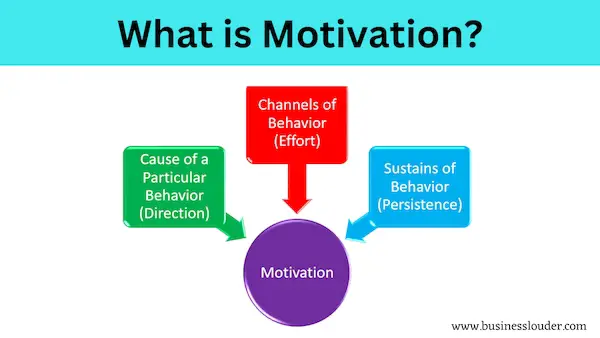
Motivation is that force which leads people to act in order to achieve their objectives. It is the inner psychological force that activates and compels an individual to behave in a particular manner. These individuals are willing to act because they are motivated toward their goals. The driver of their actions may be money, success, and position.
Definition of Motivation – According to Michael J. Jucius, Motivation is the act of stimulating oneself or someone to get a desired course of action, to push the right button to get the desired results.
What is Motivation in Management?
The act of stimulating, inspiring, and encouraging subordinates or employees at work to contribute to the best of their capability and work effectively for the achievement of organizational objectives and individual objectives is known as ‘Motivation’.
Employees get motivated when their expectations are fulfilled by the management – such as increased salary, incentives, bonuses, and other similar benefits. Both financial and non-financial incentives motivate employees in the organization.
Motivation is an essential factor for both individuals and the organization; an individual is motivated for his/her success, while an organization motivates its workers for organizational success.
Characteristics of Motivation
Motivation has the following special characteristics:
1. Continuous Process
Human needs, wants, desires, or wishes are endless.These can never be satisfied simultaneously. Satisfaction of one need gives rise to another, and managers need to continuously perform the function of motivation. Thus, motivation is a continuous and never ending process, it goes on forever.
2. Goal Directed Behavior
Motivation induces employees to behave in a particular manner, so that they can achieve their goals. Motivation helps achieve both organizational and individual goals.
For example – if a worker wants to get a promotion, he/she will work harder to achieve the goals effectively and efficiently.
3. Positive and Negative
Motivation can be either positive or negative. Motivation in the positive form can be rewards, like additional pay, promotion, incentives, recognition, etc., or negative forms of force, such as punishment, threat of demotion, etc.
Positive motivation serves as incentives to an individual to achieve the goal, whereas motivation in the negative form creates fear in the mind of individuals to influence their behavior to act in a desired manner.
4. Internal Feeling
Motivation is a psychological concept and an internal feeling that cannot be forced on employees. The feelings of need, desire, aspirations, etc., influence employees to behave in a particular manner. For instance – the desire to have a new house, respect and recognition.
5. Complex Process
Motivation is a complex and difficult process. In order to motivate workers in an organization, a manager must understand different types of human need. Human needs are mental feelings which are difficult to measure accurately.
Even if the manager measures them accurately, every worker uses different approaches to satisfy his/her needs. Some get satisfied with monetary incentives, while some with non-monetary. Some get motivated with positive, and some with negative motivators. So, it is quite impossible to make generalizations in motivation.
Process of Motivation
The process of motivation starts with needs and ends with the achievement of incentives that fulfill those particular needs. Thus, the process of motivation is based on human needs.
The steps in the process of motivation are as follows:
1. Unsatisfied Needs
Need is always the starting point of motivation. Motivation process begins when there is an unsatisfied need in an individual.
2. Tension
When an unsatisfied need is recognised, presence of that unsatisfied need gives him/her tension.
3. Drive
This tension stimulates drive in the human being and compels him/her to start looking for various alternatives and take action to satisfy the urge of drive.
4. Search Behavior
After searching for alternatives the individual starts behaving according to the chosen option to satisfy his/her need.
5. Satisfied Need
After behaving in a particular manner accordingly, for a long time then he/she evaluates whether the need is satisfied or not.
6. Reduction of Tension
After fulfilling the need the individual is satisfied and his/her tension gets reduced and the person feels motivated.
Importance of Motivation
The significant features of motivation are as follows:
1. Improves Performance Level
Motivation helps in satisfying the needs of employees. Performance of employees is improved with motivation as it bridges the gap between the employees’ capacity to work and willingness to work. A highly motivated employee puts extra effort into work and has a sense of belonging for the organization.
Thus, efficiency of work will be improved, wastage will be minimum, which will result in increased productivity, and high performance level.
2. Reduces Absenteeism and Employee Turnover
When employees are motivated, they are much satisfied with the organization. They develop a sense of belonging towards the business organization and thus improve their overall performance. This results in low absenteeism and employee turnover.
Some of the reasons behind absenteeism and employee turnover are improper work environment, lack of recognition, inadequate rewards, etc. These can be overcome or reduced if the employees are motivated properly.
3. Acceptance of Change
Any business organization can survive and grow only when it adapts itself to the dynamic environment. Any kind of changes are usually resisted by the employees because of fear of adverse effects on their employment. This resistivity to change can be overcome by proper motivation.
Motivation helps employees to accept the organizational change and convinces them that the proposed changes will bring additional rewards to them. Therefore, motivation is important to readily accept organizational changes.
4. Better Employee Relation
A good and proper motivation system creates a congenial work environment and job satisfaction. When employees are motivated, they tend to work with cooperative spirit and in a disciplined manner.
In this way, management offers them better wages and incentives. Chances of conflict and dissatisfaction are greatly reduced. All these lead to better employee relations.
5. Boosts Morale
Sometimes employees develop a negative attitude towards the organization or work. Motivation helps to boost the employees’ morale and change this negative attitude to a positive attitude. This can be done by suitable rewards, praise for good work, and positive encouragement. When the morale of the workers are boosted, they work positively towards the organizational goals.
The Closing Lines
Motivation is essential for every organization to ensure that goals and objectives are achieved. That being said, it is the role of every manager to ensure that his/her subordinates stay motivated and also satisfied with, not only their work but also the workplace, to ensure an efficient attainment of these objectives.
We hope you have understood what is motivation in management and the definition of motivation, characteristics of motivation and process of motivation and importance of motivation. If you still have any queries related to this guide please let us know in the comment section below. We will definitely help you.


2 Comments on “What is Motivation? Characteristics, Processes & Importance”