
Conflict gets a bad reputation. But it isn’t the villain you think it is — and it’s everywhere. In fact, 44% of British workers said they’d hit conflict at work in the last year, the highest level ever recorded, according to a 2025 Acas report. So if you’re dealing with it, you’re in very normal company.
Conflict is the process that starts when one person or group believes another has blocked, or is about to block, something they care about — their goals, values, or interests. It shows up inside your own head, between two people, between teams, and between whole organizations.
What Is Conflict?
Conflict is any disagreement or clash that happens when two or more people have incompatible interests, values, or goals. One side feels the other is standing in the way of something they want — and friction follows.
Notice the key word: perceived. Conflict doesn’t need the other person to actually be against you. It only needs you to believe they are. That’s why so much of it traces back to how we read situations — the same factors that shape perception quietly fuel most conflicts.
Characteristics of Conflict
Strip conflict down and a few core traits show up every time:
- It’s a process, not a moment. It builds in layers — usually starting with a simple misunderstanding, then hardening into clashes of values and interests.
- It’s inevitable. No two people are identical, so differences — and the friction they cause — are unavoidable.
- It’s normal. Unlimited wants, limited resources. Conflict is just what happens when those two collide. It’s only a problem when it’s handled badly.
- It’s about perception. If no one perceives a clash, there’s no conflict — even if the interests genuinely differ.
- It needs opposition. One side has to be doing or wanting something the other doesn’t like.
- It needs interdependence. People who don’t rely on or interact with each other don’t clash. No overlap, no conflict.
- It’s not always bad. Handled well, conflict can surface better ideas and sharper decisions.
Good Conflict vs. Bad Conflict
Not all conflict is created equal. Organizational behavior splits it into two kinds, and the difference decides everything:
- Functional (constructive) conflict — the healthy kind. It challenges lazy thinking, surfaces problems early, and pushes a team toward better decisions. A sharp debate over strategy is functional conflict.
- Dysfunctional (destructive) conflict — the toxic kind. It gets personal, drains energy, and breaks trust. A shouting match that leaves everyone bitter is dysfunctional.
Here’s the kicker: the same disagreement can go either way. What tips it isn’t the conflict — it’s how people handle it. Keep it about the issue, and it stays useful. Let it get personal, and it turns destructive fast.
Types of Conflict
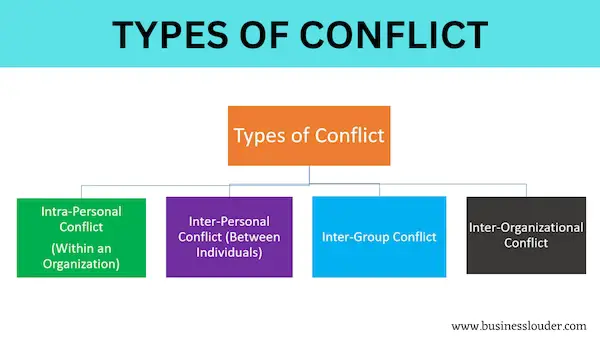
Conflict comes in four main types, scaling up from inside one person to between whole organizations:
1. Intrapersonal Conflict (inside one person)
This is the battle inside your own head — torn between competing goals, or stuck between roles you can’t fully satisfy at once. Think of a manager who has to choose between hitting a deadline and giving their team a fair workload. It also flares up when your role is unclear and you don’t know what’s actually expected of you.
2. Interpersonal Conflict (between individuals)
The most common kind — friction between two people, whether peers or a boss and a report. It usually comes from clashing personalities, different values, competition for resources, or a gap in power and status.
3. Intergroup Conflict (between teams)
This one is between groups, not people — think sales versus production, or management versus a union. It’s driven by things like competing for the same budget, depending on each other’s work, and pulling toward incompatible goals.
4. Inter-organizational Conflict (between organizations)
The biggest scale — clashes between two organizations, usually rivals competing for the same customers. Each becomes a barrier to the other’s success.
Common Causes of Conflict
Most conflict traces back to a handful of usual suspects:
- Scarce resources — not enough budget, time, or people to go around.
- Clashing goals — two people or teams pulling in different directions.
- Poor communication — the quiet cause behind a huge share of conflict. A clear message would’ve prevented the whole thing.
- Personality and value differences — people who simply see the world differently.
- Unclear roles — when nobody’s sure who owns what, toes get stepped on.
Want to go deeper on this? We break it all down in our guide to the causes of conflict in an organisation.
How to Manage Conflict
Here’s the shift most people miss: the goal isn’t to eliminate conflict. It’s to handle it well. Managers have three moves — sometimes you even want to stir up healthy conflict to break groupthink, but usually you’re preventing or resolving it.
When it’s time to resolve, there are five classic styles — and the trick is matching the style to the situation:
- Problem-solving (collaborating) — dig for the real issue and find a fix that works for everyone. The best long-term option, but it takes time and trust.
- Compromising — everyone gives up a little to meet in the middle. Fast and fair, but nobody gets everything.
- Accommodating — one side yields to keep the peace. Useful when the relationship matters more than the issue.
- Avoiding — stepping back when emotions are too hot or the issue is too small. A cooling-off period, not a real fix.
- Competing — standing firm and pushing for your position. Right when a fast, tough call is needed, wrong as a default.
And prevention beats all of them. Shared goals, clear roles, and open channels stop most conflicts before they start — which is exactly why strong communication is the single best conflict tool you have.
Frequently Asked Questions
What is conflict in simple words?
Conflict is a clash that happens when two or more people (or groups) have goals, values, or interests that don’t fit together, and one side feels the other is getting in the way.
What are the four types of conflict?
Intrapersonal (inside one person), interpersonal (between individuals), intergroup (between teams), and inter-organizational (between organizations).
Is conflict always bad?
No. Handled badly, it damages relationships and wrecks productivity. Handled well, it surfaces better ideas, exposes problems early, and can lead to stronger decisions. The outcome depends on how it’s managed, not on the conflict itself.
What are the main causes of conflict?
The usual causes are scarce resources, clashing goals, poor communication, personality and value differences, and unclear roles.
Conflict Isn’t the Enemy
Here’s the reframe worth keeping: conflict is a natural part of every team and every organization. You can’t design it away, because it’s the price of putting different people, with different goals, in the same room.
The teams that struggle aren’t the ones with conflict. Every team has that. The ones that struggle are the ones who handle it badly — who let it fester, or crush it before it can say anything useful. So the real question isn’t how to avoid conflict. It’s this: when it shows up next, will you manage it, or will it manage you?


2 Comments on “What is Conflict? Definition, Characteristics, Types”