
Here’s a rule that surprises people: in Kenya, a county government can’t legally spend a single shilling on development without one document sitting behind it. No plan, no money. That document is the County Integrated Development Plan.
A County Integrated Development Plan (CIDP) is the five-year development blueprint that every one of Kenya’s 47 counties is required by law to prepare — the master framework that guides all county planning, budgeting, and spending. It sets out what a county wants to achieve over five years, and exactly how it plans to get there.
Right now, counties are working through their third-generation CIDPs, covering 2023 to 2027, prepared under guidelines from Kenya’s National Treasury and Planning.
What Is a County Integrated Development Plan?
A CIDP is a five-year strategic plan that every county government in Kenya must produce to guide its development. It pulls together, in one place, the county’s vision, its priorities, and the specific programmes and projects it will fund over the plan period.
The word that matters is integrated. A CIDP is meant to bring economic, social, physical, environmental, and spatial planning under a single roof — so a county isn’t building roads, clinics, and markets in isolation, but as one coordinated push. It’s the county-level answer to a simple question: over the next five years, what are we actually going to do, and how will we pay for it? In practice, it’s the biggest planning exercise a county undertakes.
The Legal Basis: Why It’s Mandatory
The CIDP isn’t optional or a nice-to-have. It’s written into Kenyan law at three levels:
- The Constitution of Kenya, 2010 — Article 220(2) provides for county development plans as the basis for county budgets.
- The County Governments Act, 2012 — this is the big one. Section 104 states that no public funds may be appropriated without a planning framework approved by the county assembly. Section 107 makes county plans the basis for all planning and budgeting, and Section 108 requires the five-year CIDP itself.
- The Public Finance Management Act, 2012 — Section 126 requires each county to prepare a development plan, tying the money directly to the plan.
Read those together and the logic is airtight: the budget must follow the plan, and there is no legal way to spend development money outside it. That’s what makes the CIDP so powerful — it’s not just a wish list, it’s the gatekeeper for every development shilling.
What a CIDP Contains
A CIDP is a substantial document, but its core building blocks are consistent across counties:
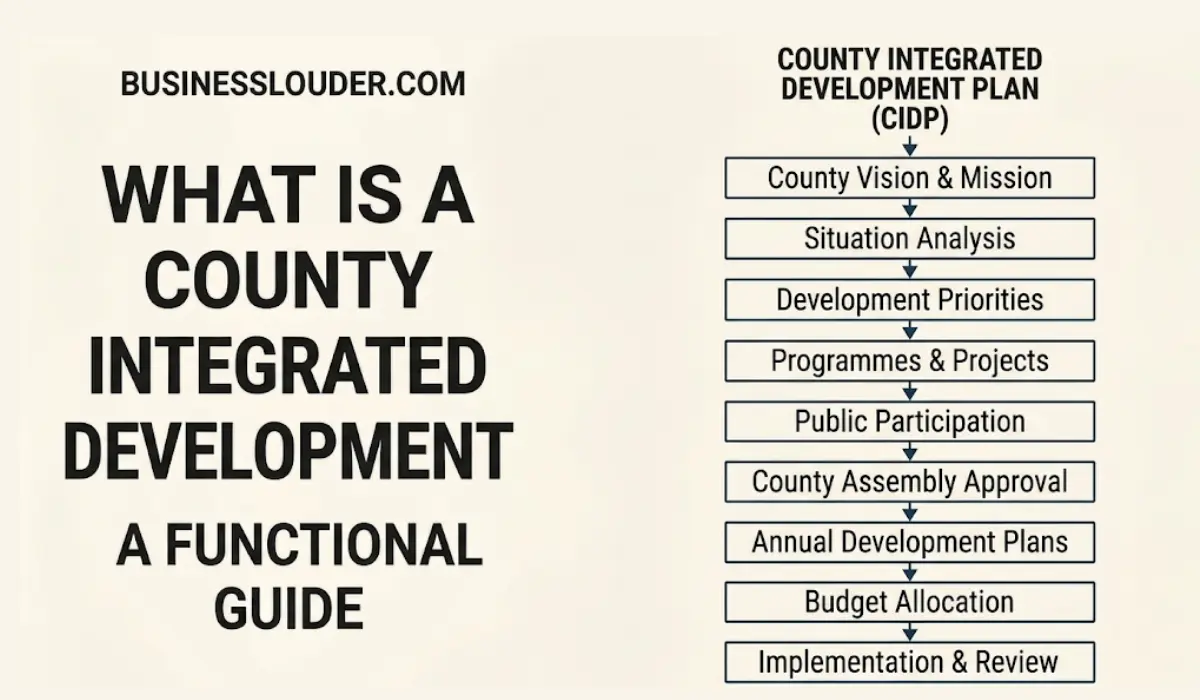
- County vision and mission — where the county wants to be by the end of the five years.
- Situation analysis — an honest picture of the county today: its people, economy, resources, and challenges.
- Development priorities and programmes — the specific goals, sectors, and projects the county will pursue, from health and water to roads and agriculture.
- Resource requirements and financing — what it will cost, and where the money will come from.
- Monitoring and evaluation framework — how progress will be tracked and measured, so plans don’t just sit on a shelf.
- Linkages — how the county’s plans connect to Kenya Vision 2030, the Sustainable Development Goals, and national flagship projects.
In short, it moves from big-picture objectives all the way down to costed, measurable projects.
How a CIDP Is Made
A CIDP isn’t drafted behind closed doors — the law requires the public to be part of it. The process runs roughly like this:
- The county executive prepares it. The county’s department of planning leads the drafting, pulling together data and priorities across every sector.
- The public has its say. Public participation is mandatory. Counties hold forums so residents and stakeholders can shape the priorities — a people-centred approach baked into the law.
- The County Assembly approves it. The draft goes to the county assembly, which must adopt it before it takes effect. No approval, no plan.
- It guides the annual budgets. Once adopted, the CIDP drives each year’s Annual Development Plan and budget for the full five years.
Why the CIDP Matters
The CIDP is the backbone of devolution actually working — disciplined management applied to a whole county. It forces counties to plan before they spend, which is the whole point — money follows a strategy instead of political whim. It makes development transparent and trackable, because the priorities are written down and measurable. And it gives citizens a real say in how their county grows.
When it works, a CIDP turns a five-year term into coordinated progress. When it’s ignored or done badly, you get scattered projects, wasted funds, and stalled development. That’s why understanding it matters — not just for county officials, but for every resident, supplier, and business operating in a county.
Frequently Asked Questions
What is a County Integrated Development Plan in simple terms?
It’s a five-year plan that every Kenyan county must prepare, setting out its development priorities, projects, and budgets. By law, no county development funds can be spent outside this plan.
What is the legal basis of the CIDP?
It’s mandated by the Constitution of Kenya 2010 (Article 220), the County Governments Act 2012 (Sections 104, 107, and 108), and the Public Finance Management Act 2012 (Section 126). Together they require a five-year plan and forbid spending without one.
Who prepares and approves the CIDP?
The county executive (through its planning department) prepares it, with mandatory public participation. The County Assembly must then approve it before it can be implemented.
What’s the difference between a CIDP and an ADP?
The CIDP is the five-year master plan. The Annual Development Plan (ADP) is a yearly plan drawn from it — it breaks the CIDP’s priorities into what the county will actually do and fund in a single financial year.
The Blueprint Behind Every County
Strip away the jargon and the CIDP is simply this: a county’s five-year promise, written down, costed, and made legally binding on the budget. It’s what stops development from being random, and turns “we should build more clinics” into a funded, tracked, accountable plan.
So whether you’re a county official, a contractor bidding for work, or a resident wondering where your taxes go, the CIDP is the document to read. It’s the clearest window there is into where a county is headed over the next five years — and how it intends to get there.