Most businesses obsess over winning new clients. Almost none put a single name against keeping the ones they already have. That gap has a cost — and it shows up as clients who quietly stop calling.
Here’s the fix nobody talks about: a client relationship partner. One senior person made responsible for the whole long-term relationship with a key client — not the project, not the invoice, the relationship. And if you don’t have that person, you’re leaking revenue you already earned.
Let’s get into what the role really is, why it quietly decides whether your best clients stay, and how to build it into your business today — even if the “one person” is you.
What a client relationship partner actually is
Forget the fancy title for a second. The job is simple to say and hard to do: own the relationship, not just the work.
The clearest definition comes from the professional-services world, where the role is most mature. As Edge International describes the Client Relationship Partner role, this person is “responsible for the overall success of the firm’s long-term relationship with each key client.” Not the deliverable. The whole relationship.
That distinction is everything. Your team can nail every deadline and still lose the client — because being good at the work and being good at the relationship are two different jobs. The client relationship partner does the second one on purpose.
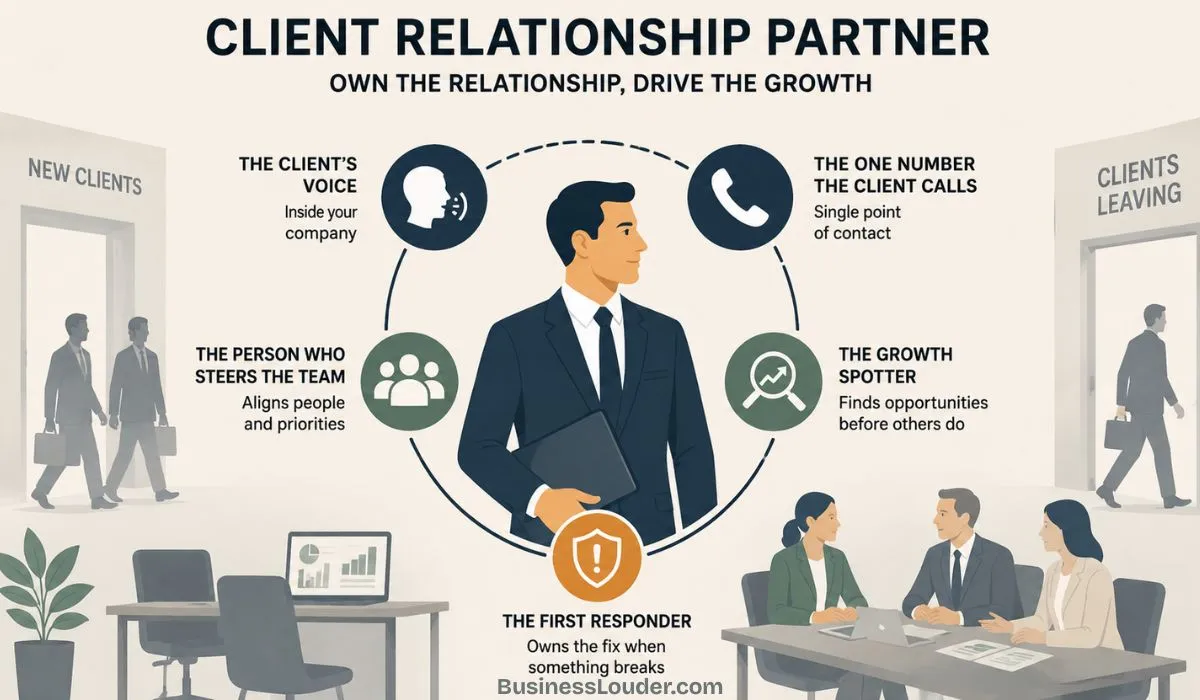
In plain terms, they’re five things at once: the client’s voice inside your company, the one number the client actually calls, the person who steers the internal team, the one who spots where you could do more, and the first responder when something breaks. Edge International’s best framing is “relationship choreographer” — the person orchestrating value between you and the client so a transaction turns into a partnership.
Why this role quietly runs your revenue
Because keeping a client is far cheaper than winning one — and the numbers aren’t close.
According to Harvard Business Review, citing Frederick Reichheld of Bain & Company, increasing customer retention by just 5% increases profits by 25% to 95%. That same HBR piece notes acquiring a new customer costs five to 25 times more than keeping one you already have. It’s a long-standing finding — and it still holds because human relationships haven’t changed.
So think about where your energy goes. Most companies pour it into the front door — ads, pitches, new logos — while the back door swings open and clients wander out. A client relationship partner is the person whose entire job is to guard the back door.
And here’s the honest part: clients rarely leave over one bad deliverable. They leave from neglect. They drift when the only time they hear from you is a bill or a renewal reminder. Nobody was watching the relationship, so nobody caught the drift until it was a cancellation email.
Client relationship partner vs. account manager — not the same job
This is where people get tangled, so let’s be blunt.
An account manager runs the work — timelines, tasks, day-to-day requests. A client relationship partner is more senior and owns the outcome — trust, growth, retention, whether the client is still around in three years spending more. The account manager makes sure it ships Friday. The client relationship partner makes sure the client is still here, and happier, next year.
You often want both. But if you only have the task-runner, you’re managing to-do lists and hoping the relationship takes care of itself. It won’t. Relationships are built by someone who reads people and defuses tension before it explodes — the same muscle behind the 7Cs of clear communication. A client relationship partner who can’t communicate under pressure is just a business card.
Does a small business really need one?
Yes. But not as a hire — as a job that exists.
If you run a small team, you can’t afford a dedicated client relationship partner, and you don’t need one. You need the role to exist, even if you’re wearing the hat. That means one person consciously owning each key client, thinking past the current project, and reaching out when there’s nothing to sell.
Imagine a small design agency with eight retainer clients. The work is sharp, deadlines are hit — but the founder only ever talks to clients about live projects. Then two of them quietly don’t renew. Nobody saw it coming, because nobody was watching the relationship, only the tasks. That’s the whole problem in one story. The fix isn’t a bigger team. It’s one person deciding the relationship is their job — and in a small company, that’s usually the founder, and that’s fine. What’s not fine is assuming it’ll happen on its own.
What separates a great one from a title
The best client relationship partners share a few traits — and almost none of them are about being the smartest person in the room.
- They listen more than they pitch. They know the client’s business and pressures, sometimes better than the client expects.
- They’re trusted on both sides. The client believes them, and so does the delivery team. Lose either, and the role collapses.
- They run toward problems. When something breaks, they call first. They don’t wait to get caught.
- They think in years, not invoices. They’ll protect the relationship even when it costs a little today.
- They handle conflict without flinching. Every real relationship hits friction; managing it well means understanding the actual causes of conflict and defusing them early.
Notice what’s not on the list: being your best practitioner. In fact, your most technically brilliant person is often the wrong pick, because the skills don’t overlap. Doing the work and owning the relationship are separate crafts.
How to build the role in — three moves
You don’t need a reorg. You need three decisions.
Name it. For each key client, pick one person who owns the relationship and write their name next to that client. “The team handles it” means nobody does. Ambiguity is how clients slip away.
Fund it. Owning a relationship is real work, not something squeezed between deliverables. Give the person actual time and a mandate. Hand someone the responsibility with zero hours to do it and you’ve created a title, not a role.
Measure the right thing. Don’t grade a client relationship partner on this quarter’s revenue alone. Grade them on retention, relationship health, and growth over time — because what you measure is what they’ll protect. This ties straight into how you set incentives across the team, which is worth reading next to the basics of sales management.
One honest caveat: this works best for businesses built on high-value, repeat clients — agencies, firms, B2B services, software. If you sell one-off, low-touch products to thousands of anonymous buyers, the formal role matters less and good systems matter more. Match the tool to your business.
The one question worth answering today
Every company celebrates the new logo on the wall. Far fewer protect the clients already paying the bills — and that’s exactly where good businesses bleed money without noticing.
A client relationship partner stops the bleed. It’s not a corporate luxury; it’s a decision about who owns the relationships that keep your lights on. So here’s the question: for each of your most important clients, can you name the one person responsible for keeping them?
If you can’t answer that in five seconds, you just found the most important role in your business. And right now, it’s empty.