
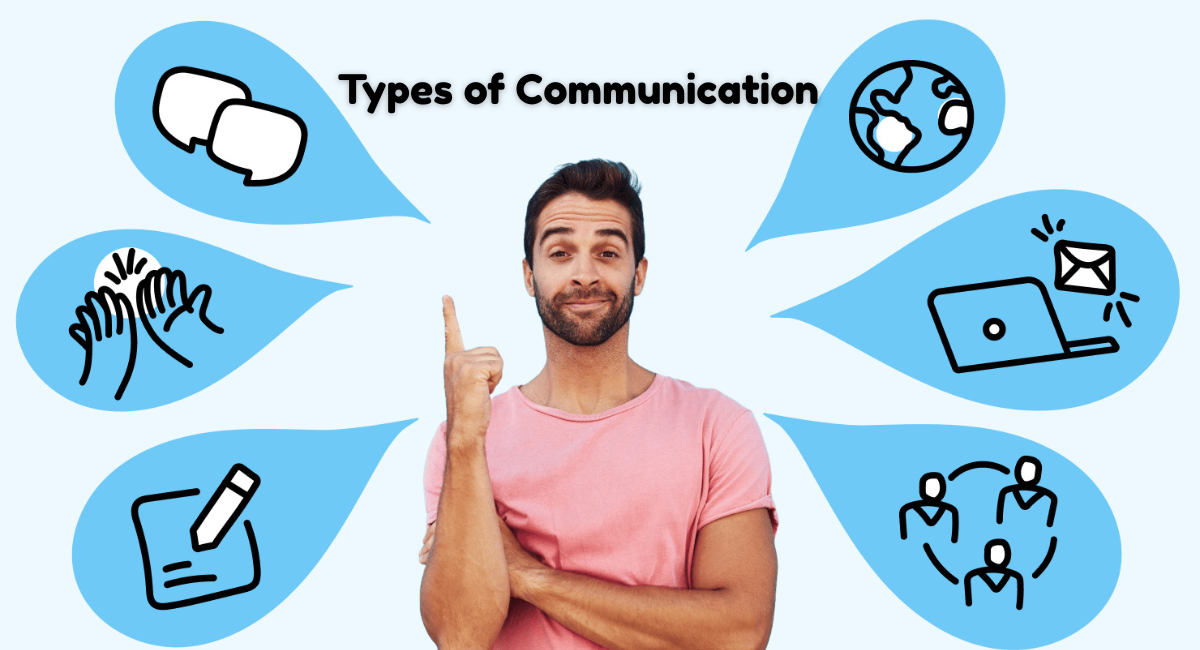
You’re using more than one type of communication right this second. You’re reading words — that’s written. But if we were face to face, my tone and hands would be doing half the talking.
The four main types of communication are verbal, non-verbal, written, and visual. Most real messages mix a few of them at once. And knowing which type to reach for — and when — is one of the most useful skills you’ll ever build, at work and everywhere else.
What Are the Different Types of Communication?
At the simplest level, communication splits into four main types based on how the message travels. As the HR reference Personio lays them out:
- Verbal — spoken words.
- Non-verbal — body language, tone, expressions.
- Written — the written word.
- Visual — images, charts, design.
Let’s take them one at a time — what each is, examples, and when it wins.
1. Verbal Communication
Verbal is talking — using spoken words to share information, ideas, and feelings. It’s the type you use most, and it runs on more than words: tone, pace, and pitch all carry meaning.
Examples: conversations, calls, meetings, presentations, interviews, video calls.
Its superpower is speed. You get instant feedback and can clear up confusion on the spot. But spoken words vanish the second they’re said — no record — which is exactly why the trade-offs matter, as we cover in the advantages and disadvantages of oral communication.
2. Non-Verbal Communication
Non-verbal is everything you “say” without words — body language, facial expressions, gestures, eye contact, posture, even how close you stand. It’s running constantly, whether you mean it to or not.
Examples: a nod, crossed arms, a warm smile, a firm handshake, a flat tone that kills an “I’m fine.”
Here’s the kicker: when your words and your body language disagree, people believe the body. Say something confident while staring at the floor, and you’ll read as unsure. And these cues shift across cultures, so what’s polite in one country is rude in another — worth remembering on any global team.
3. Written Communication
Written communication uses the written word — and it’s the backbone of professional life, because it leaves a record people can come back to.
Examples: emails, reports, memos, texts, proposals, contracts, chat messages.
Its strength is precision — you can draft, edit, and polish before you hit send. Its weakness is the flip side of non-verbal: with no tone or face attached, written messages are easy to misread. That’s how a rushed email starts a fight a two-minute call would have avoided.
4. Visual Communication
Visual communication gets the message across with images and design instead of words alone. It’s powerful because your brain reads a picture far faster than a paragraph.
Examples: charts, graphs, infographics, slide decks, maps, diagrams, photos, even emojis.
Visuals win when you need to simplify data or make something stick. One clean chart can land a point three paragraphs would blur. It rarely works alone, though — it backs up your words. That’s why the best presentations use all three: you talk, they read, and a visual ties it together.
Want to see all four working together? Picture a manager announcing a big change to the team. She says it in a meeting (verbal), keeps her tone calm and open (non-verbal), shows a slide with the new plan (visual), then sends a follow-up email with the details (written). Same message, four types, each doing the job it’s best at. That’s what strong communication actually looks like — not one channel, but the right mix.
Other Ways Communication Is Grouped
Those four cover the channel. But you’ll also hear communication split other ways, depending on the setting and the audience:
- Formal vs. informal — a company announcement goes through official channels; a chat by the coffee machine doesn’t. Both count.
- Interpersonal — one-to-one, between two people.
- Group — inside a team: meetings, discussions, working toward a shared call.
- Mass — reaching a huge audience at once through TV, radio, or social media. We break this down in our guide to mass communication.
- Listening — the one everyone forgets. A message only truly happens when someone actually receives it, which makes listening half of every exchange.
Inside a company, these flows get structured into communication networks — the patterns that decide who talks to whom.
How to Pick the Right One
Knowing the types is half the skill. The other half is choosing well:
- Need speed and back-and-forth? Go verbal — call or chat.
- Need a record, or the details matter? Go written.
- Explaining data or something complex? Add visual.
- Sensitive or emotional? Go face-to-face, so non-verbal cues can carry what words can’t.
The rule: match the channel to the message, not to your habit. Most workplace mix-ups come from someone firing off an email that should’ve been a conversation — or calling a meeting that should’ve been a memo. Whichever type you pick, the 7 Cs of communication keep it clear.
One quick gut-check before you hit send: if the message is complicated, could be misread, or carries emotion, don’t default to text. Those are exactly the moments a voice or a face prevents a mess. Save writing for when clarity and a record matter more than tone.
Frequently Asked Questions
What are the 4 main types of communication?
Verbal (spoken words), non-verbal (body language and tone), written (the written word), and visual (images and design). Most real messages combine two or more at once.
Which type of communication is the most important?
There’s no single winner — it depends on the moment. But non-verbal is often the most powerful, because when words and body language clash, people trust the body language.
What’s the difference between verbal and non-verbal communication?
Verbal uses spoken words. Non-verbal delivers meaning without words — body language, expressions, gestures, tone. They almost always work together.
Why does understanding types of communication matter?
Because picking the right type for each message prevents misunderstandings, saves time, and builds better relationships. Use the wrong one — like a text for a hard conversation — and you invite trouble.
The One Thing to Remember
Verbal, non-verbal, written, visual — these are the tools you use to connect with people every day. Each has a job it does best. And the strongest communicators aren’t the ones who’ve mastered a single type. They’re the ones who know which type the moment calls for.
So next time a message really matters, stop for one second before you send. Is this a call, an email, a chart, or a conversation? Get that one choice right, and you’ve won half the battle between being heard and being misunderstood.


3 Comments on “What Are The Different Types of Communication?”