There’s a headline that shows up in business news and gets read in two completely different ways depending on who’s sitting with it.
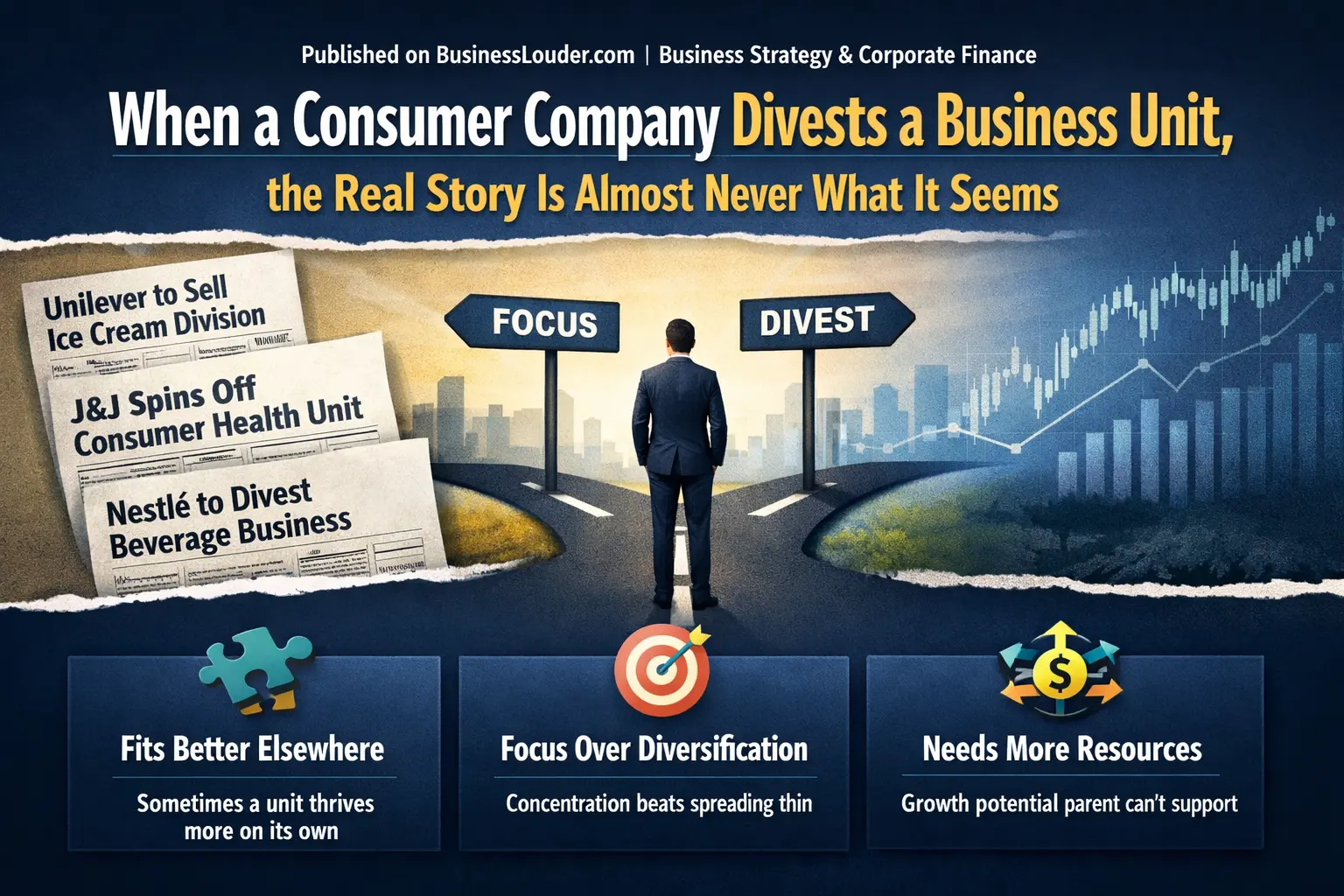
“Unilever to divest its ice cream business.” “Johnson & Johnson separates consumer health into standalone company.” “Nestlé spins off water and premium beverages division.”
To a casual reader, it sounds like retreat. To a strategist, it’s the opposite — a company surgically removing a perfectly good limb because that limb would grow faster attached to a different body.
Understanding why a consumer company divests a business unit is one of the most underrated business education opportunities available right now. Not because you’ll be executing a billion-dollar spin-off anytime soon. But because the logic behind these moves maps directly onto decisions every founder and business owner faces: when to double down, when to let go, and what “focus” actually costs when you don’t have it.
The Strategic Logic Most Coverage Misses
The financial press tends to frame divestitures as reactive. Stock underperforms. Activist investor arrives with demands. Management reshuffles — and a business unit ends up on the market. That narrative is satisfying. It’s also incomplete.
The more interesting question is what happens before the announcement. In the best cases, the decision to divest wasn’t forced at all. It was deliberate.
Unilever and Nestlé — Europe’s two largest consumer goods companies — have each announced plans to separate their lowest-margin businesses. Unilever is divesting its ice cream business, citing fundamental operational differences from its core brands. Nestlé is transitioning its waters and premium beverages segment into a global standalone company. These aren’t distressed companies offloading liabilities. They’re market leaders making a calculated bet: a focused portfolio will outperform a sprawling one.
The underlying logic is straightforward. When a business unit operates inside a larger company, it competes internally for resources, leadership attention, and strategic priority. It attends the same meetings. Reports to the same executives. And if its operational rhythms, growth profile, or market dynamics differ significantly from the parent’s core, it will almost always be disadvantaged — not because anyone is neglecting it, but because the system simply isn’t built for it.
Reckitt Benckiser announced plans to divest a 70% stake in its essential home business, aiming to refocus on its core portfolio of high-growth, high-margin brands. That’s the honest translation: the essential home business wasn’t broken. It just wasn’t their business anymore — or at least not the business they wanted to be.
The Three Real Reasons a Consumer Company Divests a Business Unit
Strip away the press releases, and the decision almost always comes down to one of three things.
1. The Unit Fits Better Somewhere Else
This is the cleanest reason — and the one that gets the least coverage.
Sometimes a business unit has genuinely strong fundamentals. Solid revenue. Loyal customers. Capable team. But the parent company is the wrong home for it. In 2015, eBay spun off PayPal into a separate publicly traded company, with both sides believing it would allow sharper focus on their respective core businesses and unlock shareholder value trapped inside the conglomerate structure.
Post-separation, PayPal has at times carried a higher market capitalisation than eBay itself.
That deserves a moment. The spun-off business became worth more than the company it came from. That’s not a failure story. That’s what happens when you recognise that value and organisational fit are two entirely different things.
2. Focus Is Worth More Than Diversification (Right Now)
There’s a persistent belief — especially among founders building their first or second business — that diversification is inherently safe. More revenue streams mean less risk. More products mean more customers.
It’s intuitive. And it’s often wrong.
According to Deloitte’s 2026 Global Divestiture Survey, based on responses from 981 dealmakers globally, divestitures heading into 2026 are increasingly driven by capital reallocation and operating model focus — not external pressure or activist demands. The companies leading this shift have, collectively, concluded that concentrated excellence beats distributed adequacy.
For smaller businesses, the equivalent isn’t a formal divestiture. It’s the harder, more personal decision to stop offering the service line generating 15% of revenue but consuming 40% of your team’s energy. The math is the same. The discipline required is the same. The results — when you follow through — tend to be the same.
That decision starts with an honest decision-making process that forces you to weigh what a service line truly costs, not just what it earns.
3. The Unit Needs Resources the Parent Can’t (or Won’t) Provide
Sometimes a business unit has real growth potential that the parent simply can’t fund, manage, or prioritise at the scale required. Keeping it internally means starving it. Letting it go — to a buyer who can properly resource it, or as a standalone with its own capital structure — may be the most pro-growth decision available.
Johnson & Johnson announced the separation of its business into two companies, each better positioned to pursue more targeted strategies and accelerate growth. The consumer health division — which became Kenvue, now publicly traded — wasn’t an underperformer. It was simply a different business with different capital needs than J&J’s pharmaceutical and medtech divisions. It needed room to run.
What the GE Story Actually Teaches Us
No discussion of corporate divestitures is complete without General Electric — and not because it’s the most inspiring case. It’s the most instructive.
By 2024, GE had split into three independent companies: GE HealthCare, GE Aerospace, and GE Vernova — marking the end of its era as a conglomerate. A company that was once the most valuable in the world, a symbol of industrial dominance, found that being everything to everyone had made it genuinely effective at nothing. The conglomerate model that defined 20th-century corporate strategy became the liability that defined GE’s 21st-century struggles.
The lesson isn’t that diversification is bad. It’s that unfocused diversification is corrosive. And recognising it requires a kind of organisational honesty that most companies — and most founders — resist until the cost of denial becomes impossible to ignore.
GE’s transformation took years and real pain. The businesses that were divested — HealthCare, Vernova — have performed strongly as independent entities. The business that remained (Aerospace) has clarity of purpose it hadn’t had in decades.
The divestiture didn’t just raise capital. It restored identity.
The Signals That a Divestiture Is Working (and When It Isn’t)
Not every divestiture creates value. Some are panic moves dressed in strategic language. Some are forced by creditors or regulators and benefit neither party.
In 2023, Meta was required to sell Giphy — purchased for $400 million in 2020 — to Shutterstock for just $53 million, following UK regulatory pressure. That’s not a strategic divestiture. That’s a regulatory undo button.
Here’s how to tell the difference.
The remaining business accelerates. If the parent’s growth rate, margins, or market position improve within 12–24 months of completing the separation, the divestiture was surgical. If nothing changes operationally, it was cosmetic.
The divested unit also performs better standalone. When both parties improve post-separation, value was genuinely unlocked. When only the seller improves, the buyer likely overpaid — or the unit needed better stewardship, which is a different lesson.
Management had a clear plan for the proceeds. Capital raised from a divestiture should have a destination before the deal closes — debt reduction, R&D investment, market expansion. Vague plans to “reinvest in core operations” are a yellow flag.
The decision wasn’t entirely driven by short-term pressure. According to the Deloitte 2026 Global Divestiture Survey, the dominant motivations heading into 2026 are strategic focus and capital reallocation. The report also found that in 2024, only one-third of sellers met their expectations for timing and proceeds — rising to nearly half by end of 2025. Speed and confidence are not the same thing, and the data bears that out.
What This Means If You’re Running a Smaller Business
You’re probably not spinning off a division via IPO. But the strategic question at the heart of every corporate divestiture is one you face on a regular basis.
Is this part of the business making the whole business better — or just bigger?
There’s a meaningful difference. Bigger is easy to see: more revenue, more headcount, more products. Better is harder — stronger margins, clearer positioning, more deliberate customer relationships, a team that knows exactly what they’re building.
Understanding your types of organisational structure matters here too. The way you’re structured either creates room for the best parts of your business to grow — or quietly starves them.
The businesses that navigate growth well, at any scale, tend to be the ones willing to let go of what works adequately in order to pour full attention into what could work exceptionally. That’s not a concession. That’s a strategy.
When a consumer company divests a business unit and the move is genuinely well-reasoned, what you’re watching isn’t retreat. You’re watching a company decide, deliberately, what it actually wants to be.
The Question Worth Taking Away
Corporate divestitures make headlines because the numbers are large. But the underlying decision — what to keep, what to let go, and what you’re actually building — is one every business owner faces. Usually without investment bankers or a board to help.
The consumer companies getting this right aren’t following a formula. They’re doing something harder: being honest about where their real edge lives, and having the discipline to stop defending everything else.
The question worth carrying out of this article isn’t “should I sell a division?”
It’s simpler — and more uncomfortable — than that.
What part of your business is quietly limiting what the rest of it could become?
Answer that honestly, and you’re already thinking like the strategists behind the biggest portfolio moves of the last decade.