
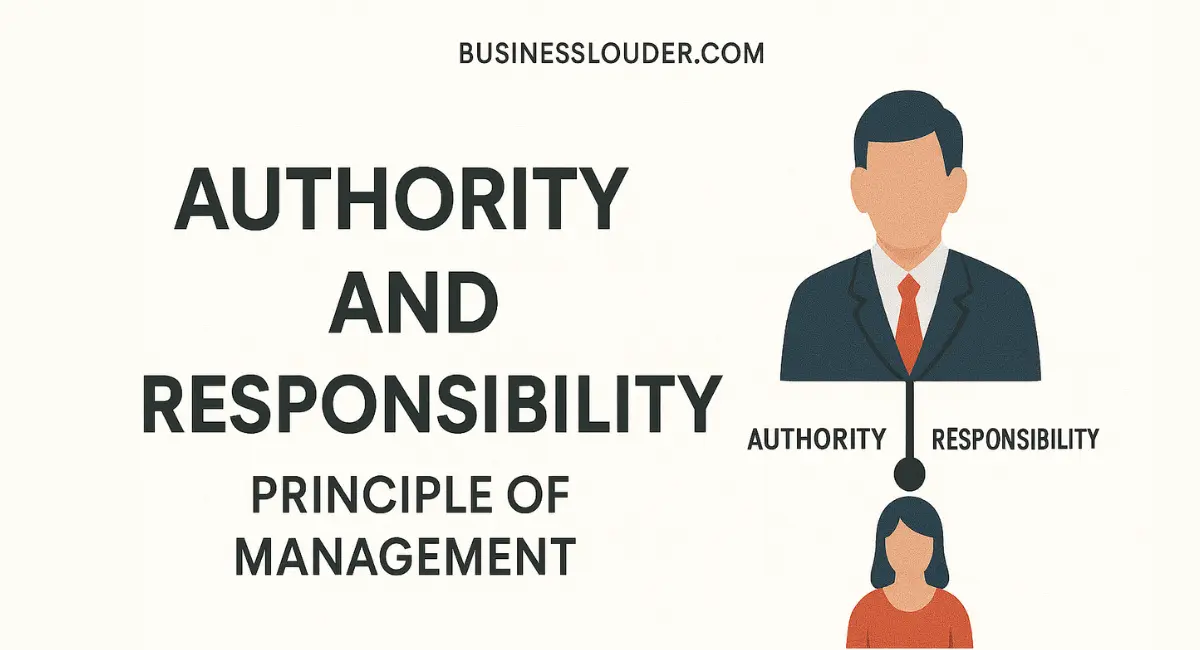
Like any other systematic branch of study, management and managerial functions are also based on some important principles. Authority and Responsibility Principle of Management are two of such, among the various principles of planning. Although they may seem synonymous, they have quite a lot of dissimilarity between them.
In this article, we will take a look at the authority and responsibility principle of management and major differences between these two.
What is the Authority and Responsibility Principle of Management?
Authority and responsibility are the two key tools of management, they are dependent and interrelated to each other.
What is authority in Management?
Authority is the right to command, and decision-making power. In other words, it is the power to give orders and get it obeyed. Authority is the power to make decisions.
What is responsibility in Management?
While responsibility is to be obliged or be answerable for one’s own actions, and decisions. It is a state of being answerable or accountable for any obligation, debt, or trust. In simple words, it means an obligation to complete a job assigned on time and in the best way.
Responsibility can be of two forms:
- Operating Responsibility
It is the responsibility of an individual to carry out the assigned tasks. It is the responsibility or obligation of the person who actually works.
- Ultimate Responsibility
Ultimate responsibility is the final obligation of the manager to ensure that the work is performed efficiently by the employees. It is the final responsibility of the manager who gets the work through his/her employees.
In the absence of authority, employees cannot perform their duties effectively and efficiently. In order to execute their duties properly, they need to have adequate authority. However, care needs to be taken so that the given authority does not exceed the limit of duty, otherwise, it leads to misuse.
Similarly, with the given authority, the employees should be accountable for his/her actions over the period of completion of the task. The authority given should be well-balanced, not more or less than the requirement of the task to be completed.
It is the duty of the manager to delegate adequate authority and responsibility to his/her employees so that the tasks are performed efficiently and effectively with the optimum chance of achieving goals. The management should ensure that there is an optimum linkage between these two factors.
Difference between Authority and Responsibility in Management
Now we shall see the main points of difference between Authority and Responsibility in Management.
| Authority | Responsibility |
| It is the legal right of the superiors to command their subordinates | It is the responsibility of a subordinate to complete the task as assigned by his/her superior |
| It normally arises due to position of the boss in the organization | Responsibility arises from superior-subordinate relations, whereby the subordinate agrees to perform such duties as he/she is assigned to |
| Authority may be delegated by a superior to his subordinate | It cannot be delegated by the subordinate |
| Authority flows downwards from superior to subordinate | Responsibility moves upward from subordinate to superior |
Relationship between Authority and Responsibility
The relationship between Authority and Responsibility principles of management can be established in the following points:
- Authority is the power to give orders and instructions to the subordinates, in an organization, that they may work upon. Responsibility means duties entrusted to an individual/employee at the time of delegation of authority.
- Authority could be delegated whereas responsibility cannot be delegated.
- A superior can always share his/her authority with his/her subordinate. But a superior cannot delegate his/her responsibility or obligation to a subordinate to perform his duty.
- Responsibility is accounted for by a person. Therefore, no subordinate can escape his/her responsibility by delegating certain rights to his/her subordinate. Responsibility always moves upwards and hence cannot be delegated.
- Authority and responsibility are closely interrelated. There needs to be parity between these two. The subordinate shall be accountable for the authority entrusted to him/her and not beyond.
The Closing Lines
The authority and responsibility principle of management believes that in order to achieve desired organizational goals, authority and responsibility should be balanced and must go hand in hand. At the core, these two should be aligned with each other as well as with the organizational goals.
These are the two key aspects of management. A manager needs to have authority to ensure that his/her instructions are carried out by the employees, and this authority should come along with responsibility. If managers did not have any authority, they would lack the ability to get any work done. However, if there is more authority than responsibility, then the employees will get frustrated.