
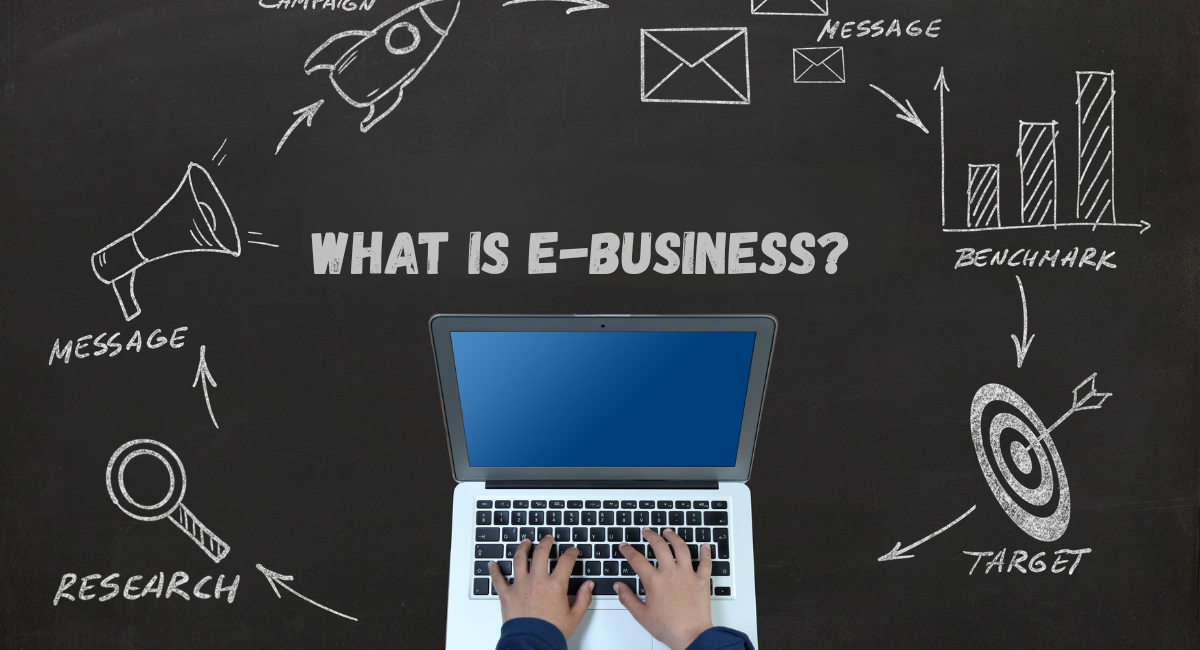
Think e-business just means having a website? That’s like calling a car “a thing with wheels.” Technically true. Wildly incomplete.
E-business is running any part of your business through digital technology — not just selling online, but handling suppliers, payments, marketing, customer service, and internal operations electronically. Selling online is one slice. Running the whole machine digitally is the real thing.
What Is E-Business?
E-business (short for electronic business) is doing business over the internet and digital networks. And it covers a lot: online sales, digital marketing, electronic payments, online support, ordering from suppliers, tracking inventory, and the internal systems that keep the lights on.
How big is this? Global e-commerce alone — just one part of e-business — is projected to hit $6.88 trillion in 2026, according to eMarketer data, with online sales making up more than a fifth of all retail. Digital isn’t a side hustle anymore. For most companies, it’s the main event.
E-Business vs. E-Commerce: What’s the Difference?
This is where everyone gets tangled, so let’s kill the confusion. E-commerce is a piece of e-business — not the same thing.
- E-commerce is just the buying and selling online. The transaction.
- E-business is everything digital: e-commerce plus the marketing, support, supply chain, and operations behind it.
Take Amazon. You adding an item to your cart and paying? That’s e-commerce. The warehouse robots, the supplier systems, the recommendation engine, the cloud servers, the automated support answering your questions? That’s e-business. E-commerce is the sale. E-business is the whole machine around it.
Why does the difference matter to you? Because if you only think “e-commerce,” you’ll build a store and stop. If you think “e-business,” you’ll ask how every part of your operation — not just the checkout — could run better online. That mindset is the gap between a website and a real digital business.
Types of E-Business Models
E-business models get named by who’s dealing with whom:
- B2B (business to business) — one business selling to another, like a supplier feeding a manufacturer through an online portal.
- B2C (business to consumer) — selling straight to individual customers. Most online stores, like Amazon’s retail side, are B2C.
- C2C (consumer to consumer) — people selling to each other through a platform, like eBay or Facebook Marketplace.
- C2B (consumer to business) — individuals selling to companies, like a freelancer landing work through a marketplace.
Examples of E-Business
You use e-business every day, probably without thinking about it:
- Online retail — Amazon and eBay run entire stores digitally, from browsing to the tracking number.
- Food delivery — Uber Eats and DoorDash tie restaurants, drivers, and you into one app. No paper menu, no phone call.
- Online learning — Coursera and Udemy sell courses, take payment, and hand out certificates without a classroom.
- Online banking — you move money and pay bills from an app, and never see a branch.
- Online booking — Expedia and Booking.com handle the whole trip, from search to confirmation.
Why E-Business Matters
E-business rewrote the rules of who gets to compete. Here’s why it’s not optional anymore:
- Reach without borders — a one-person shop can sell to the other side of the world without opening a single store.
- Always open — your digital storefront runs 24/7, in every time zone, while you sleep.
- Lower costs — automate the busywork and skip the physical overhead.
- Real data — every click tells you something about what customers want. Use it, and your decisions get sharper.
- Tighter supply chains — digital links to suppliers make ordering and restocking faster and less error-prone.
Picture a small candle maker working from a spare room. Twenty years ago, her market was whoever walked past a local stall. Today she sells to five countries through an online store, takes payments automatically, runs ads to people who’ve bought similar things, and restocks supplies with a few clicks. Same person, same spare room — a completely different business. That’s what e-business changed.
Advantages of E-Business
The upsides are practical, and they add up fast:
- A bigger audience — geography stops deciding who you can sell to.
- Sharper marketing — digital tools let you speak to the right people instead of everyone. It only works when it’s built on real consumer buying behaviour.
- Convenience — customers buy anytime; you automate the repetitive stuff.
- Faster scaling — you can add customers without adding buildings at the same pace.
Applications of E-Business
Day to day, e-business powers a handful of core jobs:
- Online retailing — selling through e-commerce stores.
- Online banking — digital payments and account management.
- Digital marketing — reaching the right audience by interest and behaviour, built on the core concepts of marketing.
- Online booking — reservations for travel, events, and services.
- Online support — chatbots, email, and social channels that fix problems without a phone call.
The Challenges of E-Business
It’s not all upside. Go digital, and you take on real risks — plan for them:
- Security — you’re handling payments and personal data, so one breach can cost you customers and trust overnight.
- Brutal competition — your rival is one click away, and so is the back button.
- Tech dependence — a crash, a bug, or a slow site can stop your sales cold.
- Less human touch — trust is harder to build through a screen, so your service has to work twice as hard.
Frequently Asked Questions
What is e-business in simple words?
E-business is running your business over the internet — selling, marketing, payments, customer service, and managing suppliers — instead of doing it all in person or on paper.
What’s the difference between e-business and e-commerce?
E-commerce is only the buying and selling online. E-business is broader — it’s e-commerce plus everything else you run electronically, from marketing to supply chain to internal operations.
Is Amazon an e-business or an e-commerce site?
Both. Amazon’s store is e-commerce. The full company — automated warehouses, supplier systems, cloud services, digital support — is a giant e-business.
What are the main types of e-business?
They’re grouped by who’s transacting: B2B (business to business), B2C (business to consumer), C2C (consumer to consumer, like eBay), and C2B (consumer to business). Plenty of companies run more than one.
Where E-Business Is Headed
E-business isn’t a strategy some companies pick and others skip anymore. For most, it’s just how business works now. The real question isn’t whether you’re online — it’s how much of your operation actually runs digitally, and how well.
So if you’re building or growing something, stop at “we need a website.” Then ask the better question: which part of your business — sales, support, suppliers, marketing — would run better digitally? Start there. Fix one thing, get it right, then expand. The companies that win didn’t digitize everything at once. They just started. For a related building block, see how C2C e-commerce fits into the wider digital economy.

One Comment on “What is e-business? Definition, Importance, Advantages”