
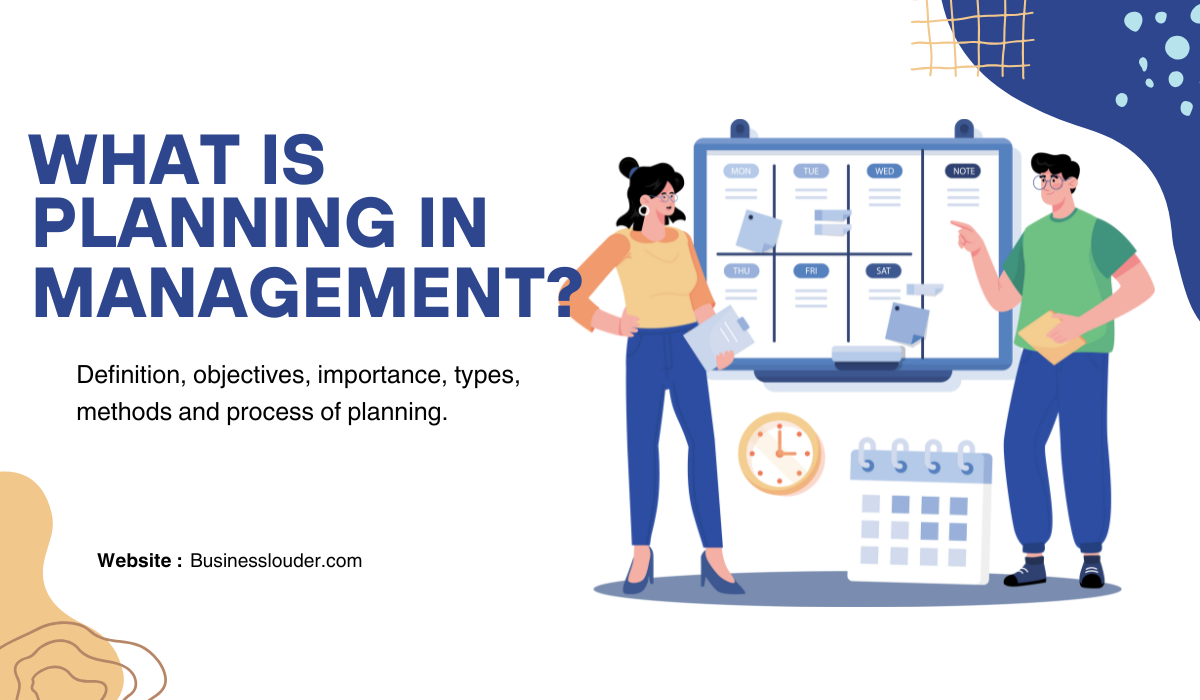
Planning is an important step for all organizations. That is why it becomes important to understand planning to achieve the objectives of organizations. Here in this blog post we will see what is planning, definition, objectives, importance, types, methods and process of planning.
What is Planning?
Planning definition: Planning is essential for all organizations, be it small, medium, or large, and whether public or private or run by sole proprietors. It is that function or process of management by which an organization can analyse and predict the business activities that are related to the objective and their future goals.
Definition of Planning in Management
Planning in the context of management can be defined as deciding in advance what to do,when to do it, how to do it, and who is to do it. The planning process bridges the gap from where you are to where you want to go.
Planning in management defines organizational goals, establishes an overall strategy, and develops a comprehensive set of plans to integrate and coordinate work in an organization.
Features of Planning
There are various characteristics or features of planning in management. They are as follows:
1. Primary Function of Management
Planning is the primary function of management. It is the first and foremost function and serves as a base for all other management functions. It provides the basic framework within which all other management functions are performed, such as organizing, staffing, directing and controlling.
2. Goal-oriented
Planning is goal-oriented. It focuses on defining the goals or objectives of an organization, identifying alternative courses of action and deciding the appropriate steps to be taken, which needs to be undertaken for reaching these goals or objectives.
3. Continuous Process
The process of planning is a continuous one. It is a never-ending activity. There is always a need for new plans to be drafted according to changes in the circumstances and new demands.
4. Mental Exercise
Planning is a mental exercise as it is an intellectual process which requires higher thinking, imagination, foresight and sound judgment. It requires higher level of intelligence and is kept separate from operational activities. The success of a plan depends on the performance of a planner, so planners must think in a logical and systematic manner.
5. Futuristic/Forward Looking
Planning generally means looking ahead and preparing for the future. All planning managers try to make predictions and assumptions about the future. These predictions are based on the managers’ prior experiences of the managers as well as thoughtful scanning of the wider environment.
Objectives of Planning
The objectives of planning in management include various points such as:
1. Optimum Utilization of Resources
In any management or business, the resources are limited in nature. Planning assembles the available resources according to their objectives and functional areas like marketing department, production, personnel, and finance.
These departments help the management to utilize the resources in an effective way so that the output gains more and more sales volume.
2. Helps to Reduce the Risks
Planning ahead also prepares the management for overcoming any obstacles that may come in the way and even reduces the chances of risks.
3. Development of Managers or Executives
Planning is the integration of thoughts, ideas, feelings, and creativity by managers. Through these, the planning managers develop their conceptual or analytical skills to plan and coordinate them in an efficient and effective manner.
4. Promotes innovation
In the planning process, managers predict future activities to analyze the strengths and weaknesses of their competitors. This, in turn, helps them develop or innovate existing products. It also promotes new ideas, new techniques and concepts, new relationships, and lastly, they promote creativity as well as innovation.
5. Enhances the morale
In a business organization, if plans are achieved, managers and employees feel satisfied and extremely happy. This enhances morale with the achievement of organizational goals and objectives. Successful planning always gives a positive attitude towards the success of the business organization because it helps to increase the level of standards and the next planning cycle.
Importance of Planning
1. Planning provides Direction
Planning makes clear what employees should do, how to do it, etc. It gives direction and a sense of purpose for the organization. By planning in advance how the work has to be done, planning provides a predetermined course of action. Thus, employees know in advance the direction in which they have to work.
If there was no planning, employees would be working in different directions and the organization would not have been able to achieve its desired goal.
2. Planning reduces the Risk of Uncertainty
Every business organization has to face many unexpected situations and uncertainties every day. Planning helps in anticipating the future, and preparing for the risk by making necessary provisions. Plans also include unexpected risks such as fire or any other calamities in the organization. There are certain resources that are kept aside in the plan to meet such uncertainties.
3. Planning promotes Creativity and Innovative Ideas
Planning forces the planning managers to find out new and improved ways of doing things in order to remain competitive. It compels the managers to be creative and innovative every single time.
Planners develop new ideas and apply those to create new products and services leading to overall growth and expansion of the business.
4. Planning facilitates Decision Making
Decision-making involves searching for various alternatives and selecting the best one. Planning helps managers look into the future, and choose among various given alternative plans of action. Thus, planning provides guidelines for sound and effective decision-making.
5. Planning Reduces Overlapping and Wasteful Activities
Planners make organizational plans keeping in mind the requirements of all the departments. An effective and well laid-out plan integrates the activity of all the departments As a result there will be coordination in the different departments. In this way, planning reduces overlapping of resources and wasteful activities.
Steps in the Planning Process
Step #1 Setting up of the objectives
The first and foremost step in the planning process is to identify the goals of the organization. The objectives must clearly indicate what is to be achieved, where the plan of action should take place, who is to perform it, how it needs to be undertaken and by when it is to be accomplished. Managers prefer to set up objectives which can be achieved quickly and in a particular limit of time.
Step #2 Developing Premises
Premises refer to making assumptions about the future. These assumptions can be about the environment in which plans are made and implemented. Premises take into consideration the impact of important environmental factors such as market demand for goods, technology to be used, cost of raw materials, population growth, government policy, etc.
Plans should be formulated by the planning management, keeping in mind the limitations imposed by internal as well as external conditions.
Step #3 Evaluating the various Alternatives available
The pros and cons of each alternative course of action must be examined thoroughly before making a final choice, keeping in mind each of its consequences. Sometimes, instead of selecting only one alternative, a combination of different alternatives are selected. The most ideal plan will be the most profitable, feasible, and with least negative consequences.
Step #4 Formulating Derivative Plans
After selecting the best plan of action, the management also has to formulate secondary plans to support the main plan. Such detailed plans derived for various departments, units, activities, etc., are known as ‘derivative plans’.
For example, the basic production plan requires a number of things such as availability of plant and machinery, provision of adequate finance, training of employees, etc. To ensure success of the main plan, the derivative plans must indicate the time schedule and also the sequence of performing the various tasks.
Step #5 Implementing the Plan
For implementing the plans or putting them into action, the managers need to communicate the plans to all the employees very clearly. After communicating the plan to employees and taking their support, the managers then start to allocate the resources according to the specifications of the plans.
For example, if the plan is to increase sales by increasing the expenditure on advertisement, then in order to put it into action, the managers must allot more funds to the advertisement department, hire advertising agencies, select better media, etc.
Step #6 Follow-up
As planning is a continuous process, the implemented plans have to be continually reviewed to ensure their relevance and effectiveness. During the follow-up step, many adjustments are made in the existing plan. Without such a regular follow-up, plans may become useless and out-of-date.
The Final Word
Planning managers should spend enough time on the planning process – deciding what to do, when to do and how to do it. If the strategies and other aspects of an organization are not done properly, it may result in taking many unfocused, unnecessary, and inefficient steps.
We hope that you have understand what is planning, and its definition, features, objectives and process of planning.



2 Comments on “What is Planning in Management: Definition, Features”