
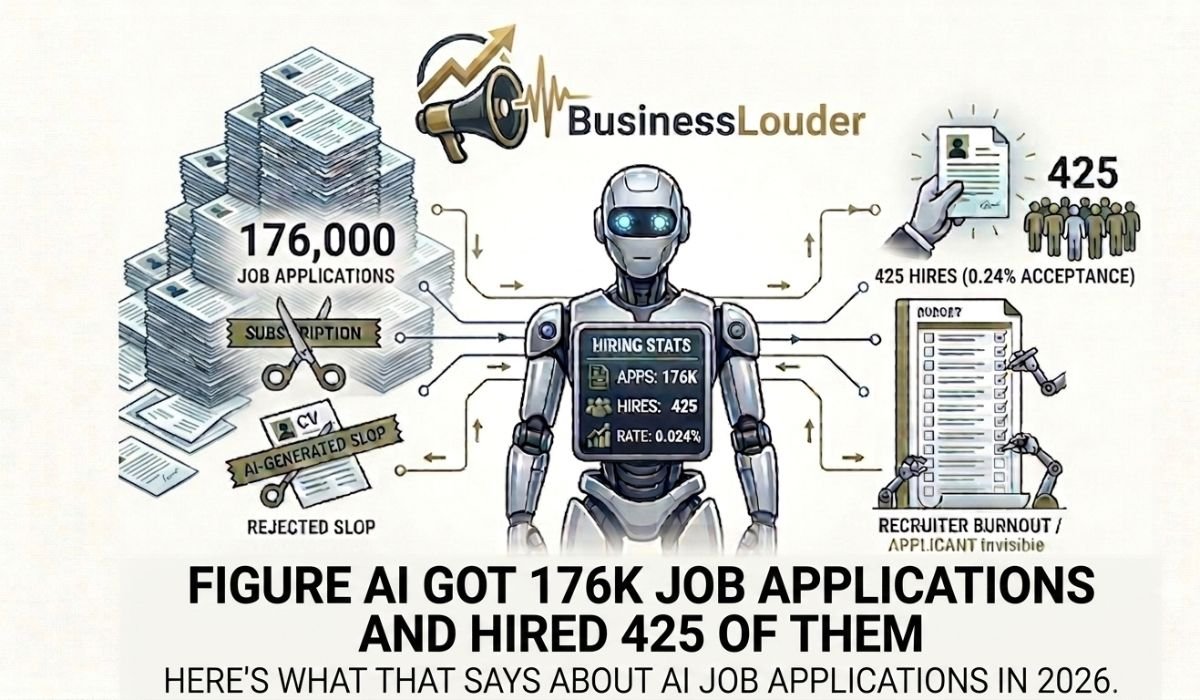
A robot company in San Jose just received more job applications than Harvard gets in five admissions cycles. It hired fewer people than a single Starbucks location.
176,000 resumes. 425 hires. A 0.24% acceptance rate. That’s lower than Stanford, lower than every Ivy League school, lower than almost any selective program in the world — and it’s for jobs building humanoid robots, not a degree from a 400-year-old institution.
If you’ve sent out fifty applications this year and heard nothing back, you’re not bad at this. The hiring system you’re applying into has fundamentally broken, and the hiring statistics behind it prove it isn’t just a feeling.
The Problem: You’re Not Competing With People Anymore
Here’s what’s actually happening. Figure AI’s founder and CEO, Brett Adcock, posted the numbers himself on X, and Business Insider reported on the fallout: “Just checked, 176,000 job applications at Figure the last 3 years. We’ve hired ~425 people.” His blunt verdict on what filled most of those applications: “slop.”
That’s not Adcock being cruel. It’s Adcock describing a flood that has buried recruiters at almost every fast-growing company, and it’s the clearest data point yet on what AI job applications have done to the job market 2026 is stuck with. According to Greenhouse’s 2025 hiring data, the applicant tracking platform used by thousands of employers, the average job opening now pulls in around 242 applications — roughly three times what it saw in 2021. Daniel Chait, Greenhouse’s CEO, has a name for what’s driving it: the “doom loop.” Candidates use AI to apply to more jobs. Employers respond with heavier AI hiring filters built into their applicant tracking systems. Candidates answer back with even more AI to get past those filters. Round and round it goes, and at the bottom of the loop, every résumé starts to look identical — which is exactly the recruitment trend Adcock ran into at scale.
Figure isn’t even the most extreme case. At New York Life, recruiters receive up to 100,000 applications for 1,400 open roles. “It’s easier to get into Harvard than it might be to get a job at New York Life,” said Glenn Padewski, the company’s head of experienced-professional hiring. He wasn’t joking.
So if you feel invisible right now, you’re reading the room correctly. You are invisible — to a system, not to a person. And the system was never built to read 176,000 résumés one by one. No system was.
The Insight: Volume Was Never the Strategy
Here’s the part most career advice gets wrong. The advice industry’s answer to a brutal job market has always been “apply to more jobs.” Use AI to write fifty cover letters in an afternoon. Mass-apply on every job board. Play the numbers.
That advice made sense in a market where you were one of 20 applicants. It is actively self-defeating in a market where you’re one of 242 — and a third of those 242 are also AI-generated.
When everyone optimizes the same way, optimization stops being an edge. It becomes the baseline noise everyone has to dig out from underneath. Adcock said his team goes through Figure’s résumés “one by one.” That’s a company with engineering talent that builds robots, and even they couldn’t build a system that replaced a human looking at each application — they just got buried slower.
The mistake most job seekers make here is assuming the bottleneck is effort. It isn’t. It’s signal. A recruiter staring down a stack of a thousand near-identical, keyword-stuffed resumes isn’t looking for the person who applied fastest. They’re looking for the one application that doesn’t read like everyone else’s.
What Actually Works When Everyone’s Doing the Same Thing
1. Get a human to open the file before the algorithm does
Most roles never even make it to a public job board before someone’s hired through a referral or a direct introduction. Industry estimates suggest 40–60% of positions are filled through referral or direct outreach before the listing fills up with hundreds of cold applications. That’s not a loophole — it’s how hiring has worked for decades, and the rise of AI hiring tools and heavier applicant tracking systems has only made it more valuable, not less.
In practice, what this looks like is: find the hiring manager or the team lead on LinkedIn, not the recruiter. Send one specific message, not a pitch. Reference something real about the role or the company. Ask for fifteen minutes, not a job.
2. Apply to fewer jobs, not more
This one fights every instinct the market has trained into you, but the data backs it up. Quality of fit beats quantity of attempts when every other application in the pile is also AI-assisted. Five applications you’ve genuinely tailored beat fifty you’ve blasted out, because the five get you past the part of the process where a human is finally looking, and the fifty just add to the slop pile Adcock was describing.
3. Make the human part of your application impossible to automate
Applicant tracking systems and AI screeners are good at matching keywords. They’re bad at recognizing a specific, well-told story about a problem you solved. “Managed a team” gets filtered with a thousand other identical lines. “Cut onboarding time from six weeks to nine days by rebuilding the training docs” doesn’t — because no AI tool generates that sentence for you. It only exists if you actually did it and bothered to write it down precisely.
This only works when you’re honest about the number — vague claims read exactly like AI filler, which defeats the entire point.
4. Show up where the volume hasn’t reached yet
Adcock’s company is in one of the most AI-talent-saturated corners of the entire economy — every researcher in robotics and machine learning wants in. If you’re applying into that kind of gravity well, expect the .24% odds. But most roles, in most companies, in most industries, are nowhere near that crowded. Niche industries, smaller cities, and roles that require a specific technical skill (not “AI experience” broadly, but a named tool, a named stack, a named certification) still see a fraction of the applicant volume that flagship tech roles do. Going where the crowd isn’t is still a strategy. It always was.
The Honest Limit Here
None of this guarantees a job. The labor market in 2026 has real headwinds that no clever application trick fixes — layoffs, hiring freezes, and a genuine oversupply of candidates in some fields. If you’re early-career with no network and no portfolio, referrals are harder to manufacture, and you’ll need to build the relationships before you need them, not during the search.
And to be fair to the other side of this: not every company drowning in applications is mishandling them. Some, like Greenhouse’s own customers, are using AI responsibly — flagging fraud, surfacing overlooked candidates, scheduling more human interviews, not fewer. The tool isn’t the villain. The undifferentiated, identical use of the tool by everyone at once is.
What To Do Today
Pick the three roles you actually want — not the thirty you’re qualified for. For each one, find a real person inside the company and send them something specific, not a cover letter restated as a message. Then go build one number, one outcome, one sentence you can say in an interview that no other candidate in that pile of 176,000 résumés could say about themselves.
The founders and employees who break through a flooded market in 2026 won’t be the ones who applied the most. They’ll be the ones who made it impossible to mistake them for slop. Every recruitment trend in the hiring statistics above points the same direction: noise is cheap now. Specificity isn’t.
This article focuses on job seekers navigating high-volume hiring pipelines. For how AI is reshaping recruitment and staffing on the employer side, see our breakdowns of staffing in management and artificial intelligence in business management.