
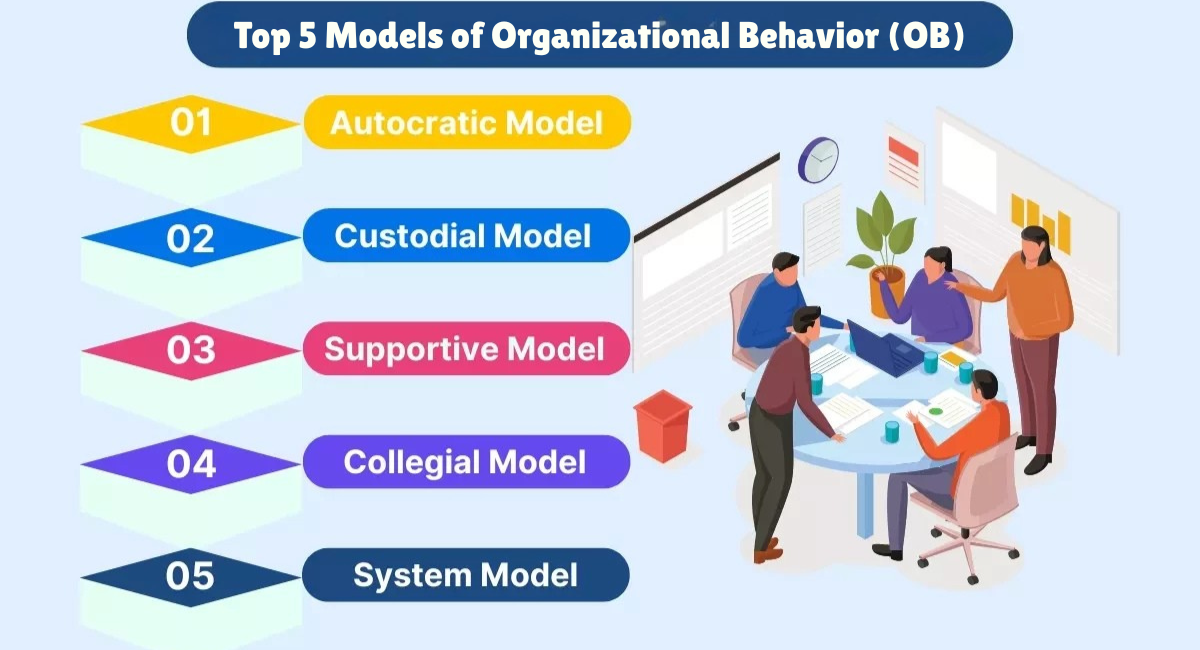
Organizational behavior refers to taking a look at and understanding the ways individuals and agencies behave inside an organization. Numerous fashions have been advanced to provide an explanation for and analyze the dynamics of organizational behavior.
Models of Organizational Behavior
Those models of OB offer insights into one-of-a-kind leadership patterns and techniques for managing employees. In this article, we will explore the subsequent models of organizational behavior: the autocratic model, the custodial model, the supportive model, the collegial model, and the gadget model.
Autocratic Model
The autocratic model of organizational behavior is a leadership style in which decisions are made totally via one individual or a small organization of individuals in a role of authority. In this model, electricity and management are centralized, and there’s little to no entry from subordinates or employees.
Benefits of the Autocratic Model:
Green decision-making: since the choice-making manner involves just a few individuals, selections may be made quickly and effectively. That is especially beneficial in conditions in which time is of the essence or in instances of disaster.
Clear hierarchy: The autocratic model establishes a clean chain of command and ensures that everybody is aware of their role and obligations. This enables preserving order and area within the organization.
Risks of the Autocratic Model:
Lack of worker empowerment: The autocratic model does not promote worker involvement or empowerment. Subordinates have little to no say in decision-making, which could lead to emotions of resentment, low morale, and reduced task delight.
Creativity and innovation might also suffer: The autocratic model stifles creativity and innovation inside the enterprise. Seeing that selections are made through a pick-out few, there may be limited opportunity for brand-new thoughts and perspectives to be taken into consideration.
Custodial Model
The custodial model of organizational behaviour is one of the several fashions used to understand and analyze the dynamics inside groups. This model specializes in the welfare and security of personnel.
Benefits of the Custodial Model:
Task security: In this model, personnel enjoy a sense of activity safety because the business enterprise specializes in supplying strong employment. This balance can grow worker delight and reduce turnover rates.
Economic benefits: The custodial model emphasizes offering monetary rewards and advantages to personnel. This may encompass aggressive salaries, pension plans, healthcare benefits, and other economic incentives. Such advantages can inspire personnel to perform better and feel valued by the employer.
Risks of the Custodial Model:
Loss of Employee Engagement: The custodial model assumes that economic rewards alone are enough to encourage personnel. However, it fails to understand the importance of intrinsic motivation and employee engagement.
Dependency at the agency: The custodial model creates an experience of dependency amongst employees in the direction of the agency. This will bring about decreased man or woman initiative and creativity, as employees might also fear taking dangers or hard the status quo.
Supportive Model
The supportive model of organizational behavior is one of the fashions used to understand and manipulate behavior within an employer. This model recognizes the significance of interpersonal relationships, communique, and teamwork in reaching organizational goals.
Benefits of the Supportive Model:
Progressed process satisfaction: through prioritizing employee nicely-being and creating a supportive environment, the supportive model facilitates to enhance process pride. While personnel sense supported, valued, and revered, they’re much more likely to be satisfied with their paintings.
Better teamwork and collaboration: This model places a sturdy emphasis on teamwork and collaboration. By encouraging open verbal exchange, acceptance as true with constructing, and cooperation among team participants, the supportive model promotes a collaborative work culture where employees can work together effectively in the direction of commonplace dreams.
Risks of the Supportive model:
Capability dependency: One ability drawback of the supportive model is that it can cause worker dependency on leaders or supervisors for steering and selection-making. This could preclude personnel’s capacity to develop their problem-solving capabilities and take ownership of their work.
Time-eating: imposing the supportive model requires effort and time from leaders and supervisors. The emphasis on teamwork, conversation, and employee well-being needs continuous help and involvement from control, which can be time-consuming and difficult to sustain in larger businesses.
Collegial Model
The collegial model of organizational behavior is a control approach that emphasizes teamwork, collaboration and shared selection-making within a company. In this model, employees are encouraged to collectively, exchange ideas, and contribute to the decision-making process.
Benefits of the Collegial model:
Increased employee engagement: by way of encouraging collaboration and concerning employees in choice-making methods, the collegial model fosters a sense of possession and engagement among employees.
Stronger creativity and innovation: when employees from exceptional backgrounds and areas of understanding come together, they bring numerous views and ideas to the desk. The collegial model promotes open conversation and record sharing, taking into account the alternative of revolutionary ideas and answers.
Risks of the Collegial model:
Time-ingesting choice-making process: In a collegial model, selection-making can be a more time-eating system as compared to autocratic or custodial fashions. Because multiple people are concerned with decision-making, it is possible to take longer to reach a consensus or make a final selection. This could doubtlessly gradual down the pace of operations and hinder organizational agility.
Ability for conflicts and disagreements: In a collegial model, in which multiple people have a say in decision-making, conflicts or disagreements may also stand up.
Differing opinions and views can cause prolonged discussions or even stalemates. Managing and resolving conflicts effectively becomes critical to maintaining productiveness and harmony within the organization.
System Model
The system model of organizational behaviour views a company as a complex and interconnected device of various additives. It emphasizes the interdependence and interactions between distinct elements within the company, inclusive of individuals, teams, approaches, and the external environment.
Benefits of the System Model:
Holistic method: The system model takes a holistic method to information organizational behavior, considering the interrelationships among numerous factors. This permits a comprehensive analysis of the business enterprise’s functioning and facilitates a better understanding of the effect of changes in one component on the entire machine.
Adaptability: The machine model recognizes the importance of adapting to the external environment. By using expertise in the business enterprise as a device, it becomes easier to discover ability-demanding situations and possibilities and make necessary modifications to ensure the employer’s survival and achievement.
Risks of the System Model:
Complexity: The gadget model recognizes the complexity of companies and their interactions. This complexity could make it hard to fully apprehend and examine the numerous additives and their interrelationships.
Time and resource-extensive: enforcing the system model and making adjustments based totally on the evaluation can be time-eating and aid-extensive. It requires a sizable investment of time, effort, and monetary resources to acquire records, and behavior analyses, and put into effect changes across the company.
Conclusion
In conclusion, knowledge and making use of different models of organizational behavior (OB) is important for effective management and leadership inside an employer. Every model offers its own set of benefits and risks, and the selection of which model to adopt ought to be primarily based on the particular needs and goals of the organization.
Also Read:


2 Comments on “Top 5 Models of Organizational Behavior (OB)”