When Ray Kroc transformed McDonald’s from a single burger stand into a global empire, he didn’t just change the menu—he revolutionized the company’s organizational structure. This strategic decision enabled McDonald’s to scale from 1 restaurant to over 40,000 locations worldwide.
Choosing the right organizational structure isn’t just an administrative task—it’s a strategic decision that impacts everything from communication flow to employee productivity and business growth. Yet many business leaders struggle to understand which structure best fits their needs.
In this comprehensive guide, we’ll explore the 7 main types of organizational structures, complete with real-world examples, diagrams and practical insights to help you make informed decisions for your organization.
What is Organizational Structure?
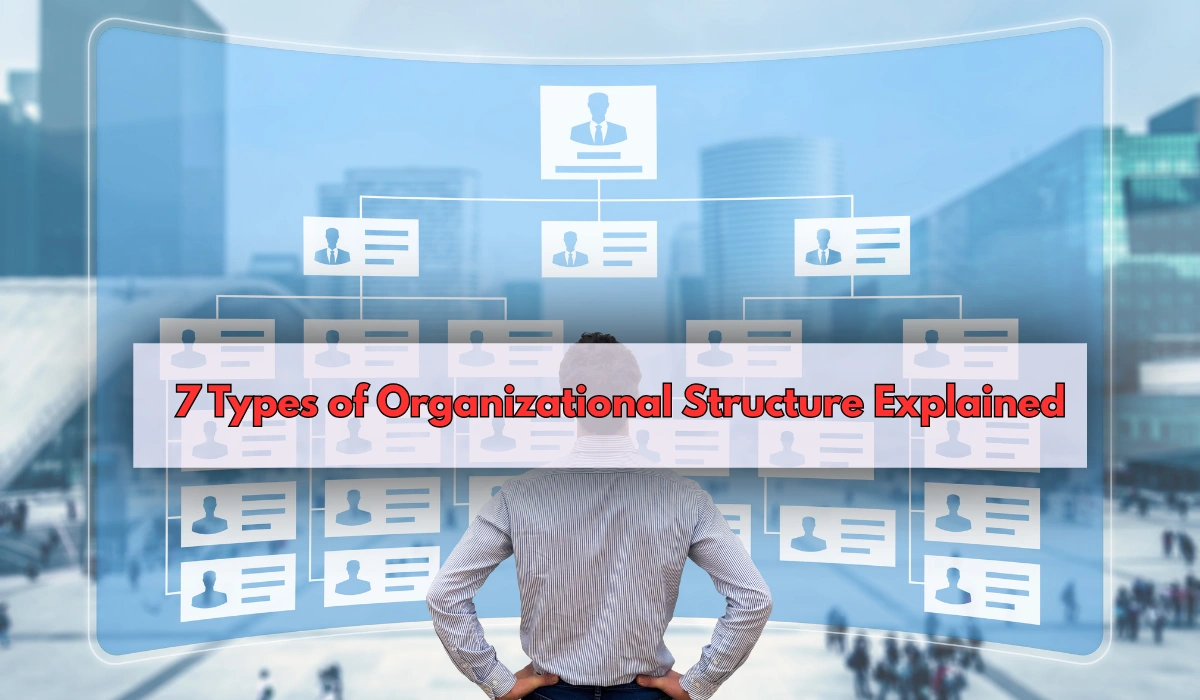
Organizational structure is the framework that defines how activities are coordinated, supervised, and directed within a company to achieve organizational goals. Think of it as your company’s blueprint—it determines who reports to whom, how information flows, and where decision-making authority resides.
As Harvard Business School research indicates, organizational structure directly influences how management functions and how effectively teams collaborate toward common objectives.
Key Components of Organizational Structure
Chain of Command – The line of authority from top management to employees
Span of Control – The number of employees a manager supervises
Departmentalization – How jobs are grouped together
Centralization vs Decentralization – Where decision-making power lies
Work Specialization – How tasks are divided among employees
Formalization – The degree to which rules and procedures govern work
According to McKinsey & Company research, companies with effective organizational structures are 2.2 times more likely to outperform competitors financially.
Why Organizational Structure Matters
A well-designed structure delivers measurable benefits:
Increased Efficiency – Clear roles eliminate confusion and duplication of effort, supported by the principle of division of work
Faster Decision-Making – Proper authority distribution speeds up responses, which is essential in the decision-making process
Better Communication – Defined channels improve information flow through effective communication networks
Enhanced Accountability – Everyone knows their responsibilities through clear authority and responsibility definitions
Easier Scalability – Growth doesn’t require constant reorganization
Structure also profoundly affects organizational behavior, company culture, and overall workplace dynamics.
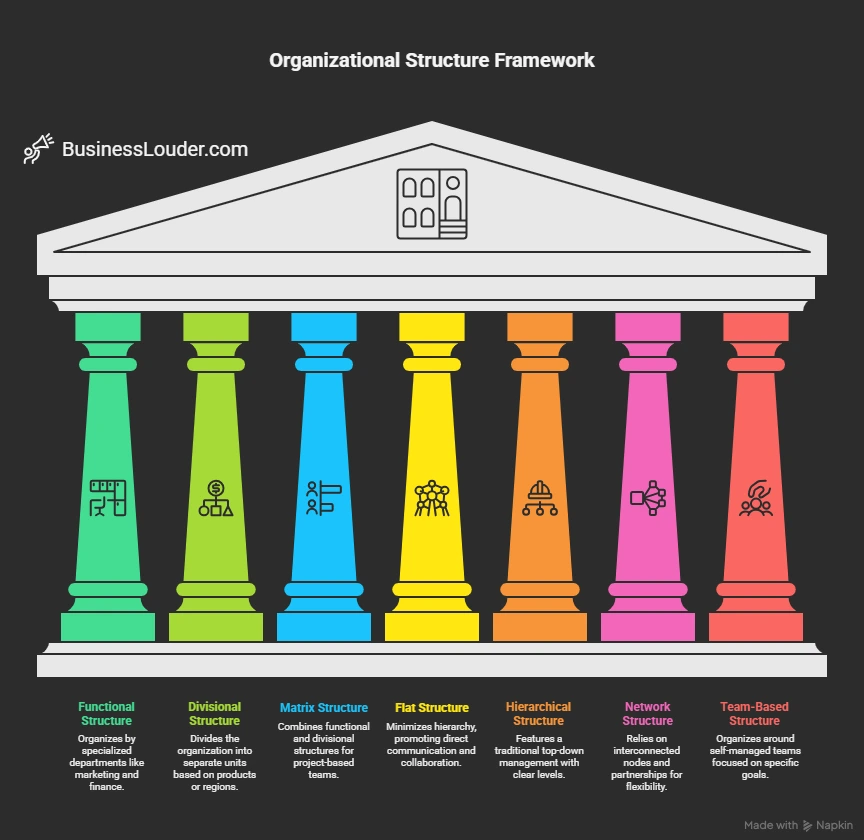
7 Types of Organizational Structure
1. Functional Organizational Structure
The functional structure groups employees based on specialized functions or departments such as marketing, finance, operations, and human resources. This is the most traditional and widely used structure, particularly among small to medium-sized businesses.

Real-World Examples:
McDonald’s Corporate Headquarters uses functional structure with departments including Marketing and Brand Strategy, Finance and Accounting, Restaurant Operations, Supply Chain Management, and Technology and Digital Innovation.
Coca-Cola Company organizes functionally with clear divisions for Marketing, Finance, Operations, Legal, and Human Resources.
Strengths:
- Deep Specialization – Employees develop expertise in their functional area
- Operational Efficiency – Similar activities grouped together eliminate duplication
- Clear Career Paths – Well-defined progression within each function
- Cost Effective – Economies of scale through shared resources
- Easy to Understand – Simple structure that’s straightforward to implement
- Quality Control – Functional experts maintain high standards
Weaknesses:
- Departments often operate in their own bubble, which limits communication across the company.
- Decisions take longer because information must move through multiple people and layers.
- Employees can become too focused on their own tasks and lose sight of the bigger picture.
- It’s harder to get different departments aligned and working toward the same goals.
- No single person owns the full process, so accountability for results can feel unclear.
Best For: Growing small and mid-sized companies that need clear departments and strong specialization to keep daily operations running smoothly. This structure also supports effective staffing in management.
2. Divisional Organizational Structure
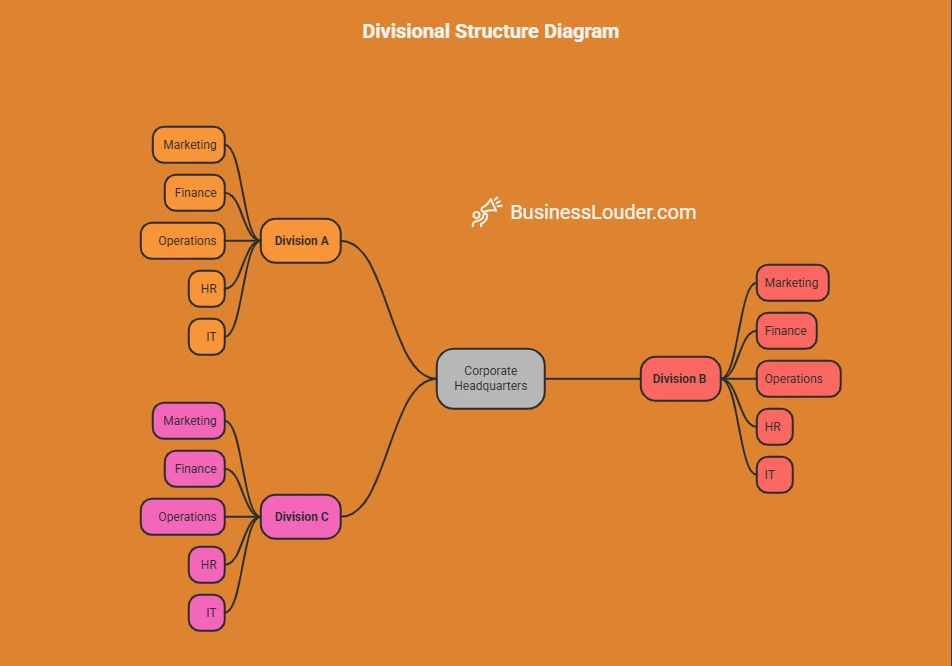
The divisional structure organizes the company into semi-autonomous divisions based on products, geographic regions, or customer segments. Each division operates almost like an independent company with its own functional departments.
Real-World Examples:
General Electric (GE) operates with product-based divisions: GE Aviation, GE Healthcare, GE Renewable Energy, GE Power, and GE Digital.
PepsiCo uses geographic and product divisions: Frito-Lay North America, PepsiCo Beverages North America, Quaker Foods North America, Latin America Division, Europe Division, and Asia, Middle East, and North Africa.
Strengths:
- Product Focus – Each division concentrates on specific markets or products
- Clear Accountability – Division leaders own profit and loss responsibility
- Faster Response – Divisions adapt quickly to market changes
- Better Coordination – Easier alignment within divisions than across functions
- Develops Leaders – Division heads gain comprehensive management experience
- Scalability – New divisions can be added without disrupting existing ones
Weaknesses:
- Resource Duplication – Each division maintains its own functional departments
- Higher Costs – Multiple administrative teams increase overhead
- Reduced Economies of Scale – Separate operations limit bulk-buying advantages
- Internal Competition – Divisions may compete for corporate resources
- Inconsistent Policies – Different practices across divisions
- Limited Knowledge Sharing – Best practices don’t transfer easily
Best For: Large organizations with multiple products or regions, where each area needs its own focused leadership and strategy. Understanding scalar chain principle helps manage divisional hierarchies effectively.
3. Matrix Organizational Structure
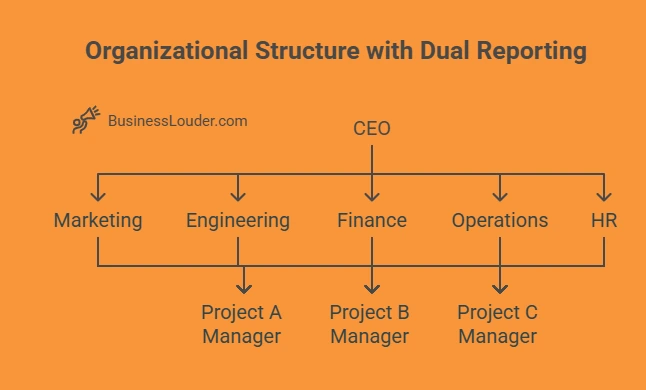
The matrix structure combines functional and divisional approaches, creating dual reporting relationships. Employees report to both a functional manager (based on expertise) and a project or product manager (based on assignments).
Real-World Examples:
Starbucks uses a matrix structure combining geographic divisions (regional managers) and functional departments (marketing, supply chain, HR). Store managers report to both regional and functional leaders.
NASA operates with a matrix structure: Mission projects (Mars Exploration, International Space Station) and Functional centers (Engineering, Research, Operations). Personnel report to both project leaders and functional directors.
Philips Electronics combines Product divisions (Healthcare, Personal Care, Lighting) with Functional expertise (R&D, Manufacturing, Marketing).
Strengths:
- Flexible Resource Allocation – Employees assigned dynamically to priorities
- Efficient Resource Use – Specialists work across multiple projects
- Enhanced Communication – Direct connections between functions and projects
- Balanced Focus – Maintains functional expertise and project accountability
- Employee Development – Diverse experiences across projects and functions
- Innovation Boost – Cross-functional collaboration sparks creativity
- Customer Responsiveness – Project teams access all functional resources quickly
Weaknesses:
- Dual Reporting Confusion – Conflicting instructions from two managers
- Power Struggles – Competition between functional and project managers
- Slower Decisions – Consensus-seeking between managers causes delays
- Higher Administrative Costs – More managers needed for coordination
- Role Ambiguity – Unclear responsibilities create confusion
- Employee Stress – Competing demands from multiple bosses
- Complexity – Requires sophisticated management skills
Best For: Companies that run many projects at once and need people from different departments to work together effectively. This structure supports effective business communication across multiple levels.
4. Flat (Horizontal) Organizational Structure
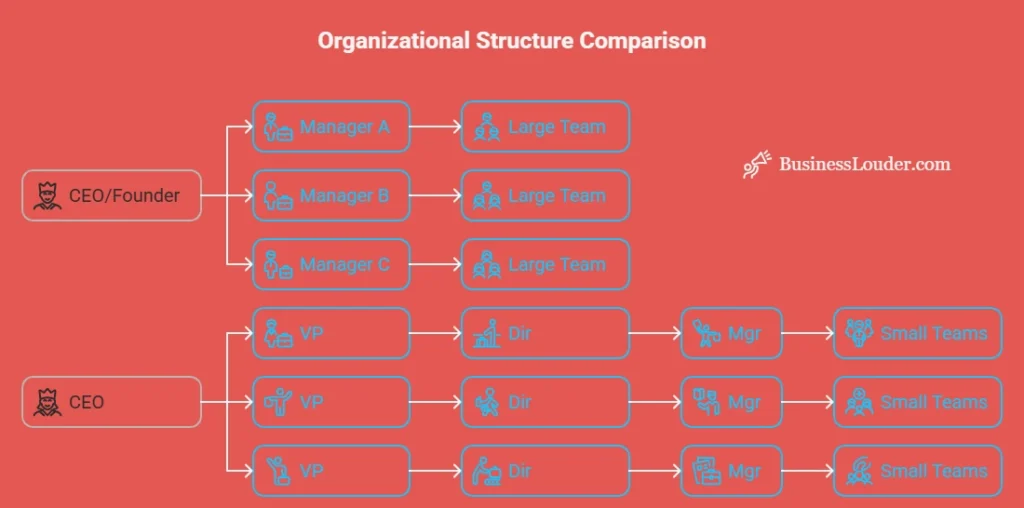
The flat structure minimizes or eliminates middle management layers between executives and front-line employees. This creates a wide span of control with emphasis on employee empowerment and direct communication.
Real-World Examples:
Valve Corporation (video game company) operates with no formal management hierarchy where employees choose which projects to work on and uses peer-based evaluation.
Buffer (social media management platform) maintains minimal hierarchy with transparent operations, self-organizing teams, and public salaries with open decision-making.
GitHub (before Microsoft acquisition) operated with limited management layers, employee autonomy in project selection, and collaborative decision-making culture.
Strengths:
- Faster Decisions – Fewer approval layers speed up responses
- Lower Costs – Reduced management positions decrease overhead
- Improved Communication – Direct access eliminates information filtering (related to functions of communication)
- Employee Empowerment – Greater autonomy increases motivation
- Innovation Culture – Open communication fosters creativity
- Flexibility – Quick adaptation to market changes
- Transparency – Fewer barriers create open organizational culture
Weaknesses:
- Role Confusion – Ambiguous responsibilities without clear hierarchy
- Limited Career Growth – Fewer promotion opportunities
- Manager Overload – Wide spans of control overwhelm supervisors
- Scalability Issues – Structure becomes chaotic as company grows
- Lack of Specialization – Employees may lack clear functional development
- Potential Chaos – Decision-making can become disorganized
- Not Universal – Some employees prefer clear direction and structure
Best For: Startups and creative teams that thrive on quick decisions, open communication, and minimal layers of management.
5. Hierarchical (Tall) Organizational Structure
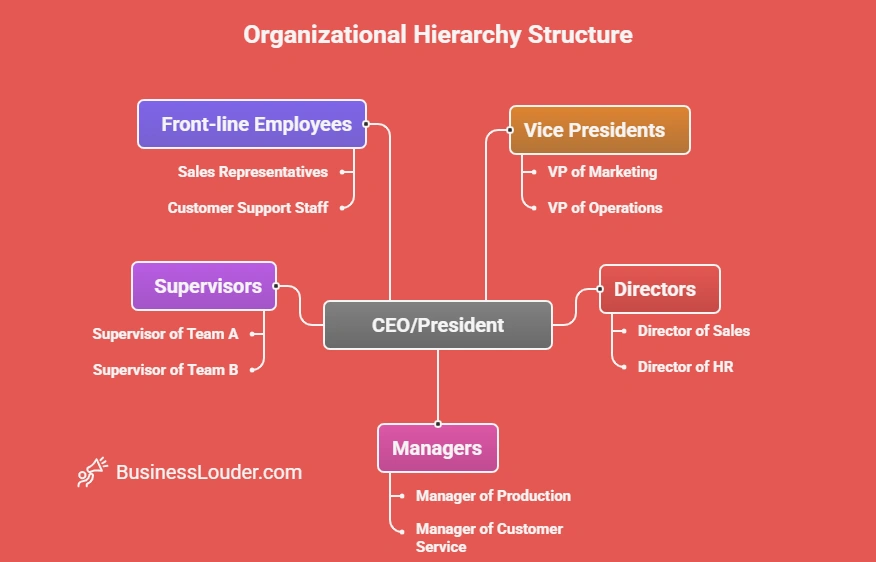
The hierarchical structure features multiple management layers with clearly defined roles, strict reporting relationships, and formalized rules. This traditional “tall” structure emphasizes control, standardization, and clear authority.
Real-World Examples:
Government Organizations include federal agencies with multiple bureaucratic layers, military organizations with strict rank hierarchies, and public universities with defined administrative levels.
Large Traditional Corporations: General Motors (automotive manufacturing), ExxonMobil (oil and gas operations), and JPMorgan Chase (banking and financial services).
Healthcare Systems: Large hospital networks, pharmaceutical companies (regulatory compliance focus).
Strengths:
- Clear Authority – Everyone knows reporting relationships and responsibilities
- Defined Career Paths – Multiple levels provide advancement opportunities
- Specialization – Deep expertise development within narrow roles
- Control and Consistency – Standardized procedures ensure quality
- Large-Scale Management – Effectively manages thousands of employees
- Risk Management – Multiple approval layers prevent costly mistakes
- Stability – Formal structure provides organizational continuity
Weaknesses:
- Slow decision-making due to many layers
- High costs from multiple management levels
- Rigid structure that’s slow to adapt
- Communication barriers and office politics
- Risk of low morale and limited innovation
This structure relates to understanding causes of conflict in organizations and requires strong workers participation in management.
Best For: Big, structured, or heavily regulated organizations that depend on clear authority and well-defined reporting lines.
6. Network (Virtual) Organizational Structure

The network structure outsources major business functions to external partners while maintaining a small core team for strategy and coordination. This creates a web of contractual relationships rather than a traditional hierarchy.
Real-World Examples:
Nike operates with a core focused on Brand management, design, and marketing (76,000 employees) and outsources Manufacturing and distribution (1+ million contract workers), allowing the company to focus on brand while partners handle production.
Apple (partially) maintains core functions in Product design, software development, and retail experience while outsourcing Manufacturing (Foxconn), component production, and assembly.
Alibaba doesn’t own inventory or warehouses but instead operates as a platform connecting buyers and sellers, coordinating a vast network of merchants and logistics providers.
Uber/Airbnb operate with minimal physical assets owned and use a platform business model connecting supply and demand through a network of independent drivers/hosts.
Strengths:
- Flexibility – Quickly reconfigure partnerships based on needs
- Access to Expertise – Tap into specialized capabilities globally
- Lower Fixed Costs – Minimal infrastructure reduces overhead
- Core Competency Focus – Concentrate resources on strategic strengths
- Scalability – Easy expansion without hiring permanent staff
- Innovation Access – Leverage cutting-edge partner capabilities
- Global Reach – Operate internationally without physical presence
- Risk Sharing – Partners share operational and market risks
Weaknesses:
- Loss of Control – Less direct oversight of outsourced functions
- Dependency Risk – Partner failures directly impact your business
- Coordination Complexity – Managing multiple partners is challenging
- Quality Concerns – Maintaining consistent standards across network
- Intellectual Property Risk – Increased exposure to IP theft
- Cultural Differences – Partners may have conflicting values
- Communication Difficulties – Time zones and distance complicate coordination
- Reduced Loyalty – Contractors lack commitment to company mission
Best For: Modern, lean companies that outsource major functions and want a flexible setup that can scale without heavy internal staffing.
7. Team-Based (Circular) Organizational Structure
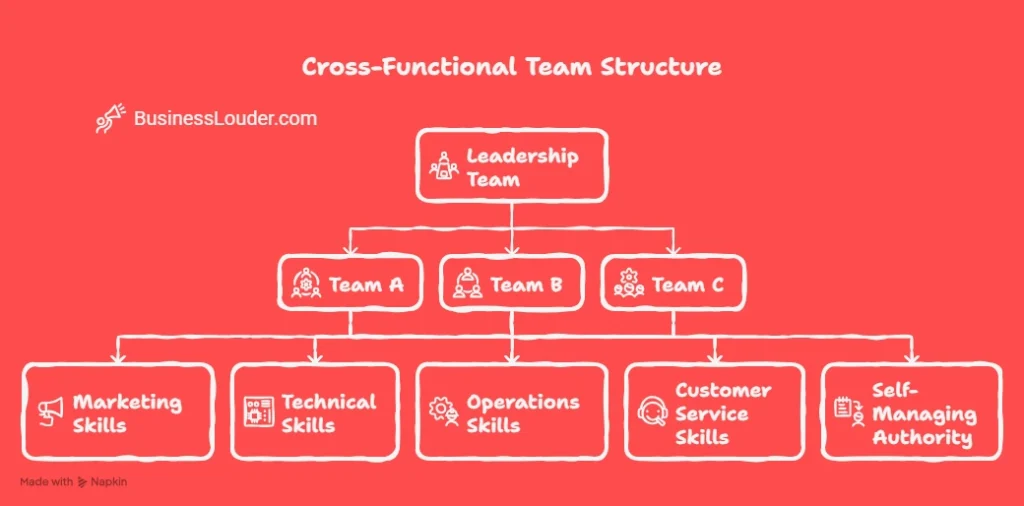
The team-based structure organizes around self-managed, cross-functional teams with decision-making authority and responsibility for complete work processes. Traditional departmental boundaries are eliminated in favor of collaborative pods or squads.
Real-World Examples:
Spotify organizes into small squads (6-12 people per squad) as cross-functional teams with full autonomy, grouped into tribes and connected via guilds, with decentralized decision-making.
Whole Foods Market uses self-managed teams by department in each store where teams make hiring, purchasing, and operational decisions with performance-based team compensation and a democratic team culture with voting rights.
W.L. Gore & Associates (Gore-Tex) employs a lattice structure with small teams, no traditional management hierarchy, leaders who emerge based on follower support, and a team-driven innovation culture.
Strengths:
- Enhanced Collaboration – Cross-functional teams work seamlessly (supported by business communication principles)
- Faster Problem-Solving – Teams make decisions without approvals
- Employee Engagement – Ownership and autonomy increase motivation
- Innovation – Diverse perspectives spark creative solutions
- Customer Focus – Teams own complete customer experience
- Flexibility – Teams adapt quickly to changing priorities
- Skill Development – Members learn multiple disciplines
- Reduced Bureaucracy – Minimal hierarchy speeds action
Weaknesses:
- Coordination Challenges – Aligning multiple autonomous teams
- Inconsistency – Different teams may develop different practices
- Resource Conflicts – Teams compete for shared resources
- Accountability Issues – Collective responsibility can diffuse ownership
- Requires Maturity – Teams need strong interpersonal skills
- Leadership Ambiguity – Unclear authority in leaderless teams
- Not Scalable – Becomes chaotic with too many teams
Best For: Agile and innovative companies where small cross-functional teams need the freedom to build, explore, and move fast.
How to Choose the Right Organizational Structure
Selecting the optimal structure depends on multiple factors:
Key Factors to Consider
Company Size
- Small (under 50): Flat or functional structure
- Medium (50-500): Functional or team-based structure
- Large (500+): Divisional, matrix, or hierarchical structure
Industry and Environment
- Stable industries: Functional or hierarchical structure
- Dynamic industries: Flat, team-based, or matrix structure
- Highly regulated: Hierarchical structure
Strategy and Goals (related to planning and types of planning)
- Cost leadership: Functional structure for efficiency
- Innovation focus: Flat or team-based structure
- Diversification: Divisional structure
- Global expansion: Divisional (geographic) or network structure
Product Complexity
- Single product: Functional structure
- Multiple products: Divisional structure
- Complex projects: Matrix structure
Geographic Spread
- Single location: Functional or flat structure
- Multiple regions: Divisional (geographic) structure
- Global with outsourcing: Network structure
Company Culture (influenced by organizational behavior models)
- Traditional, formal: Hierarchical structure
- Innovative, collaborative: Flat or team-based structure
- Entrepreneurial: Flat or network structure
Hybrid Organizational Structures
Many successful companies combine elements from multiple structures:
Apple uses a hybrid approach with Functional structure at corporate level (design, engineering, operations), Divisional structure for retail stores by geography, and Project teams for new product development (matrix elements).
Amazon combines Divisional structure (AWS, Retail, Devices), Functional structure within divisions, and Team-based structure for innovation (two-pizza teams).
Unilever employs Geographic divisions for different markets, Product categories within regions, and Functional expertise shared across divisions.
Implementing or Changing Organizational Structure
7 Step-by-Step Process
1. Assess Current State
- Analyze existing structure strengths and weaknesses
- Identify pain points and inefficiencies
- Gather employee feedback
2. Define Objectives
- Clarify strategic goals
- Determine what structure should enable
- Set measurable success criteria
3. Design New Structure
- Choose appropriate structure type
- Define reporting relationships
- Establish decision-making authority
- Create clear role descriptions
4. Plan Transition
- Develop implementation timeline
- Identify potential resistance points
- Plan communication strategy
- Arrange training and support
5. Communicate Clearly
- Explain rationale for change (related to functions of communication)
- Address employee concerns
- Provide visual diagrams
- Offer Q&A opportunities
6. Implement Gradually
- Start with pilot departments if possible
- Monitor progress closely
- Adjust based on feedback
- Celebrate early wins
7. Evaluate and Refine
- Measure against success criteria
- Gather ongoing feedback
- Make necessary adjustments
- Document lessons learned
Common Mistakes to Avoid
- Copying competitors without considering your unique needs
- Changing structure too frequently causing organizational chaos
- Ignoring company culture when implementing new structure (understand organizational behavior challenges)
- Failing to communicate the reasons and benefits of change
- Not providing training for new roles and responsibilities
- Choosing complexity when simplicity would work better
- Neglecting to update systems (HR, IT, finance) to support new structure
Frequently Asked Questions
Q: What is the most common organizational structure?
A: The functional structure is most common, especially among small to medium businesses, due to its simplicity and efficiency.
Q: Can a company have multiple organizational structures?
A: Yes, many large companies use hybrid structures, combining elements from different types across divisions or departments.
Q: How often should a company review its organizational structure?
A: Companies should review structure annually or when significant changes occur (rapid growth, new products, market shifts, mergers).
Q: Which organizational structure is best for startups?
A: Startups typically benefit from flat or functional structures that are simple, cost-effective, and allow quick decision-making.
Q: What is the difference between organizational structure and organizational chart?
A: Organizational structure is the overall framework of authority and relationships; an organizational chart is the visual diagram representing that structure.
Q: How does organizational structure affect company culture?
A: Structure significantly influences culture by determining communication patterns, decision-making processes, autonomy levels, and collaboration opportunities. It directly impacts organizational behavior and conflict resolution.
Q: What’s the best structure for innovation?
A: Flat and team-based structures typically foster innovation best through employee empowerment, cross-functional collaboration, and reduced bureaucracy.
Final Thoughts on Choosing an Organizational Structure
Organizational structure is more than boxes and lines on a chart—it’s the foundation that enables your business to function effectively, adapt to change, and achieve strategic goals. The right structure aligns your people, processes, and resources toward common objectives while the wrong structure creates bottlenecks, confusion, and competitive disadvantages.
Whether you’re building a startup, managing a growing business, or leading a large corporation, understanding these seven organizational structure types helps you make informed decisions. Consider your unique circumstances, involve stakeholders in the design process, and remember that structure should evolve as your organization grows and markets change.
Understanding how structure relates to broader management principles, staffing, and organizational behavior ensures you build a sustainable framework for success.
Start by honestly assessing your current structure against your strategic needs. Identify gaps, explore alternatives, and don’t be afraid to experiment with hybrid approaches that capture the best elements of multiple structure types. Ready to optimize your organizational structure? Begin with a comprehensive assessment of your current framework, engage your leadership team in strategic discussions, and take deliberate steps toward a structure that empowers your organization to thrive.