
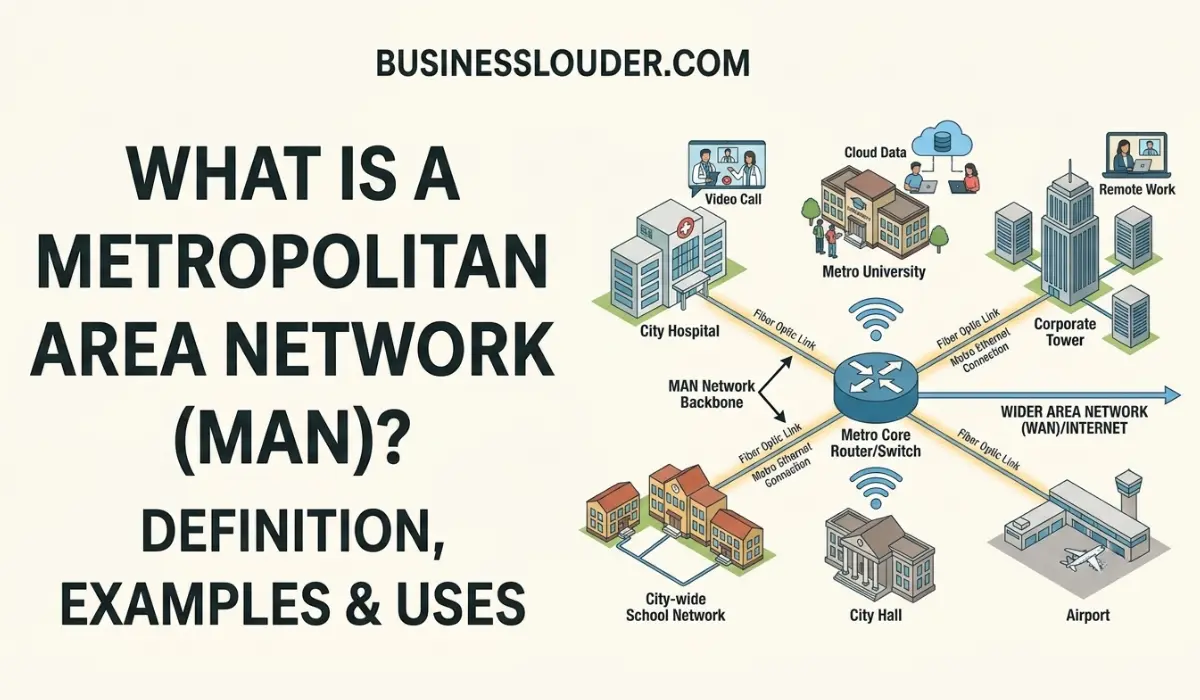
Your office network stops at the front door. The internet spans the planet. But what connects the dozen buildings of a university, a bank’s branches across a city, or an entire town’s cable TV? That in-between layer has a name — the metropolitan area network.
A metropolitan area network (MAN) is a computer network that spans a whole city or metropolitan area — bigger than a single office’s local network (LAN), but smaller than a country-wide network (WAN). It links multiple smaller networks across a city into one, so buildings miles apart can share data as if they were next door.
What Is a Metropolitan Area Network?
A MAN is a network that covers a geographic area roughly the size of a city — typically anywhere from 5 to 50 kilometres across. It’s built to connect several local area networks (LANs) that sit in different parts of the same city, tying them together under one high-speed backbone.
As the networking reference TechTarget puts it, a MAN falls squarely between a LAN and a WAN in size. Think of it as the middle child of computer networks: too big to be a single building’s network, too focused to be a global one. A city government, a university with campuses across town, or an internet service provider will often run one.
How Does a MAN Work?
A MAN works by joining separate LANs together over a shared, high-capacity backbone that runs across the city — usually fibre-optic cable, because it carries huge amounts of data over long distances fast.
Here’s the basic idea. Each building or site has its own LAN. The MAN links those LANs using connecting hardware — routers, switches, and fibre lines — often built on technologies like Metro Ethernet or fibre backbones. One organisation typically owns and manages the whole thing, or leases capacity from a telecom provider. The result: a bank’s downtown headquarters and its branch across the city talk to each other instantly, over a network the bank effectively controls.
LAN vs MAN vs WAN
The easiest way to understand a MAN is to see it beside its neighbours. Computer networks are usually grouped by the area they cover:
| Feature | LAN | MAN | WAN |
|---|---|---|---|
| Covers | One building or site | A city or metro area | A country or the globe |
| Typical range | Up to ~1 km | ~5–50 km | Hundreds to thousands of km |
| Owned by | One organisation | One org or an ISP | Multiple parties / telecoms |
| Speed | Very high | High | Lower over distance |
| Example | An office network | A city cable network | The internet |
In one line: a LAN is a room, a MAN is a city, and a WAN is the world. A MAN is often the bridge that connects an organisation’s local networks before they ever reach the wider WAN.
Examples of a Metropolitan Area Network
MANs are all around you, even if you never see them:
- Cable TV networks — the classic MAN, wiring an entire city’s homes to one provider.
- City-wide Wi-Fi — public wireless networks that blanket a downtown or campus.
- University networks — connecting multiple campuses and buildings spread across a city.
- Bank and business branch networks — linking a company’s offices throughout a metro area.
- Government and smart-city networks — tying together traffic systems, offices, and public services across a city.
Advantages of a MAN
- Wide coverage — connects an entire city under one network, far beyond what a LAN can reach.
- High speed — fibre backbones move large volumes of data quickly between sites.
- Centralised management — one organisation can run and secure the whole network, keeping it consistent.
- Efficient resource sharing — offices across the city share data, systems, and internet access seamlessly.
- Cheaper than many WANs — for city-scale needs, a MAN is often more cost-effective than stitching together wide-area links.
Disadvantages of a MAN
- Expensive to set up — laying fibre across a city and buying the hardware costs a lot up front.
- Complex to manage — a city-wide network needs skilled staff to run and maintain it.
- Security challenges — the more sites and users connected, the larger the surface to protect.
- Harder to scale — extending a MAN beyond the city edges toward WAN territory adds cost and complexity fast.
For any organisation running one, a MAN is a serious piece of infrastructure — the kind of backbone that quietly powers everything from a city’s e-business operations to the tools behind AI in business. And like any network, it only delivers value when the information moving across it flows the right way — the same principle behind a well-designed communication network.
Frequently Asked Questions
What is a metropolitan area network in simple words?
It’s a computer network that covers a whole city. It connects many smaller local networks (LANs) across the metro area into one, so sites miles apart can share data quickly — bigger than an office LAN, smaller than a country-wide WAN.
What is the difference between a MAN and a WAN?
A MAN covers a single city (about 5–50 km) and is usually run by one organisation or ISP. A WAN covers a country or the whole world, spans much longer distances, and is typically built from many providers’ networks — the internet is the biggest WAN.
What is an example of a MAN?
A city’s cable television network is the classic example. Others include city-wide public Wi-Fi, a university connecting campuses across a city, and a bank linking its branches throughout a metro area.
Is a MAN wired or wireless?
It can be either, and often both. Most MANs use fibre-optic cable for their high-speed backbone, but city-wide Wi-Fi and wireless links are also common ways to extend coverage across a metro area.
The Network That Runs Your City
A metropolitan area network is the layer most people never think about — the invisible backbone that connects a city’s buildings, campuses, and services into one fast, shared system. Sitting neatly between the local network in your office and the global reach of the internet, it’s what makes city-scale connectivity possible.
So the next time your city’s cable, public Wi-Fi, or a company’s cross-town offices just work, you’ll know what’s underneath: a MAN, quietly doing the job of tying a whole metropolis together.