Within the giant and tricky panorama of commercial enterprise and organizational management, a perennial and perception-scary debate keeps captivating the minds of students, practitioners, and theorists alike: Is management an art or science?
Let’s explore the controversy, Is management an art or science?
Exploring the Controversy: Is Management an Art or Science
This ancient controversy, filled with contradictory philosophies and views, has inspired intense discussions inside the field of academia and corporate governance.
In this sizable exploration, we delve into the multifaceted dimensions of management, dissecting it as each a technology and an art. Our venture is to illuminate the charming duality inherent in control, demonstrating its capacity to be effectively regarded as both a technology and an artwork, instead of being rigidly pigeonholed into a single category.
Management as Science
A Scientific and Based Paradigm
Viewed via the lens of technological know-how, control assumes the mantle of a scientific and dependent area. Managers, in this context, are similar to scientists, carrying out methodical experiments with variables which include sources, time, and human capital.
They acquire data, scrutinize traits, and formulate hypotheses to force the delivery of organizational success. This scientific method ensures that managerial decisions are grounded in rationality and substantiated by using empirical proof.
Within the annals of management history, luminaries including Frederick Taylor, the proponent of scientific management, take center level. Taylor championed the concept of dissecting painting methods into their smallest additives and optimizing every aspect for efficiency. His time and motion studies sought to do away with inefficiencies and redundancies, imparting a dependent framework for agencies to thrive.
The Pervasive Role of Information Analytics
In today’s fast-paced and statistics-wealthy commercial enterprise landscape, information analytics has emerged as a cornerstone of managerial methods. Cutting-edge technologies and facts-driven equipment empower managers to resolve complex commercial enterprise challenges, hit upon patterns, and forecast future traits.
The infusion of records analytics transforms control right into technology by furnishing irrefutable proof to strengthen strategic selections. This analytical method endows businesses with the agility to hastily adapt to the ever-transferring sands of market dynamics, securing an aggressive facet.
Furthermore, the arrival of artificial intelligence (AI) and gadget studying machine learning (ML) has ushered in a new technology of statistics analytics control. These technologies own the potential to manner significant datasets at unprecedented speeds, unearthing insights that previously lay hidden.
As an example, predictive analytics leverages AI and ML to forecast marketplace developments with a diploma of precision that changes as soon as taken into consideration unimaginable, permitting agencies to recalibrate their techniques preemptively.
Management as an Art
The Human Element in Management
In stark contrast to the based technique of science, the artwork of control accentuates the human element. Talented managers,
in this context, resemble achieved artists, adept at comprehending and harmonizing the multifaceted tapestry of personalities, talents, and aspirations that compose their group. This artistry manifests in the cultivation of collaboration, motivation, and innovation in the organizational milieu.
The human-centric technique of management reveals embodiment in concepts like servant management, championed using Robert K. Greenleaf.
This philosophy underscores the chief’s role as a servant to their group, prioritizing the needs and well-being of personnel. It engenders empathy, instils a sense of network, and promotes a nurturing environment in the agency.
The Intangible energy of instinct and Creativity
suave managers depend on their instinct and creativity to navigate the frequently unpredictable terrain of the enterprise. Their decisions amplify past the confines of data and facts, guided by an acute understanding of human conduct and the subtle nuances of interpersonal relationships. This innovative facet of management is the crucible wherein exquisite leaders are forged.
In the realm of suave control, leadership styles along with transformational leadership take center stage. Transformational leaders inspire and inspire their teams via a shared vision and charismatic presence. They foster innovation and dare to project the reputation quo, nurturing a culture of continuous improvement inside the enterprise.
Management as both Science and Art
Accomplishing Synergy: the marriage of technological know-how and art
Even as the dichotomy of science versus art in control endures, astute managers apprehend the inherent fee in harmonizing both paradigms. Management, while practiced in its full beauty, emerges as a symphony of clinical precision and inventive finesse. It represents the right amalgamation of records-pushed selection-making and empathetic leadership.
This synergy isn’t a novel concept. Control trailblazer Henri Fayol underscored the significance of melding technical and human skills for effective management. Fayol delineated five features of control: planning, organizing, commanding, coordinating, and controlling.
Even as these functions offer the clinical scaffolding of control, Fayol additionally emphasized the significance of interpersonal abilities inside the managerial toolkit.
Conclusion
In summation, the controversy encircling the nature of control, whether is management an art or science, no longer joins a binary proposition. As a substitute, it beckons us to acknowledge the multifaceted and dynamic individual of the managerial position.
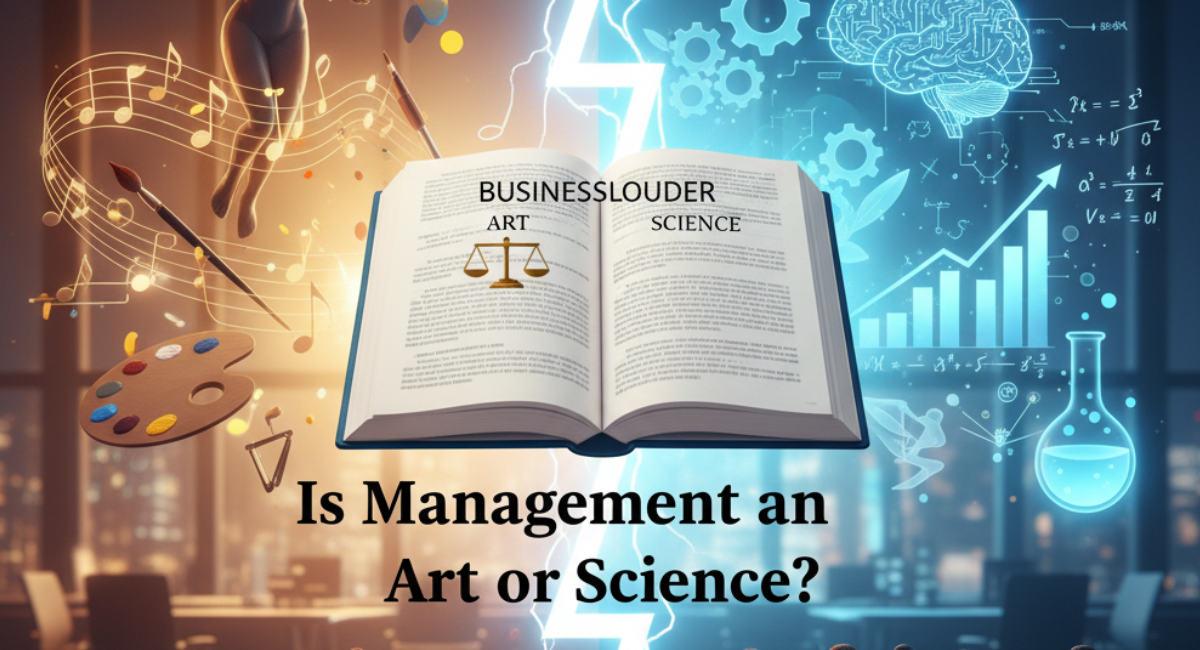
Effective management necessitates a judicious blend of clinical rigout and artistic finesse, as depicted in the synergy diagram above. By embracing both dimensions, businesses can nurture innovation, foster adaptability, and lay the muse for enduring fulfilment.
The true essence of control is living with the capability to strike a harmonious stability between information-driven evaluation and the cultivation of a thriving, stimulated team of workers. This holistic technique not only ensures the conclusion of organizational targets but also enriches the expert lives of personnel, rendering control an ever-evolving and captivating odyssey that maintains to shape the contours of the enterprise panorama.
In this era marked by unceasing trade and technological development, the call for managers able to traverse the geographical regions of analytics and human engagement has in no way been extra urgent.
As organizations try to stay competitive and applicable, they ought to include the notion that management is each an art and a science—an elegant choreography of empirical evidence and the profound artistry of human connection. In doing so, they can free up their complete ability and ascend above their competitors in the ever-evolving commercial enterprise arena.
Armed with this complete comprehension of the duality of control, you stand prepared to navigate the complicated challenges of leadership, drawing proposals from the rich tapestry of both science and art to excel in your managerial exploits.
Read More: