When Amazon entered the pharmacy business in 2018, analysts struggled to categorise it. Was it retail? Healthcare? Technology? Logistics? The answer was all four — and that confusion revealed something important: understanding business vertical classification categories is not just an academic exercise. It is a strategic decision that shapes how you compete, how investors evaluate you, and how customers trust you. It sits at the heart of sound business management
This guide breaks down what business verticals are, how the three major US classification systems work, the ten core business vertical classification categories with real data behind each, and how to find the right vertical for your business.
What Is a Business Vertical?
A business vertical — also called a vertical market — is a specific industry segment in which companies offer specialised products or services to a defined customer base with shared needs, challenges, and regulatory environments.
Every business within a vertical competes for the same type of customer, faces similar operational challenges, and gets benchmarked against comparable peers.
Simple definition: A business vertical is the industry lane your company operates in.
A hospital management software company operates in the healthcare vertical. A platform selling accounting tools to restaurants, law firms, and retailers operates in a horizontal market — it crosses multiple verticals rather than specialising in one.
Business vertical classification categories are the structured systems used to group and label those verticals so that analysts, investors, regulators, and businesses can speak the same language.
Business Vertical vs. Horizontal Market
| Vertical Market | Horizontal Market | |
| Scope | One specific industry | Multiple industries |
| Specialisation | Deep, domain-specific | Broad, generalist |
| Pricing Power | Higher — expertise commands premium | Lower — competing on breadth |
| Customer Trust | Faster — shared industry language | Slower — must prove relevance |
| Example | Cybersecurity firm for banks only | Microsoft Office — used everywhere |
How you define your vertical is also the first step in any serious market segmentation strategy. According to Research and Markets, the global vertical market software industry is projected to grow from $172.51 billion in 2025 to $195.12 billion in 2026 at a CAGR of 13.1% — driven by increasing demand for industry-specific solutions that horizontal platforms cannot match.
Why Vertical Classification Matters
Market positioning: Customers immediately understand what you do and who you serve when you clearly occupy a vertical.
Investment and funding: Investors evaluate companies against vertical-specific benchmarks — growth rates, churn, and TAM all look different by vertical.
Regulatory compliance: Healthcare businesses navigate HIPAA. Financial services firms deal with SEC and CFPB. Knowing your vertical tells you which rules apply before you build the wrong product.
Government contracting: According to the US Census Bureau, NAICS codes are legally required for all federal contracting solicitations and directly determine SBA loan eligibility.
Marketing efficiency: Vertical-specific messaging consistently outperforms generic messaging in conversion rates and customer acquisition cost.
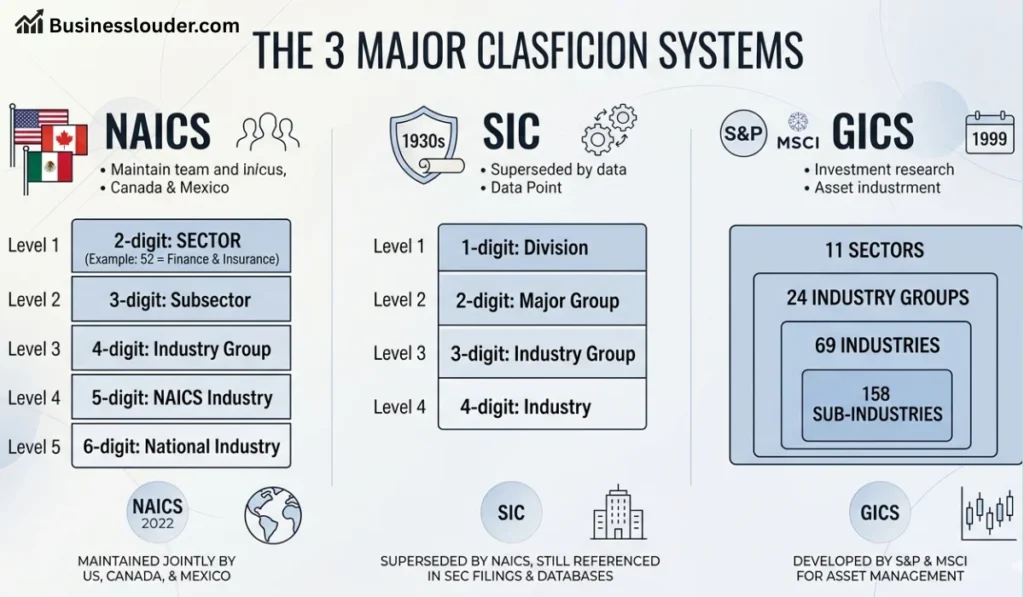
The 3 Major Classification Systems
NAICS — North American Industry Classification System
The standard used by all US federal statistical agencies, maintained jointly by the US, Canada, and Mexico. According to the US Census Bureau, NAICS uses a 6-digit code structure across 20 sectors and is updated every five years — the current edition is NAICS 2022, with a 2027 revision in development.
- 2-digit code = Sector (e.g., 52 = Finance and Insurance)
- 3-digit code = Subsector (e.g., 522 = Credit Intermediation)
- 4-digit code = Industry Group
- 5-digit code = NAICS Industry
- 6-digit code = National Industry — most specific level
Why it matters: NAICS codes appear on government contracts, SBA loan applications, tax filings, and industry research. Every US business should know its code.
SIC — Standard Industrial Classification
Introduced in the 1930s and officially superseded by NAICS in 1997, SIC codes remain widely referenced in SEC filings, legacy financial systems, and older databases. SIC uses a 4-digit structure across 11 industry divisions. According to the Bureau of Labor Statistics, familiarity with both systems remains practically useful.
Why it still matters: Many banking systems, legal platforms, and federal programmes still reference SIC for historical data comparability.
GICS — Global Industry Classification Standard
Developed in 1999 by S&P Dow Jones Indices and MSCI for investment research and asset management. GICS organises markets into 11 sectors, 24 industry groups, 69 industries, and 158 sub-industries.
Why it matters: If you are seeking investment, planning an IPO, or benchmarking against publicly traded competitors, GICS is the framework your investors are using.
Top 10 Core Business Vertical Classification Categories
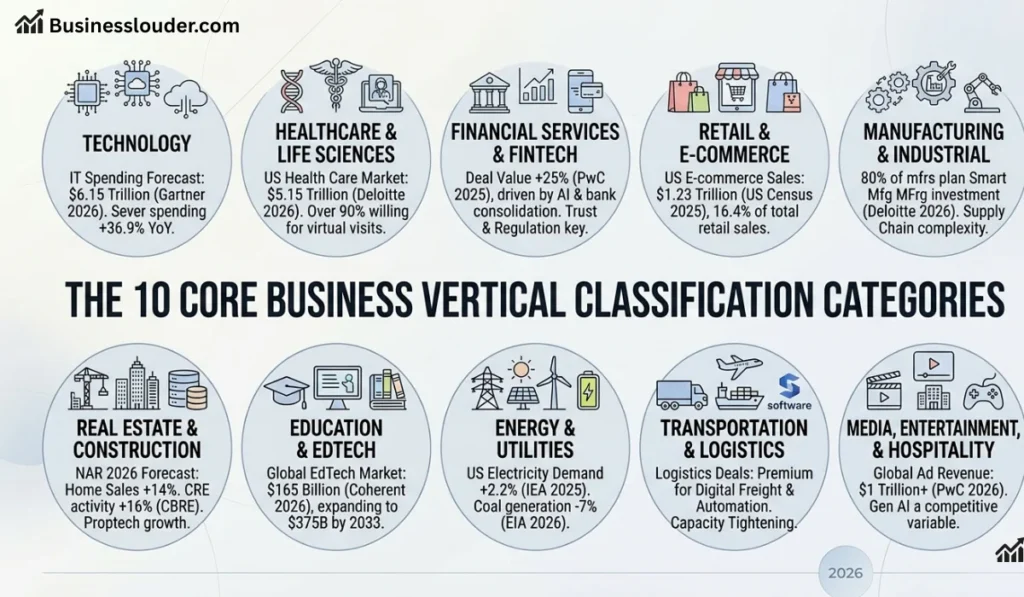
1. Technology
What it covers: Hardware, software, cloud, cybersecurity, AI, semiconductors, consumer electronics.
Key sub-verticals: SaaS, cybersecurity, cloud infrastructure, artificial intelligence, semiconductors.
2026 data: According to Gartner’s February 2026 IT Spending Forecast, worldwide IT spending is projected to reach $6.15 trillion in 2026, up 10.8% from 2025. Server spending alone is forecast to grow 36.9% YoY, driven by AI infrastructure investment.
Key characteristics: Fast innovation cycles, high scalability, IP-driven value, and especially as artificial intelligence in business accelerates across every sector.
2. Healthcare and Life Sciences
What it covers: Pharmaceuticals, biotech, medical devices, hospital systems, health technology, managed care.
Key sub-verticals: Pharma and biotech, medical devices and diagnostics, healthtech platforms, insurance and managed care.
2026 data: According to Deloitte’s 2026 US Health Care Outlook, more than 90% of consumers who had a virtual health visit would be willing to have another, and 37% of consumers use monitoring devices for health conditions. The US healthcare market is valued at $4.87 trillion in 2025, estimated to reach $5.15 trillion in 2026.
Key characteristics: Long sales cycles, strict FDA and HIPAA compliance, high switching costs, and accelerating AI adoption in diagnostics and administration.
3. Financial Services and Fintech
What it covers: Retail and commercial banking, investment management, insurance, payments, lending, wealthtech.
Key sub-verticals: Commercial banking, fintech platforms, insurtech, payments infrastructure, private credit.
2026 data: According to PwC’s 2026 Banking and Capital Markets Deals Outlook, six US fintech IPOs raised approximately $3.2 billion in 2025 — the highest level in at least a decade. Global financial services deal value increased 25% in 2025, driven by bank consolidation and AI-led transformation.
Key characteristics: Heavy regulation (SEC, FDIC, CFPB), trust-dependent customer relationships, AI at the top of investment priorities, and significant fintech disruption across every sub-vertical.
4. Retail and E-Commerce
What it covers: Physical retail, e-commerce, DTC, marketplaces, grocery, luxury.
Key sub-verticals: Omnichannel retail, direct-to-consumer (DTC), marketplace platforms, FMCG, fashion and luxury.
2026 data: According to the US Census Bureau’s Q4 2025 E-Commerce Report, US retail e-commerce sales totalled $1.23 trillion in 2025, up 5.4% from 2024, accounting for 16.4% of total retail sales.
Key characteristics: Thin margins in traditional retail, intense price competition, high logistics dependence, and the continued shift from traditional retail toward full e-business models.
5. Manufacturing and Industrial
What it covers: Automotive, aerospace and defence, industrial machinery, consumer goods, food and beverage production.
Key sub-verticals: Automotive manufacturing, aerospace and defence, industrial equipment, consumer goods, advanced materials.
2026 data: According to Deloitte’s 2026 Manufacturing Industry Outlook, 80% of manufacturers plan to invest at least 20% of their improvement budgets in smart manufacturing initiatives in 2026. Over 78% cited trade uncertainty as their top concern heading into the year.
Key characteristics: High capital expenditure, complex global supply chains, growing automation investment, and significant exposure to tariff and trade policy shifts.
6. Real Estate and Construction
What it covers: Residential real estate, commercial real estate, proptech, construction, REITs.
Key sub-verticals: Residential housing, commercial property (office, industrial, multifamily), proptech platforms, construction and contracting.
2026 data: According to NAR’s 2026 Housing Forecast, existing home sales are projected to rise 14% in 2026. CBRE’s 2026 US Real Estate Outlook forecasts commercial real estate investment activity will increase 16% to $562 billion.
Key characteristics: Highly sensitive to interest rates, location-dependent, long project cycles, and data centre demand creating a structural tailwind for industrial property.
7. Education and EdTech
What it covers: K-12 education, higher education, corporate learning, EdTech platforms, professional certification.
Key sub-verticals: K-12 digital tools, higher education platforms, corporate learning and development, professional certification.
2026 data: According to Coherent Market Insights’ January 2026 EdTech Report, the global EdTech market is expected to reach $165 billion in 2026, expanding to $375 billion by 2033 at a 13% CAGR.
Key characteristics: Mission-driven, accreditation requirements, long customer relationships, and permanent structural shift toward hybrid and digital delivery since 2020.
8. Energy and Utilities
What it covers: Oil and gas, renewable energy, electric utilities, energy storage, cleantech.
Key sub-verticals: Oil and gas exploration, solar and wind energy, electric utilities, battery storage, nuclear power.
2026 data: According to the IEA’s Electricity Mid-Year Update 2025, US electricity demand growth is projected at 2.2% in 2026 — more than double the average of the past decade, driven primarily by data centre expansion. The EIA’s March 2026 Short-Term Energy Outlook forecasts US coal generation declining 7% in 2026 as renewables increase.
Key characteristics: Capital intensive, heavily regulated, long asset life cycles, and a structural shift toward clean energy creating both disruption and investment opportunity.
9. Transportation and Logistics
What it covers: Freight and trucking, last-mile delivery, supply chain management, aviation, rail.
Key sub-verticals: Truckload and LTL freight, intermodal logistics, last-mile delivery, supply chain software, aviation.
2026 data: According to PwC’s Transportation and Logistics Deals 2026 Outlook, M&A activity is accelerating around technology-led platforms with premium valuations going to digital freight marketplaces and automation providers. C.H. Robinson’s 2026 Freight Market Outlook revised truckload spot rate growth to approximately 8% YoY for 2026.
Key characteristics: Margin-sensitive, fuel cost exposure, high labour dependency, capacity tightening after a prolonged freight downcycle, and strong tailwinds from e-commerce volume growth.
10. Media, Entertainment, and Hospitality
What it covers: Streaming and digital media, gaming, film and music, hotels and travel, restaurants.
Key sub-verticals: Streaming platforms, gaming, live events and sports, hotel and travel, food service.
2026 data: According to PwC’s Global Entertainment and Media Outlook 2025-2029, global advertising revenue is projected to top $1 trillion in 2026, with the global E&M industry on track to reach $3.5 trillion by 2029. Deloitte’s 2026 Media and Entertainment Industry Outlook identifies gen AI as the defining competitive variable for the sector in 2026.
Key characteristics: Consumer sentiment-driven, high content production costs, AI reshaping production and distribution, and premium experience demand driving hospitality M&A activity.
Emerging Verticals in 2026
The clean boundaries between traditional verticals are blurring. Three categories are growing fast but do not yet have established NAICS or GICS classification codes.
Vertical AI: Unlike general-purpose AI, vertical AI companies build models for specific industries — legal, medical, financial. This sub-vertical is attracting a disproportionate share of venture capital and commanding AI valuation premiums across sectors.
Climate Tech: Spanning energy, manufacturing, agriculture, and real estate, climate tech defies single-vertical classification. According to the World Economic Forum’s 2026 Energy Outlook, global clean energy investment hit a record $2.2 trillion in 2025 — with two-thirds of every energy dollar now flowing to cleaner technologies.
Creator Economy: Content creators, platforms, monetisation tools, and creator-focused financial services form a distinct emerging vertical that barely existed five years ago and has no official classification code yet.
How to Find Your Business Vertical
Step 1: Follow the revenue. Which industry generates the majority of your revenue? That is your primary vertical.
Step 2: Identify your most specialised offering. What do you do that is specifically designed for a particular industry? That specialisation points to your true vertical.
Step 3: Look at your best customers. Who are your highest-value customers? This is essentially a market segmentation exercise applied to your existing base. What industry are they in?
Step 4: Look at your real competitors. Who do you compete against in active sales processes? Those competitors define your vertical more accurately than any self-applied label.
Step 5: Find your NAICS code. Go to census.gov/naics and look up your code. If one fits cleanly, you have your vertical. If you split between two, you likely operate in a horizontal market with vertical specialisation opportunities ahead.
Step 6: Reassess annually. NAICS updates every five years and your business evolves. Treat it like any strategic decision-making process — structured, evidence-based, and revisited regularly.
Common Classification Mistakes to Avoid
Choosing prestige over accuracy. Calling yourself a technology company when you are a services company in a tech-adjacent field t also leads directly to a misaligned organisational structure — both mistakes compound each other.
Ignoring sub-verticals. “Healthcare” is a vertical. “Healthcare technology for rural hospital networks” is a sub-vertical — and the specificity is a competitive advantage, not a limitation.
Classifying by product instead of by customer. Your vertical is defined by who you serve, not what you build. A software company building tools exclusively for insurance adjusters is in the insurance vertical, not the software vertical.
Never revisiting your classification. A company that started in retail and now generates 70% of its revenue from logistics technology is no longer a retail company. Classification should reflect current reality, not history.
Frequently Asked Questions
What is a business vertical classification category?
A structured grouping of companies that operate in the same industry or serve the same type of customer, used by businesses, investors, and regulators to organise the economy into comparable segments for analysis, reporting, and strategic decision-making.
What is the difference between a vertical and a horizontal market?
A vertical market focuses on one industry with tailored products and deeper customer relationships. A horizontal market serves multiple industries with generalist solutions and higher volume but lower per-customer depth.
What is NAICS and why does it matter?
NAICS is the North American Industry Classification System — the standard for all US federal statistical agencies. It determines eligibility for government contracts, SBA loans, and industry benchmarking. Find your code at census.gov/naics.
What is the difference between NAICS and SIC codes?
SIC was the original US classification system, replaced by NAICS in 1997. NAICS is more detailed and covers modern industries more accurately. SIC still appears in SEC filings, older financial databases, and legal documents.
Can a business operate in more than one vertical?
Yes. Large companies like Amazon and Google operate across multiple verticals simultaneously. For smaller businesses, vertical focus typically produces better positioning, more efficient marketing, and stronger customer trust.
How often should I review my vertical classification?
At least annually, or whenever your product offering, customer base, or revenue mix changes significantly.
Final Thoughts
Business vertical classification categories are the strategic framework through which markets organise themselves, investors evaluate opportunity, and businesses find their strongest competitive position.
The companies that consistently win in their markets share three things: clarity about which vertical they serve, depth of expertise in that vertical’s specific challenges, and the discipline to resist trying to serve everyone.
Know your vertical. Own it. Build everything — your product, your marketing, your hiring, your strategy — around the specific needs of the customers inside it.
That is not just classification. That is competitive advantage.