Communication is the backbone of all human interaction. Whether you’re leading a team, negotiating with clients, or delivering presentations, mastering effective communication skills and professional communication techniques determines your success. The 7Cs of Communication provide a simple framework to craft clear, persuasive, and compelling messages that resonate in business and personal settings.
This guide explores each principle in depth with practical examples. Whether you’re focused on types of communication, communication process optimization, or improving your communication skills, these 7Cs apply everywhere.
What are the 7 C’s of Communication?
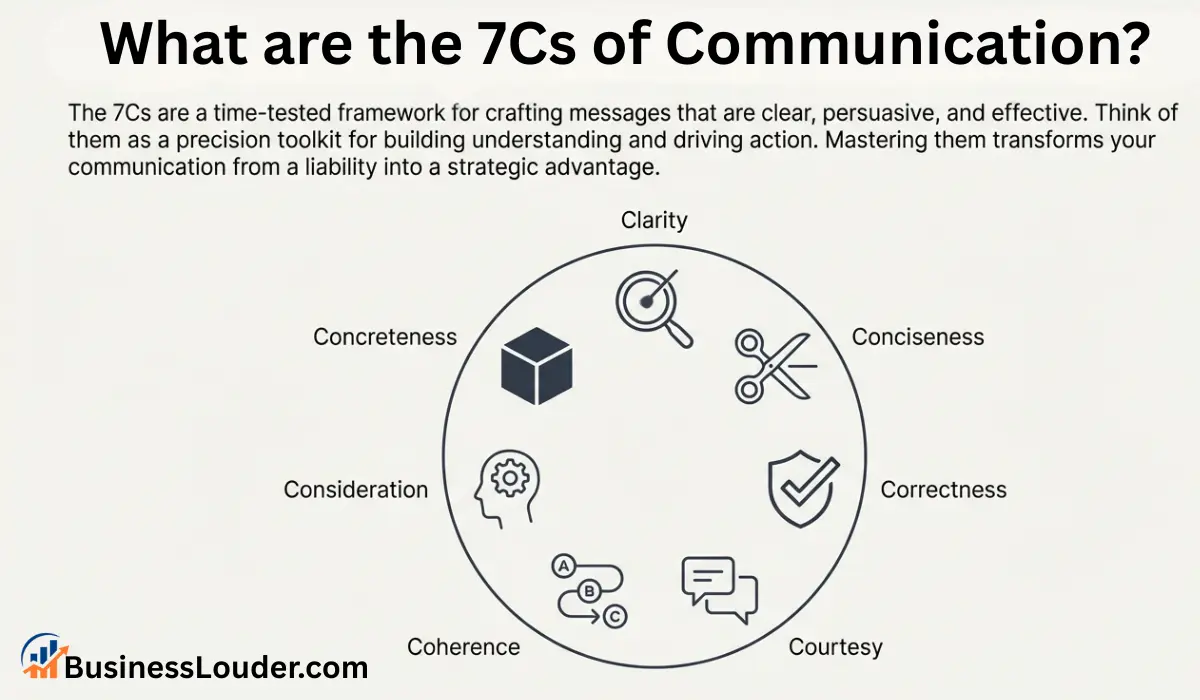
The 7Cs of communication framework consists of seven fundamental principles that transform ordinary messages into powerful communication. These principles are Clarity, Conciseness, Correctness, Courtesy, Coherence, Consideration, and Concreteness. When applied together, they create communication that achieves its intended purpose.
These 7Cs work across all types of communication—whether you’re doing written communication, presentations, meetings, or one-on-one conversations. Understanding the communication process behind each principle helps you apply them more effectively in any business communication situation.
1. Clarity: Making Your Message Unmistakable
Clarity—meaning the quality of being clear and easy to understand—is the foundation of effective communication. It means expressing your ideas in a way that your audience can easily understand without confusion or ambiguity. It’s about choosing simple, straightforward language and structuring your thoughts logically.”
Why Clarity Matters
When your message is unclear, your audience wastes time trying to figure out what you mean. This creates frustration, leads to mistakes, and damages your credibility. Clear communication, on the other hand, builds trust and moves projects forward faster.
Real-World Example: Sales Manager to Team
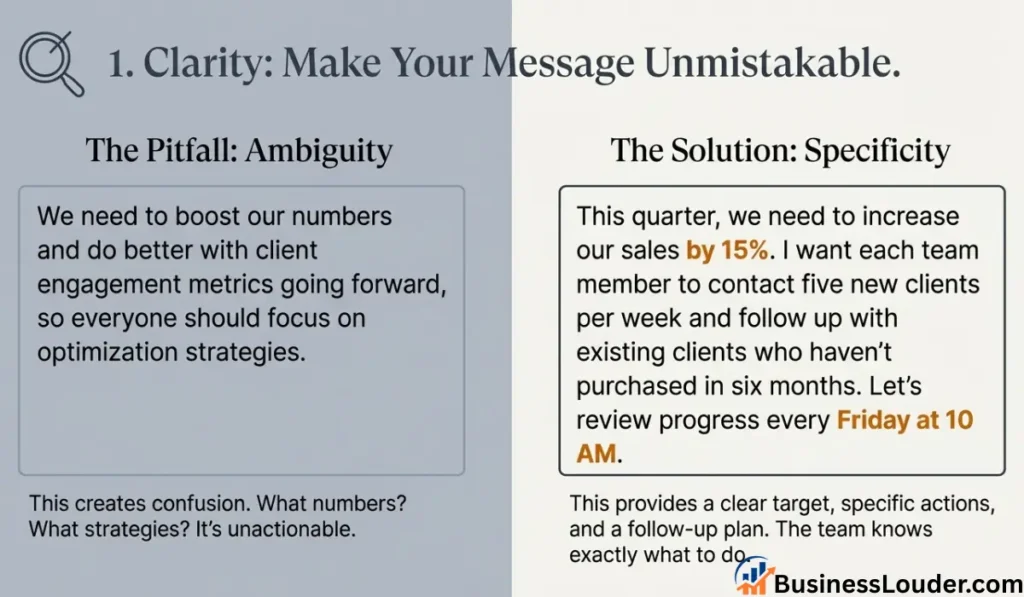
Unclear: “We need to boost our numbers and do better with client engagement metrics going forward, so everyone should focus on optimization strategies.”
Clear: “This quarter, we need to increase our sales by 15%. I want each team member to contact five new clients per week and follow up with existing clients who haven’t purchased in six months. Let’s review progress every Friday at 10 AM.”
The second version removes jargon, specifies exactly what “boost our numbers” means, and outlines concrete actions. Your team knows exactly what to do.
How to Achieve Clarity
- Use simple, everyday language instead of technical jargon when your audience isn’t familiar with the terminology
- Break complex ideas into smaller, digestible parts
- Define specialized terms when they’re necessary
- Use concrete examples rather than abstract concepts
- Ask yourself: “Would a smart person who knows nothing about this topic understand my message?”
2. Conciseness: Respecting Your Audience’s Time
Conciseness—being concise and saying what needs to be said—is one of the most underrated 7Cs of communication. It’s the art of eliminating unnecessary words while keeping your message complete and meaningful.
Why Conciseness Matters
People are busy. Every extra word you include competes for attention and risks losing your audience entirely. Concise communication shows respect for people’s time and increases the likelihood they’ll actually read, listen to, or act on your message.
Real-World Example: Project Update Email
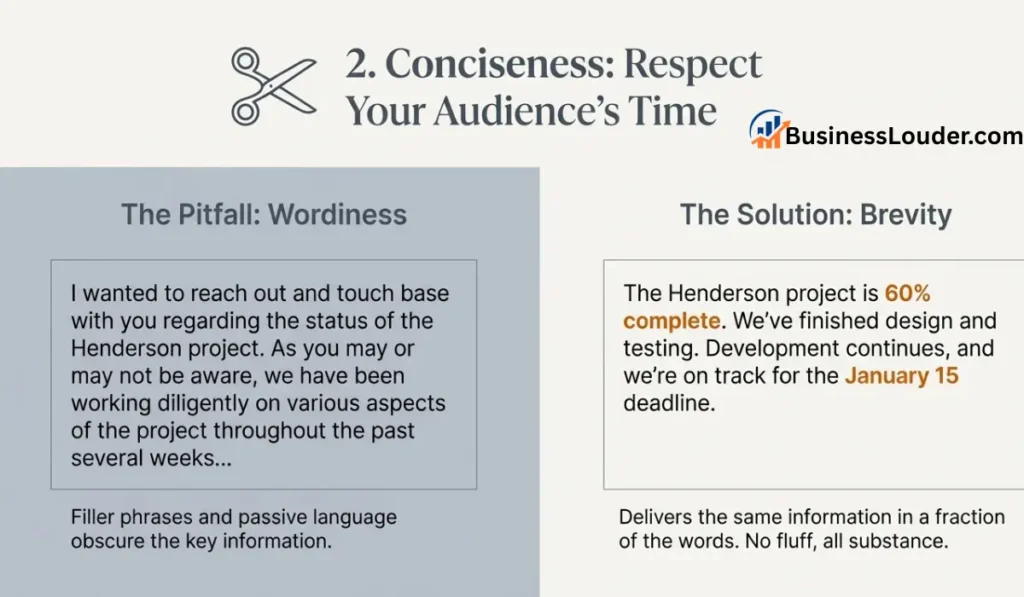
Too Wordy: “I wanted to reach out and touch base with you regarding the status of the Henderson project. As you may or may not be aware, we have been working diligently on various aspects of the project throughout the past several weeks. The team has been making progress in multiple directions, and there are several updates that I think would be beneficial for you to be aware of at this time.”
Concise: “The Henderson project is 60% complete. We’ve finished design and testing. Development continues, and we’re on track for the January 15 deadline.”
The concise version delivers the same information in a fraction of the words. No fluff, all substance.
How to Achieve Conciseness
- Write first, then edit ruthlessly—remove every word that doesn’t add meaning
- Avoid filler phrases like “in my opinion,” “I think,” “it seems like,” and “kind of/sort of”
- Use active voice instead of passive voice (it’s usually shorter)
- Replace long phrases with single words when possible (“because” instead of “due to the fact that”)
- Read your message aloud—if it sounds wordy, it probably is
3. Correctness: Building Trust Through Accuracy
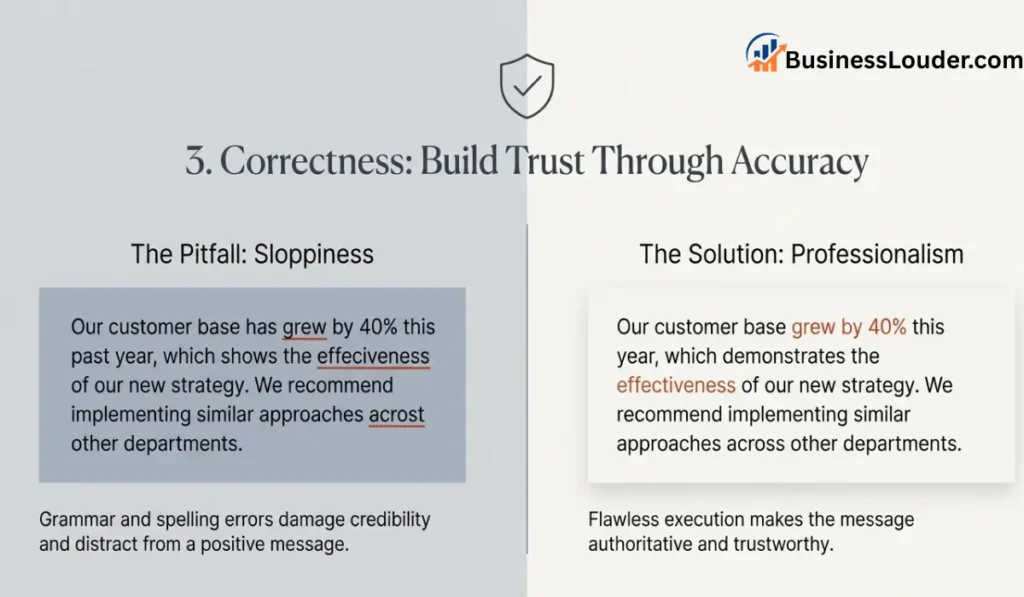
Correctness means ensuring that your facts are accurate, your grammar is right, and your spelling is perfect. It’s about doing your homework and presenting information you can stand behind.
Why Correctness Matters
One spelling error or factual mistake can damage your credibility far more than the incorrect word itself. People judge you not just on what you say, but on how carefully you’ve said it. Correct communication shows professionalism and builds confidence in your message.
Real-World Example: Marketing Campaign Brief
Incorrect: “Our customer base has grew by 40% this past year, which shows the effeciveness of our new strategy. We recommend implementing similar approaches acrost other departments.”
Correct: “Our customer base grew by 40% this year, which demonstrates the effectiveness of our new strategy. We recommend implementing similar approaches across other departments.”
The first version has multiple errors that undermine the otherwise positive message. The corrected version sounds authoritative and trustworthy.
How to Achieve Correctness
- Verify all statistics, dates, names, and facts before sharing them
- Use grammar and spell-check tools, but don’t rely on them entirely
- Have someone else review important communication before you send it
- When presenting data, include your sources
- If you discover an error after sending something, correct it promptly and acknowledge the mistake
- Double-check contact information, addresses, and specific details
4. Courtesy: Building Relationships Through Respect
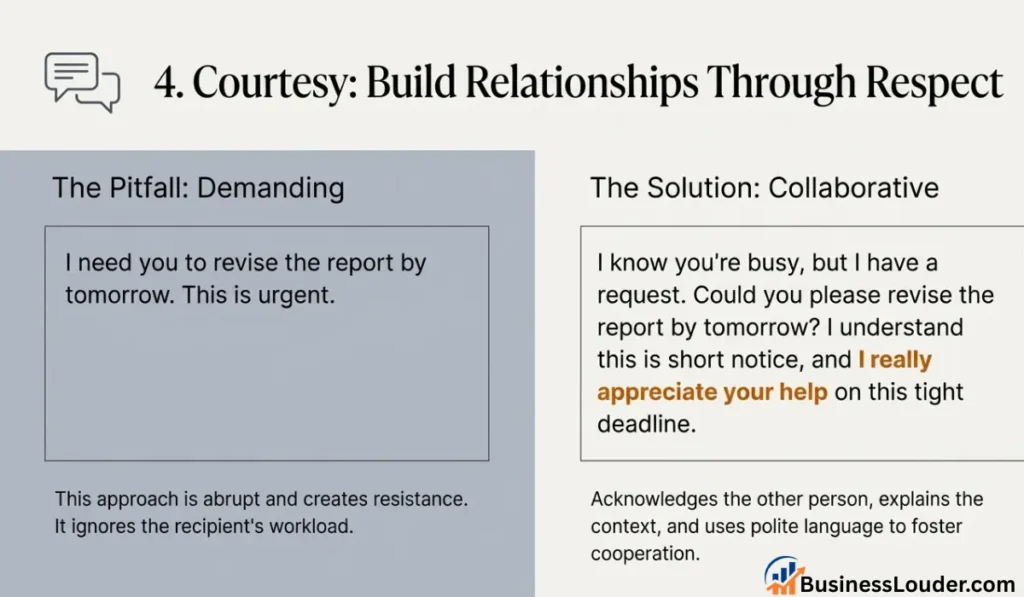
Courtesy—being courteous and respectful—means treating your audience with genuine respect, acknowledging their perspective, and maintaining a professional, friendly tone even when discussing disagreements or delivering bad news.”
Why Courtesy Matters
Courtesy doesn’t just make communication pleasant—it makes people more receptive to your message. People are more likely to help someone who treats them with respect, and they’re more willing to forgive mistakes from someone who’s been courteous to them.
Real-World Example: Requesting a Favor
Discourteous: “I need you to revise the report by tomorrow. This is urgent.”
Courteous: “I know you’re busy, but I have a request. Could you please revise the report by tomorrow? I understand this is short notice, and I really appreciate your help on this tight deadline.”
The second version acknowledges the other person’s time, explains why the request matters, and thanks them. It opens the door to cooperation rather than creating resistance.
How to Achieve Courtesy
- Use “please,” “thank you,” and “I appreciate” genuinely and frequently
- Acknowledge the other person’s perspective or constraints
- Avoid accusatory language—use “I noticed” instead of “You failed to”
- Give people the benefit of the doubt
- Deliver criticism privately, never in front of others
- When you make a mistake, own it and apologize sincerely
- Show genuine interest in the other person’s viewpoint
5. Coherence: Creating Logical Flow

Coherence—the quality of being coherent and logically organized—means organizing your communication in a logical, structured way so that ideas connect smoothly and your overall message makes sense. It’s about creating a narrative thread in your communication process that guides your audience from beginning to end. This is critical in decision-making processes where clear communication of goals matters.
Why Coherence Matters
A coherent message is easy to follow. When ideas flow logically, your audience can follow your reasoning and understand not just what you’re saying, but why you’re saying it. Lack of coherence leaves people confused and wondering how one thought connects to the next.
Real-World Example: Product Pitch
Incoherent: “Our software has real-time collaboration features. Many companies struggle with productivity. We’ve been in business for five years. The dashboard is user-friendly. We serve clients in 12 industries.”
Coherent: “Many companies struggle with productivity because their teams can’t work together efficiently. Our software solves this problem through real-time collaboration features and an intuitive dashboard. We’ve been in business for five years and now serve clients across 12 industries. These clients report a 30% increase in productivity within the first month of use.”
The second version follows a logical progression: problem → solution → proof of concept. Each sentence builds on the previous one.
How to Achieve Coherence
- Start with your main point or objective
- Organize supporting ideas in a logical sequence
- Use transitions between ideas (“As a result,” “Furthermore,” “In contrast”)
- Make sure each paragraph or section leads naturally to the next
- Outline complex messages before writing them
- Read your complete message and ask: “Does this make sense as a whole?”
- Avoid jumping between unrelated topics without explanation
6. Consideration: Tailoring Your Message to Your Audience

Consideration means thinking about who you’re communicating with—their background, knowledge level, concerns, and expectations—and tailoring your message accordingly. It’s about meeting your audience where they are.
Why Consideration Matters
The same information delivered in the same way won’t resonate with everyone. A message that works for an expert might confuse a beginner. A technical explanation might bore a non-technical executive. When you consider your audience, your message lands better and creates stronger connections.
Real-World Example: Explaining a Technology Change
For IT Staff: “We’re migrating from our legacy authentication system to OAuth 2.0 with JWT tokens, integrating SSO capabilities to reduce credential management overhead. Implementation will require API endpoint updates and session management reconfiguration.”
For General Employees: “Starting next month, you’ll log in using your email and a single password across all company systems. You won’t need to remember multiple passwords anymore, and it will be more secure.”
For Executive Leadership: “We’re updating our security system to reduce password-related breaches and decrease IT support costs. Employees will have a simpler login experience, and security incidents will drop significantly.”
Each version explains the same change but focuses on what matters most to that specific group.
How to Achieve Consideration
- Know your audience’s technical knowledge level and adapt accordingly
- Understand their main concerns and address those specifically
- Consider cultural differences in communication preferences
- Know whether they prefer detail or just the bottom line
- Ask yourself: “What does this audience care about? What do they need to know?”
- Use examples and references they can relate to
- Anticipate questions and objections they might have
7. Concreteness: Making Abstract Ideas Real
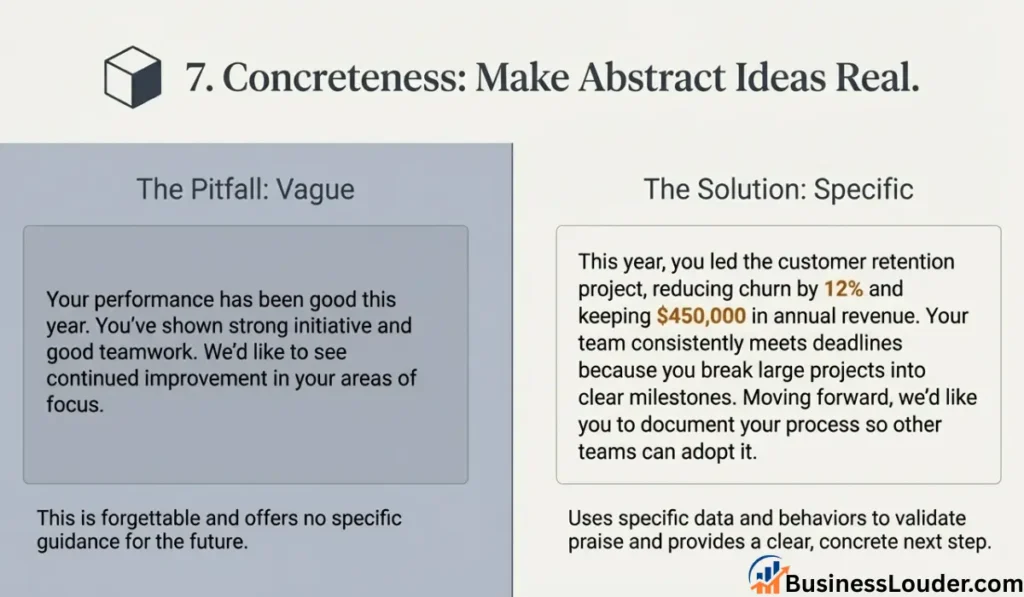
Concreteness means using specific, tangible details and examples rather than vague generalizations. It’s about painting a picture rather than describing the frame.
Why Concreteness Matters
Abstract ideas are forgettable. Specific, concrete details stick in people’s minds and make your message more persuasive and memorable. When you use concrete examples and specific numbers, people can visualize your point and understand exactly what you mean.
Real-World Example: Performance Review
Too Abstract: “Your performance has been good this year. You’ve shown strong initiative and good teamwork. We’d like to see continued improvement in your areas of focus.”
Concrete: “This year, you led the customer retention project, reducing churn by 12% and keeping $450,000 in annual revenue. Your team consistently meets deadlines because you break large projects into clear milestones. Moving forward, we’d like you to document your project management process so other teams can adopt it.”
The second version gives specific examples of what “good performance” means and what “continued improvement” looks like. The employee knows exactly what they did right and what to focus on next.
How to Achieve Concreteness
- Replace vague words with specific details: “soon” → “by Friday at 3 PM”
- Use numbers and metrics whenever possible
- Provide real examples instead of hypotheticals
- Describe specific behaviors rather than general traits
- Use vivid, sensory language when appropriate
- Ask yourself: “Could someone misunderstand this, or is it specific enough that only one interpretation is possible?”
How to Apply the 7Cs in Business Communication
In Written Communication (Emails, Reports, Proposals)
The 7Cs of communication work across all types of communication—but the way you apply them varies. Whether you’re focused on written communication, presentations, or personal communication, each principle adapts to your context. For example, oral communication requires different techniques than written formats.
When writing emails, reports, or proposals, run through each C:
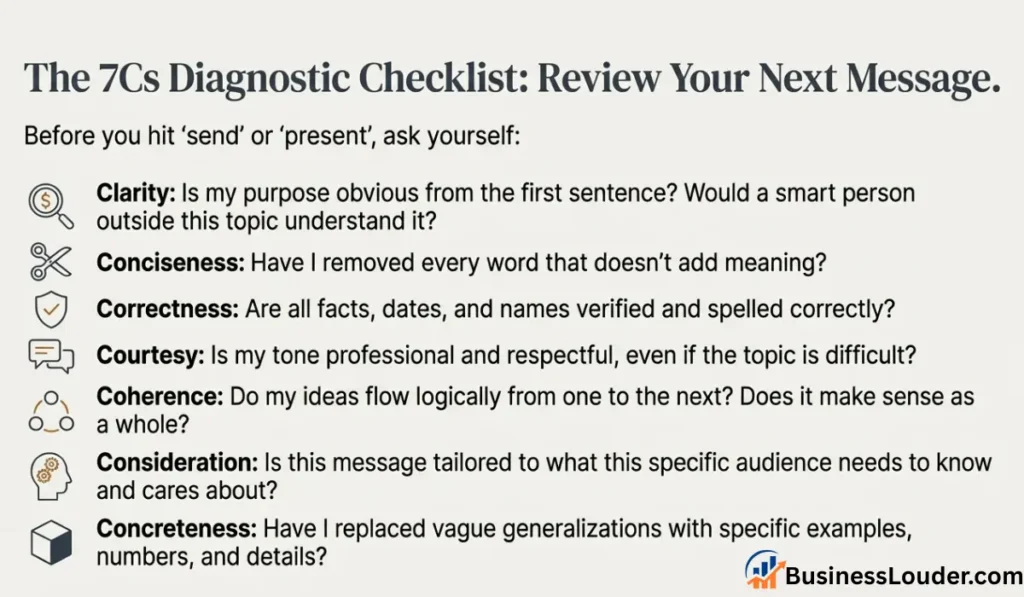
- Clarity: Is my purpose obvious from the first sentence?
- Conciseness: Have I removed unnecessary words?
- Correctness: Are all facts verified and spelling correct?
- Courtesy: Is my tone professional and respectful?
- Coherence: Do my ideas flow logically?
- Consideration: Is this tailored to my reader?
- Concreteness: Have I used specific examples and numbers?
In Presentations and Verbal Business Communication
When speaking to an audience, the 7Cs still apply, though your focus shifts. In verbal business communication:
- Clarity: Use simple language and explain jargon
- Conciseness: Cut slides that don’t support your main message
- Correctness: Fact-check everything, especially statistics
- Courtesy: Acknowledge audience questions respectfully
- Coherence: Follow a clear logical structure with smooth transitions
- Consideration: Match your content depth to audience expertise
- Concreteness: Use visuals, stories, and specific examples
In Personal Relationships
Even in casual communication:
- Clarity: Say what you mean directly, avoiding hints
- Conciseness: Don’t over-explain when a simple answer works
- Correctness: Get the facts right before sharing stories
- Courtesy: Show respect even during disagreements
- Coherence: Help people understand your perspective logically
- Consideration: Think about their feelings and viewpoint
- Concreteness: Use specific examples from your shared experience
Common Communication Mistakes and How the 7 Cs Help
Mistake 1: Using Too Much Jargon Solution: Apply Clarity. Explain technical terms or use simpler language your audience understands.
Mistake 2: Including Irrelevant Information Solution: Apply Conciseness. Cut anything that doesn’t directly support your message.
Mistake 3: Forgetting to Verify Facts Solution: Apply Correctness. Always fact-check before communicating important information.
Mistake 4: Communicating in an Aggressive Tone Solution: Apply Courtesy. Adjust your language to show respect and openness.
Mistake 5: Jumping Between Topics Randomly Solution: Apply Coherence. Outline first and ensure logical connections between ideas.
Mistake 6: Using Language Everyone Understands but Not Your Specific Audience Solution: Apply Consideration. Tailor your message to who’s listening.
Mistake 7: Speaking in Generalities Solution: Apply Concreteness. Use specific examples, numbers, and details.
Putting It All Together: A Real-World Example
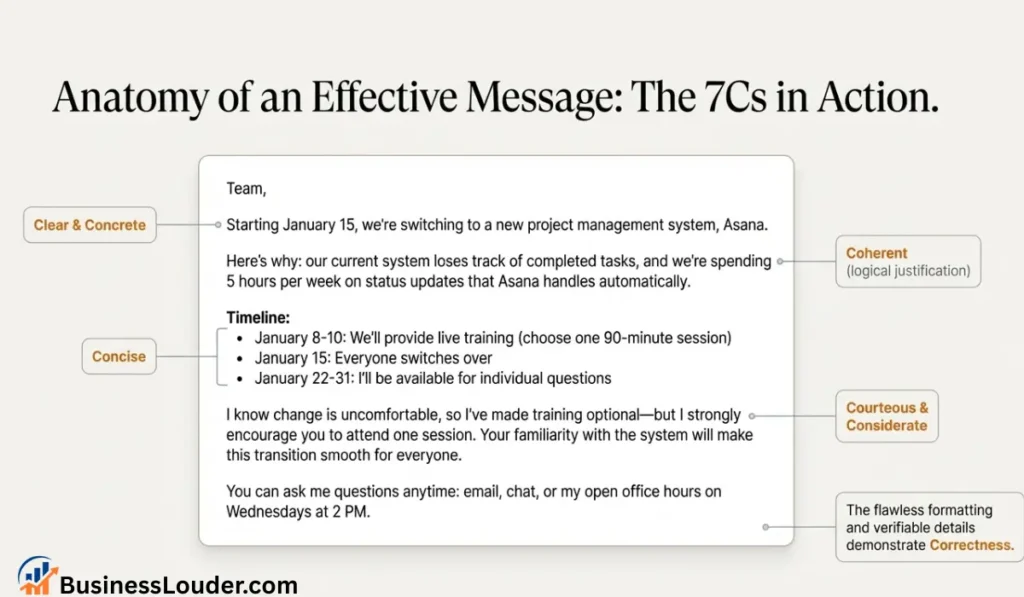
Let’s look at how one manager transformed an unclear communication into one that hits all 7 Cs:
Original Message (Poor): “Hi team. We’ve got some changes happening with how we work. It’s important that everyone adapts well to new processes. There will be training sessions available. Your participation is critical. Changes will be happening soon. Please be proactive and reach out if you have questions or concerns.”
Improved Message (All 7 Cs): “Team, starting January 15, we’re switching to a new project management system, Asana. Here’s why: our current system loses track of completed tasks, and we’re spending 5 hours per week on status updates that Asana handles automatically.
Timeline:
- January 8-10: We’ll provide live training (choose one 90-minute session)
- January 15: Everyone switches over
- January 22-31: I’ll be available for individual questions
What You’ll Learn:
- Creating and assigning tasks
- Setting timeline expectations
- Collaborating with teammates
- Reporting on project status
I know change is uncomfortable, so I’ve made training optional—but I strongly encourage you to attend one session. Your familiarity with the system will make this transition smooth for everyone.
You can ask me questions anytime: email, chat, or my open office hours on Wednesdays at 2 PM.
— [Manager]”
This version scores perfectly on the 7 Cs: It’s clear (specific dates and actions), concise (no filler), correct (verifiable information), courteous (acknowledges concerns), coherent (logical progression from why to how), considers the audience (options for different learning styles), and concrete (specific dates and numbers).
Conclusion
The 7 Cs of Communication aren’t complicated, but they’re powerful. By consistently applying these principles—Clarity, Conciseness, Correctness, Courtesy, Coherence, Consideration, and Concreteness—you’ll become a communicator people want to listen to. You’ll influence decisions, build stronger relationships, and move your projects forward.
These principles are foundational to effective management and leadership.
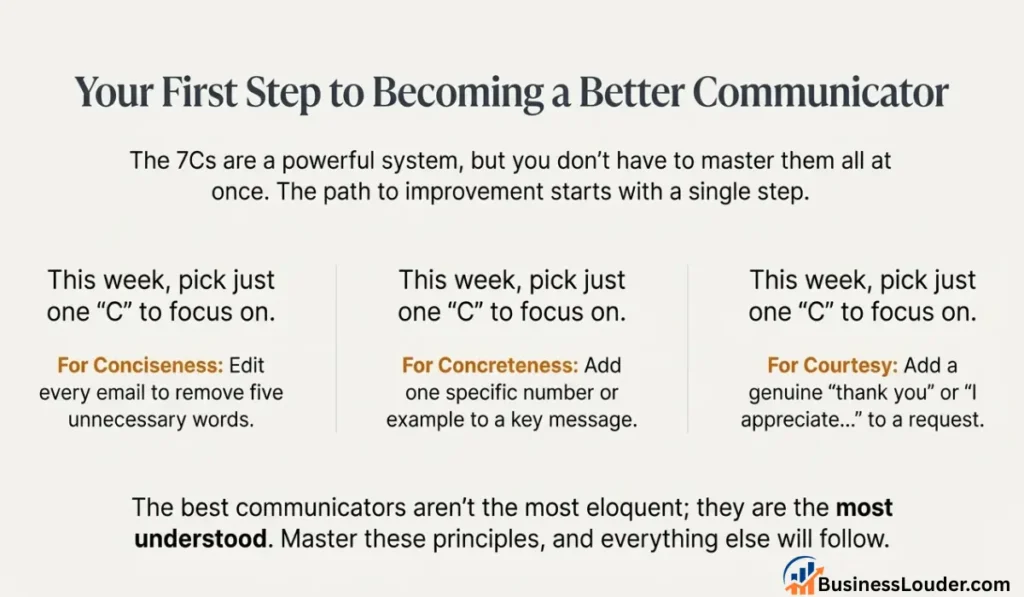
Start by picking one C to focus on this week. Maybe you’ll commit to eliminating filler words (Conciseness), or you’ll add one specific example to every message you write (Concreteness). As each C becomes habit, your overall communication will transform.
Remember: the best communicators aren’t necessarily the most eloquent. They’re the ones who understand effective communication isn’t about sounding smart—it’s about being understood. Master these 7Cs of communication principles and everything else follows.