A company can hold millions in the bank and still not really know how much cash it has, or where it’s sitting. Money scattered across dozens of accounts, currencies, and countries adds up to one dangerous blind spot. A core treasury system is what turns that fog into a single, real-time picture.
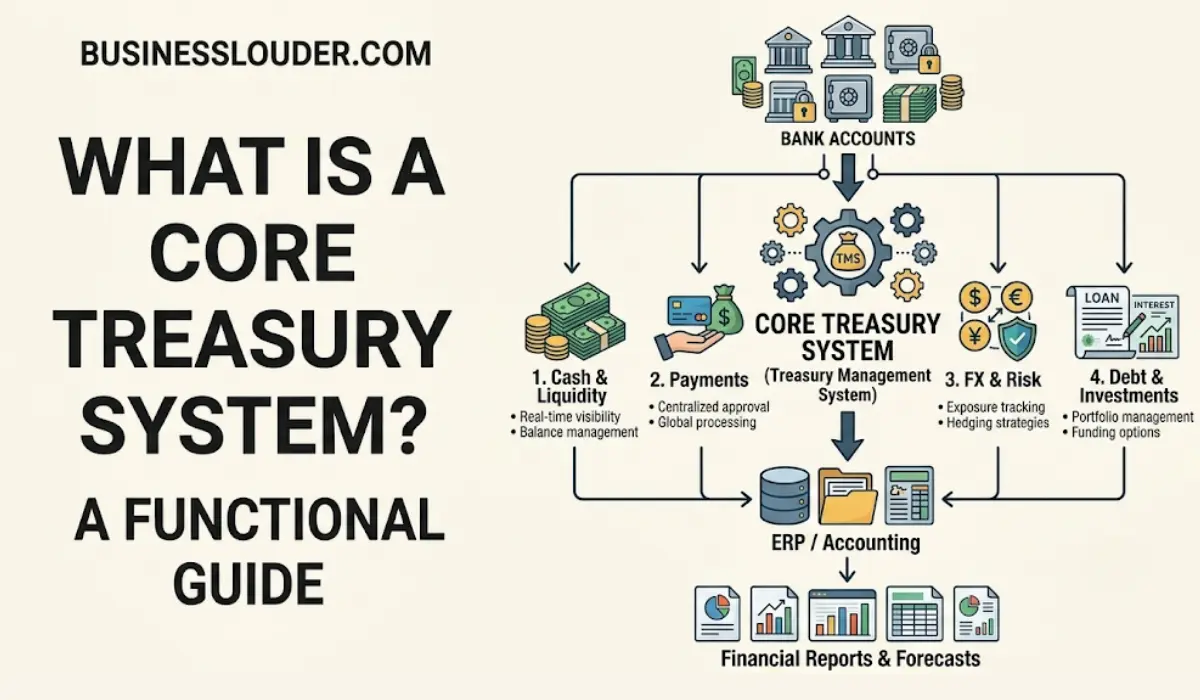
A core treasury system — usually called a Treasury Management System, or TMS — is the central software platform an organisation uses to run all its treasury operations from one place: cash and liquidity, payments, foreign exchange and risk, investments, and debt. It’s the financial control tower for a company’s money.
And demand is climbing fast. The treasury management system market is projected to reach $16.1 billion by 2032, growing at nearly 14% a year, according to Polaris Market Research — a sign of how many finance teams are done running the company’s cash on spreadsheets.
What Is a Core Treasury System?
A core treasury system is the central hub that a company’s treasury department — the team responsible for managing cash, funding, and financial risk — uses to see and control the organisation’s money. The word “core” is the point: it’s the foundational platform everything else plugs into, from the company’s banks to its accounting system.
Instead of logging into fifteen different bank portals and stitching the numbers together in a spreadsheet, treasury works from one system that pulls it all together automatically. Large corporations run them, and so do banks and financial institutions, which use their own core treasury systems to manage their funding and liquidity. Different scale, same job: one source of truth for the money.
What Does a Core Treasury System Do?
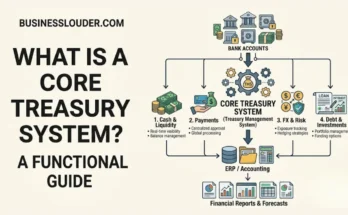
A good TMS bundles the whole treasury toolkit into connected modules. The main ones:
- Cash and liquidity management — a real-time view of every balance across every account, plus forecasting so you can see cash coming and going before it happens.
- Bank connectivity and account management — direct links to the company’s banks (via SWIFT, host-to-host, or APIs) and a live register of every account and who can sign on it.
- Payments — processing and approving payments centrally, with fraud controls and audit trails built in.
- FX and risk management — tracking exposure to currency and interest-rate swings, and managing the hedges that protect against them.
- Debt and investment management — keeping tabs on loans, borrowings, and where spare cash is invested.
- Accounting, reporting, and compliance — generating the entries, reports, and records that keep treasury audit-ready and in line with the rules.
Tie those together and you get the whole point of the system: not just data, but control over the single most important resource a business has — its cash.
Why Companies Need One
For a small business, a spreadsheet and online banking are fine. Scale up — more accounts, more currencies, more countries — and that approach quietly becomes a liability. Here’s what a core treasury system fixes:
- Cash visibility. You finally see all your money, everywhere, in real time — instead of a stale snapshot pieced together by hand.
- Fewer errors and less fraud. Automated, controlled payment workflows cut the manual mistakes and the openings fraudsters exploit.
- Better risk control. You can actually measure and manage your exposure to currency and rate moves, rather than hoping for the best.
- Time back. Automating reconciliation and reporting frees the treasury team from spreadsheet drudgery for work that matters.
- Smarter decisions. Reliable, real-time numbers sharpen every decision-making process that depends on knowing what cash you’ve got.
The bottom line: managing cash badly is one of the fastest ways to sink an otherwise healthy company, which makes the treasury system a genuine tool of good management, not just a finance-team convenience.
Core Treasury System vs. ERP
People often ask why you’d need a treasury system if you already have an ERP (the big system that runs finance and accounting). The short answer: they do different jobs.
An ERP is a generalist — it handles the broad sweep of accounting, invoicing, and operations. A core treasury system is a specialist, built for the depth treasury actually needs: real-time bank connectivity, cash forecasting, FX hedging, and risk. The two usually work together — the TMS handles treasury, then feeds clean data into the ERP. Increasingly, both are getting smarter as AI in business moves into forecasting and fraud detection.
Frequently Asked Questions
What is a core treasury system in simple terms?
It’s the central software a company uses to manage all its money in one place — cash, payments, currency risk, investments, and debt. Often called a Treasury Management System (TMS), it gives real-time visibility and control over the organisation’s cash.
What’s the difference between a TMS and an ERP?
An ERP is a broad system for accounting and operations. A TMS is a specialist tool for treasury — deeper cash management, bank connectivity, FX, and risk. They typically integrate, with the TMS feeding treasury data into the ERP.
Who uses a core treasury system?
Mainly the treasury or finance teams of medium-to-large companies with lots of cash, accounts, or international operations. Banks and financial institutions also run their own core treasury systems to manage their funding and liquidity.
Is a core treasury system the same as core banking?
No. Core banking runs a bank’s customer accounts, deposits, and loans. A core treasury system manages an organisation’s own money — its cash, funding, investments, and financial risk. A bank can have both.
Control the Cash, Control the Company
Cash is the lifeblood of any business, and a core treasury system is what lets you actually see and steer it. It pulls a company’s scattered money into one real-time view, automates the risky manual work, and hands the finance team the control they need to protect and grow the balance.
As money moves faster and businesses go more global, running treasury on spreadsheets stops being thrifty and starts being reckless. The companies that take their cash seriously are the ones that see it clearly — and a core treasury system is how they do it.