
Growth eats cash. That’s the part nobody warns you about. The moment your business starts to take off, it gets hungrier — more staff, more stock, more kit, more everything — and if the money runs out before the growth pays off, none of it matters. In fact, of the failed startups CB Insights studied, a staggering 70% simply ran out of capital, according to its 2026 report. So getting funding right isn’t a finance-team detail. It’s survival.
Navigating growth funding comes down to one thing: matching the right kind of money — equity, debt, or non-dilutive — to your stage, your goals, and how much control you’re willing to give up. Then getting your business ready before you ask. Do that well, and funding fuels the climb instead of sinking it.
What Is Growth Funding?
Growth funding is the money a business raises to scale up — not to get off the ground, but to go faster once it’s already moving. It’s what pays for the next hire, the bigger premises, the marketing push, the new market. Where startup funding is about proving an idea works, growth funding is about pouring fuel on something that already does.
And here’s the catch that trips people up: raising money isn’t the goal. The goal is raising the right money, on the right terms, at the right time. Grab the wrong kind and you can end up drowning in repayments, or handing over half your company for a cheque you didn’t really need.
The Main Types of Growth Funding
Broadly, the money falls into three camps — and knowing which is which is half the battle.
1. Bootstrapping (Funding It Yourself)
You reinvest your own profits and grow at the pace your cash allows. It’s slow, and it’s limiting — but you keep every share and every ounce of control. Plenty of great companies never take a penny of outside money, and never regret it.
2. Debt Financing (Borrowing It)
Bank loans, lines of credit, and newer options like revenue-based financing, where you repay as a slice of monthly revenue. You take the money, you pay it back with interest — but you don’t give up a single share. The trade-off: you need steady cash flow to cover the repayments, and the lender wants that money back whether business is booming or not.
3. Equity Financing (Selling a Piece)
Angel investors, venture capital, and growth-equity or private-equity firms give you cash in exchange for a share of the company. The upside is huge: big money, plus experienced backers who open doors and steer you clear of mistakes. The cost is real too — you dilute your ownership, and you take on investors who now have a say in where things go.
A Fourth Worth Knowing: Non-Dilutive Funding
Grants, government schemes, R&D tax credits, and competitions hand you money without taking equity or demanding repayment. It’s the closest thing to free money there is — which is exactly why it’s competitive and often comes with strings on how you spend it. Worth chasing, rarely enough on its own.
Debt vs Equity: The Core Decision
Strip everything else away and most growth-funding decisions boil down to this one choice. Here’s how they stack up:
| Debt | Equity | |
|---|---|---|
| You give up | No ownership | A share of the company |
| You take on | Repayments + interest | Investors with a say |
| Best when | Cash flow is steady and predictable | You’re chasing fast, big growth |
| The risk | Repay even in a bad month | Dilution and lost control |
| Keeps control? | Yes | Partly — you share it |
Neither is “better.” Debt suits a steady, profitable business that just needs a boost. Equity suits a company going for explosive growth that couldn’t fund that pace from cash flow alone. Most scale-ups end up using a mix of both over time.
How to Navigate Growth Funding
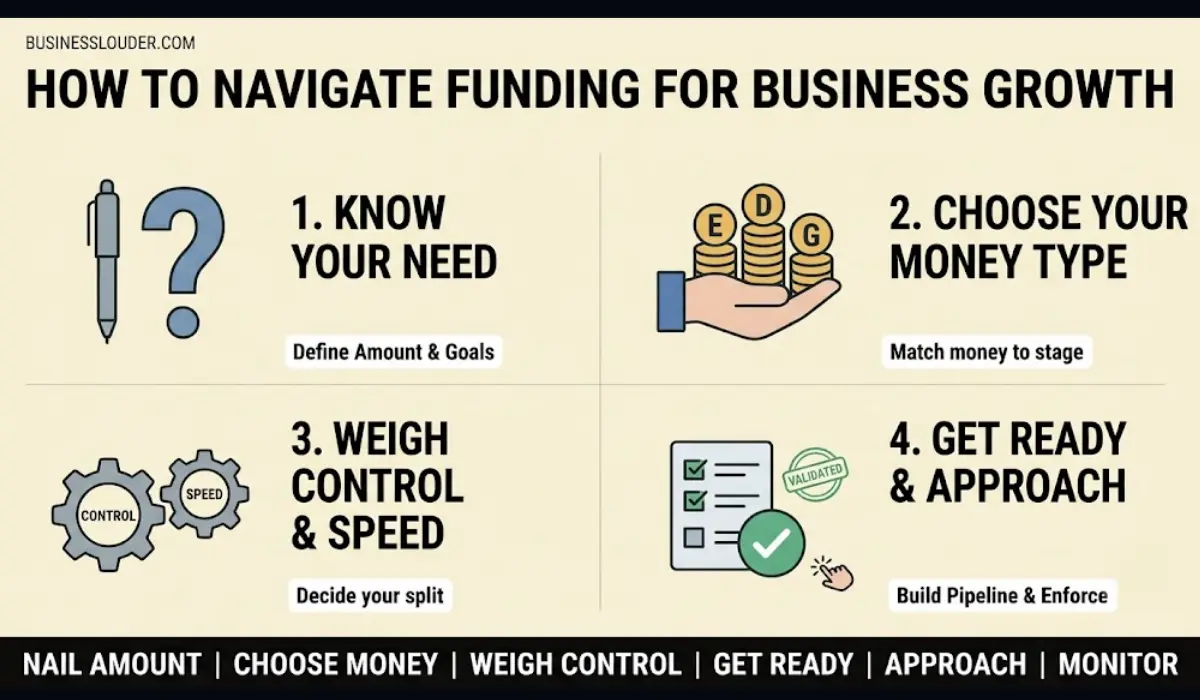
Knowing the options is one thing. Choosing well is another. Here’s the path:
- Nail down how much, and what for. Vague asks get vague answers. Know the exact number you need and the specific growth it’s going to buy. This is really an exercise in setting clear objectives before you spend a penny.
- Match the money to your stage. Early and unproven? Angels and grants. Steady and profitable? Debt. Ready to scale hard and fast? Growth equity. Don’t chase venture capital just because it’s glamorous — it’s the wrong fit for most businesses.
- Weigh control against speed. Ask yourself honestly: would you rather own all of a smaller company, or a slice of a much bigger one? There’s no wrong answer — but you have to actually answer it.
- Get your house in order before you ask. Clean financials, clear metrics, a plan that holds up to hard questions. Funders back businesses that look ready — not ones scrambling to explain their own numbers.
- Approach the right people, not everyone. Target funders who back companies like yours, at your stage, in your sector. A focused shortlist beats a hundred cold emails every time.
- Read the terms, not just the number. A bigger cheque with brutal terms can cost you the company. What you give up matters as much as what you get.
Mistakes That Sink Growth Rounds
- Raising too much, too early. More money means more dilution and more pressure to grow at a pace you may not be ready for.
- Raising too little. Running out halfway to the goal forces a rushed, weak round on worse terms. Leave yourself a buffer.
- Giving away too much equity. Hand over a big chunk early and you’ll wince at every future round when it shrinks further.
- Timing it wrong. The best time to raise is from a position of strength, not when the account is nearly empty and you’re desperate.
Every one of these is really a judgment call — which is why funding is one of the highest-stakes parts of the whole decision-making process a growing company faces, and a core test of good management.
Frequently Asked Questions
What is growth funding?
It’s money raised to scale a business that’s already working — funding expansion, hiring, new markets, or bigger operations. Unlike startup funding, which proves an idea, growth funding accelerates one that’s already proven.
Is debt or equity better for funding growth?
Neither is universally better. Debt keeps your ownership but demands repayment, so it suits steady, cash-generating businesses. Equity brings bigger money and expert backers but dilutes your stake, so it suits companies chasing fast, capital-hungry growth.
How much should I raise?
Enough to hit a clear milestone with a sensible buffer — not so much that you dilute or over-borrow, and not so little that you run dry before you get there. Tie the amount to a specific goal, not a round number.
What’s the best funding for a small business to grow?
For most steady small businesses, reinvested profit plus sensible debt (a loan or line of credit) beats giving away equity. Equity makes more sense only when you’re going for growth too fast and too capital-intensive to fund any other way.
Fund the Growth, Keep the Company
Here’s the whole thing in a sentence: the best funding isn’t the biggest cheque — it’s the one that gets you where you’re going without costing you the thing you’re building. Money is fuel, but pour in the wrong kind and the engine seizes.
So before you chase a raise, get clear on how much you need, why, and what you’re willing to trade for it. Match the money to the moment. Ask from strength, not panic. Get that right, and funding stops being the thing that might sink you — and becomes the thing that finally lets you fly.

One Comment on “How to Navigate Funding for Business Growth?”