Two miles below the ocean surface, in cold, crushing darkness, sits some of the most valuable oil on Earth. Getting it out is one of the hardest engineering jobs humans attempt — and an entire field of technology exists just to do it.
Deep offshore technology is the collection of specialised systems, vessels, and equipment used to explore, drill, and produce oil and gas in deep water — depths where fixed platforms standing on the seabed are impossible. It’s what lets energy companies tap reserves lying under thousands of metres of water, far from land.
And it’s booming. US Gulf of Mexico deepwater output alone is on track to hit an all-time high of nearly 2.2 million barrels of oil equivalent per day in 2026, according to Rystad Energy — proof that as easy oil runs out, the deep water is where the industry is heading.
What Is Deep Offshore Technology?
Deep offshore technology refers to the engineering used to produce oil and gas in deepwater and ultra-deepwater environments. Broadly, the industry splits offshore water depths into three bands:
- Shallow water — up to around 400 metres, where platforms can be fixed directly to the seabed.
- Deepwater — roughly 400 to 1,500 metres, where structures must float.
- Ultra-deepwater — beyond 1,500 metres (about 5,000 feet), the most extreme and technically demanding of all.
Once you pass the point where a rig can physically stand on the ocean floor, everything changes. You need floating platforms, equipment that sits and operates on the seabed, and robots to install and maintain it all. That’s the world deep offshore technology was built for.
How Deep Offshore Production Works
A deepwater field is a system with three layers — on the surface, on the seabed, and connecting the two. The core technologies are:
- Floating production platforms — the surface facilities that process the oil and gas (more on the types below).
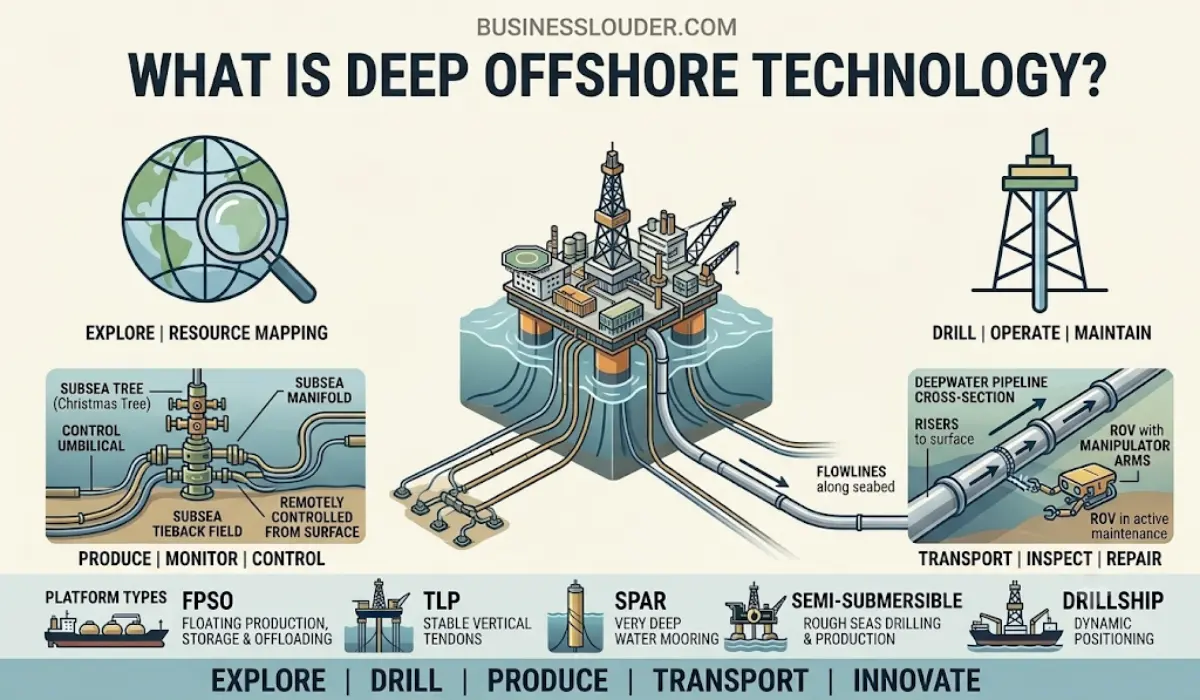
- Subsea production systems — the wellheads, valves, and gear that sit on the seabed. The key component is the subsea tree (or “Christmas tree”), a stack of valves that controls the flow from each well, often feeding into a manifold that gathers several wells together.
- Risers, umbilicals, and flowlines (SURF) — risers are the pipes carrying oil up to the surface; flowlines move it along the seabed; and umbilicals are bundled cables that send power, hydraulics, and control signals back down to the subsea equipment.
- Drillships and dynamic positioning — because you can’t anchor easily in deep water, drillships use dynamic positioning: thrusters linked to GPS that hold the vessel perfectly still above the well, automatically.
- ROVs (remotely operated vehicles) — underwater robots that do the hands-on work at depths no diver could survive: connecting pipes, inspecting equipment, and making repairs.
A common setup is the subsea tieback: wells on the seabed piped back to a nearby floating platform, letting one host facility drain several fields at once.
Types of Deepwater Platforms
Since fixed platforms are out, deep offshore relies on four main floating structures, each suited to different depths and jobs:
| Platform | What it is | Best for |
|---|---|---|
| FPSO | A ship that produces, stores, and offloads oil to tankers | Remote fields with no pipeline to shore |
| TLP (Tension Leg Platform) | A floating platform held down by taut vertical tendons | Stable production up to ~1,500 m |
| Spar | A huge vertical cylinder floating deep in the water, moored to the seabed | Very deep water, high stability |
| Semi-submersible | A platform floating on submerged pontoons | Drilling and production in rough seas |
The FPSO is the workhorse of the deep. Because it stores oil onboard and offloads to shuttle tankers, it can operate almost anywhere — no seabed pipeline to land required — which is exactly why it dominates remote deepwater developments.
Why Deep Offshore Technology Matters
A huge share of the world’s remaining undiscovered oil and gas lies offshore, much of it in deep water. As onshore and shallow fields mature and decline, deepwater has become one of the industry’s most important frontiers — and, as that 2.2-million-barrel figure shows, one of its fastest-growing.
It matters for energy security, for the economies of producing nations, and as a hotbed of engineering innovation — automation, robotics, and AI are increasingly central to running these fields safely. It’s a textbook case of the energy sector’s place among the world’s major business verticals, which we break down in our guide to business vertical classification categories, and of how AI in business is reshaping even the heaviest industries.
The Challenges of Going Deep
None of this is easy, and the difficulty is the whole point:
- Extreme conditions — at these depths, pressure is crushing and temperatures near freezing, which can clog pipes with gas hydrates and wax. Keeping the oil flowing (called flow assurance) is a science in itself.
- Enormous cost — a single deepwater project can run into billions of dollars and take years before it produces a drop.
- Safety and environmental risk — the 2010 Deepwater Horizon disaster showed how catastrophic a deepwater failure can be. Safety systems and blowout preventers are non-negotiable.
- Harsh weather — hurricanes and heavy seas can shut operations down and demand structures built to survive the worst the ocean offers.
Frequently Asked Questions
What is deep offshore technology in simple terms?
It’s the specialised equipment and systems used to find and produce oil and gas in deep water — floating platforms, seabed wellheads, underwater robots, and the pipelines connecting them — in places too deep for a platform to stand on the ocean floor.
How deep is “deepwater”?
Deepwater generally means water depths beyond about 400 metres, while ultra-deepwater refers to depths beyond 1,500 metres (roughly 5,000 feet) — the most technically challenging environment in the industry.
What is an FPSO?
An FPSO is a Floating Production, Storage and Offloading vessel — a ship that produces oil and gas, stores it onboard, and transfers it to tankers. Because it needs no pipeline to shore, it’s ideal for remote deepwater fields.
Why is deep offshore drilling so difficult?
Because of extreme pressure and cold, huge costs, complex seabed equipment, and serious safety and environmental risks. Everything has to work reliably in an environment where repairs can only be made by robots.
Engineering at the Edge
Deep offshore technology is what happens when an industry refuses to be stopped by two miles of ocean. Floating cities of steel, robots working in the dark, wells drilled kilometres beneath the waves — it’s some of the most ambitious engineering on the planet, all to reach the energy the easy fields no longer provide.
And with deepwater production climbing to record highs, this frontier isn’t fading — it’s expanding. As the shallow, simple oil runs dry, the future of offshore energy keeps moving in one direction: deeper.