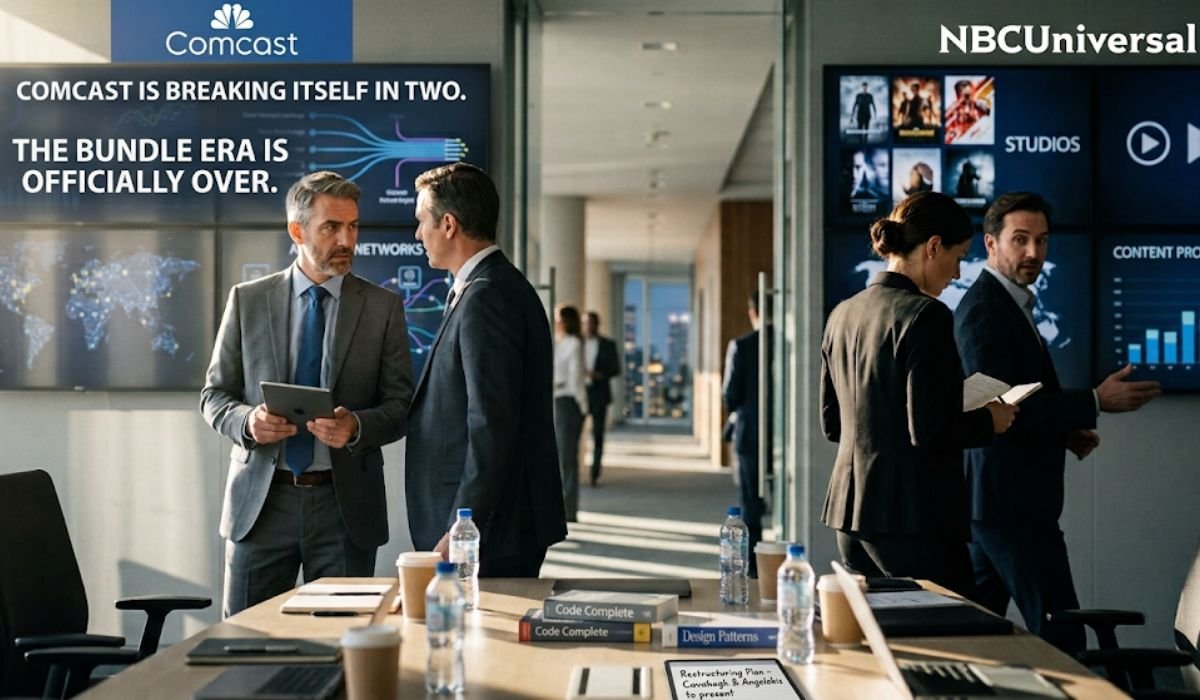
On June 29, 2026, Comcast said it would break itself into two separate public companies — spinning off NBCUniversal and Sky into a standalone media business, and leaving behind a connectivity company built around broadband and wireless. It is the second time in six months that Comcast has cut off a piece of itself. And together, the two moves quietly end a strategy that defined the American media industry for three decades.
The idea being abandoned is simple, and for years it looked unbeatable: own the pipe and the content that flows through it. Comcast spent much of the 2000s and 2010s assembling exactly that — the cables into people’s homes, plus NBC, Universal Studios, theme parks, and, after 2018, the European giant Sky. The logic was that distribution and content strengthened each other. Comcast has now decided the opposite is true.
What is actually being split
Under the plan, Comcast separates into two companies with very different jobs.
One keeps the name Comcast and becomes a pure connectivity business: residential and business broadband, Comcast’s growing wireless service, and the network infrastructure underneath it. The other becomes a standalone NBCUniversal, holding the film and television studios, the Peacock streaming service, the theme parks, the NBC broadcast network, and Sky in Europe. Comcast framed the goal in its own announcement as “enhanced strategic focus, agility and value creation” for both sides.
The leadership split tells you how seriously they mean it. Brian Roberts, Comcast’s long-time chairman, keeps roughly one-third of the voting control and stays involved in both companies. Mike Cavanagh, currently co-CEO, becomes chief executive of the independent NBCUniversal. Michael Angelakis, a former Comcast finance chief, returns to run the standalone connectivity company, as Variety reported. This is not a paper reshuffle — it is two management teams pointed at two different markets.
The company is targeting mid-2027 to complete the separation, and it is not a done deal until then: it still needs board approval, favorable tax rulings, regulatory clearance, and financing to be finalized.
This is the second cut, not the first
To understand why this matters, you have to see it as part of a sequence rather than a one-off headline.
Back in January 2026, Comcast completed a separate spin-off called Versant Media Group, which took the company’s cable television networks — names like USA, CNBC, MSNBC, and E! — and floated them as an independent business on the Nasdaq. That earlier move carved out the declining cable-channel bundle. The new June announcement goes much further, separating the entire remaining media empire — studios, streaming, parks, and Sky — from the connectivity business.
Read together, the message is unmistakable. Comcast is not trimming one weak unit. It is dismantling the conglomerate model on purpose, in stages, and keeping the part it believes has the cleaner future: the broadband and wireless pipes.
Why the bundle stopped working
The strategic reason comes down to a problem that shows up whenever two very different businesses share one balance sheet: they eventually want opposite things.
A broadband and wireless business is, at its core, infrastructure. It rewards steady investment, predictable cash flow, and patience. Investors value it like a utility — for reliability, not for drama. A modern media business is the reverse. To compete in streaming against Netflix, Disney, and Amazon, it has to spend aggressively and absorb losses while it builds scale, and it lives or dies on hits, subscriber growth, and creative risk.
Bolt those two together and each one drags on the other. The infrastructure side looks reckless when it is funding a streaming war. The media side looks starved when it is competing against rivals who can raise money as pure content companies. Comcast’s own language pointed at this directly, citing how “technological innovation, consumer behavior and competitive dynamics” have reshaped both industries into ones that are better pursued separately. Splitting lets each company be valued, funded, and run on its own terms — and lets investors buy the utility or the studio, instead of an awkward blend of both.
It is the same underlying pattern behind a wave of corporate break-ups in recent years, and it is exactly the dynamic we explored in our look at why companies divest business units: a separation that reads like retreat in the headlines is often an attempt to let two trapped businesses finally move at their own speed.
The part the announcement doesn’t guarantee
Here is the caution that belongs in any honest read of this story: splitting a company in two does not automatically create value. It only creates the conditions for value. The execution still has to follow.
Comcast’s own recent history makes the point. When Versant began trading in January, its stock slid after the debut — a reminder that spinning off a business exposes it to the market’s full, unsentimental judgment, and the market does not always like what it sees when the parent company’s support is removed. A standalone NBCUniversal will carry its own debt, fund its own streaming ambitions, and answer to shareholders who can no longer be reassured by Comcast’s steady broadband cash. That is freedom and exposure at the same time.
There is also the simple fact that this is an announcement, not a completed transaction. A mid-2027 target leaves a year of regulatory review, tax structuring, and market conditions between the plan and the reality. Deals of this size have been reshaped — or delayed — by less.
What business readers should take from it
The lesson here is bigger than one cable company. For most of the last thirty years, the assumed path to strength was to get larger and more integrated — own more of the value chain, bundle more together, become harder to unbundle. Comcast, one of the companies that pursued that strategy most successfully, has now concluded that the integration itself became the liability. It is a reminder that how a business is classified and structured is never just an org-chart detail — it shapes how investors value it and how freely it can compete.
When you find yourself holding two businesses that need different investors, different risk appetites, and different definitions of success, keeping them under one roof can quietly tax both. The strategic question worth borrowing from this — whether you run a conglomerate or a company with two divisions that never quite fit — is straightforward: are these parts genuinely stronger together, or are they just historically attached? Comcast spent six months answering that question with the most expensive tool available. By mid-2027, we will find out whether the answer was right.