Most businesses don’t have a strategy problem. They have an execution problem dressed up as a strategy problem.
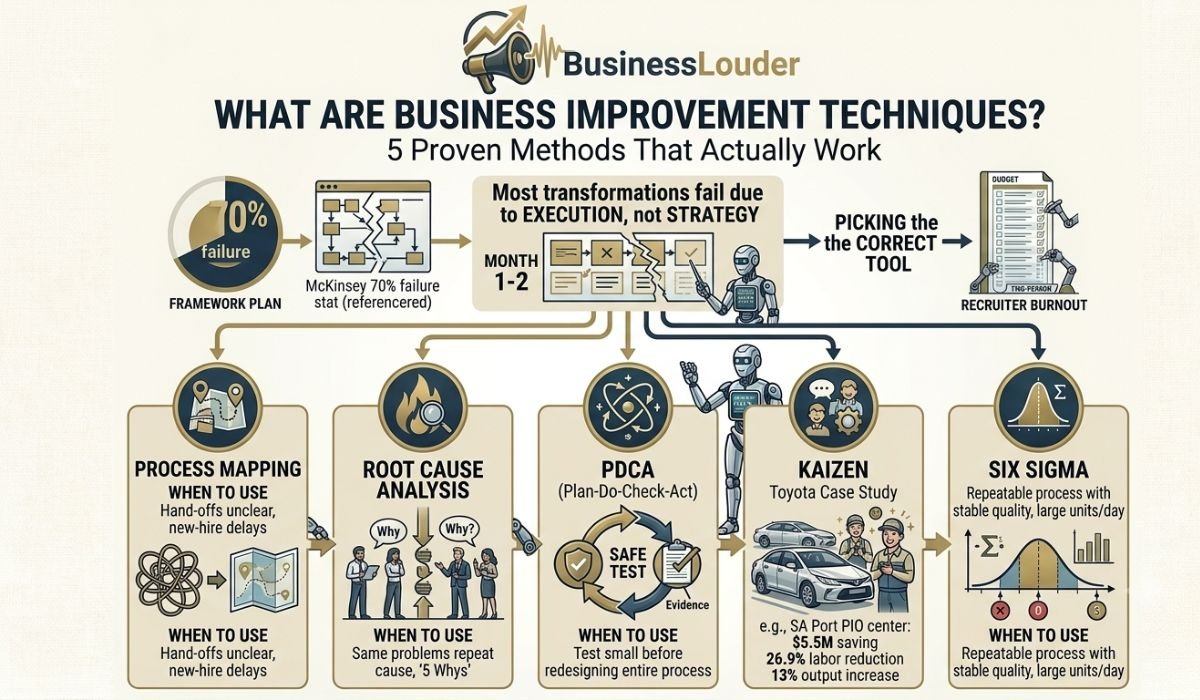
Seventy percent of company transformations fail, according to McKinsey’s own Transformation Practice — not because the leadership team picked the wrong framework, but because nobody built the discipline to follow through on the one they picked.
If you’ve ever asked “what are business improvement techniques” and gotten back a wall of acronyms — Lean, Six Sigma, Kaizen, PDCA — you’re not wrong to feel like the answer is more complicated than it needs to be. It isn’t complicated. It’s just badly explained.
The Problem: Everyone Picks the Framework Before the Problem
Here’s the pattern that kills most improvement efforts before they start. A leadership team reads about Six Sigma, or hires a consultant who’s certified in it, and decides that’s the answer — before anyone has actually defined what’s broken.
That’s backwards. Business improvement techniques are structured methods for finding inefficiency, waste, and inconsistency in how work gets done, then fixing it in a way you can measure. They only work when the method matches the problem in front of you, not the other way around.
And the cost of getting this wrong is well documented. The McKinsey research above doesn’t blame the methodology — Harry Robinson, a senior partner at the firm, points to a different root cause entirely: leaders who don’t set a high enough target, don’t build a clear reason for the change, and skip the basic infrastructure — regular check-ins, a clear owner, a way to track progress — that keeps a transformation alive past month two.
It’s worth being honest here: that 70% figure has a messy history. It traces back to a 1993 book by Michael Hammer and James Champy, who called it an “unscientific estimate.” A 2011 academic review in the Journal of Change Management, led by University of Brighton researcher Mark Hughes, examined five separate instances of the claim and found none of them backed by solid empirical evidence. McKinsey still cites the 70% figure today and stands behind it as “academic research,” but it’s fair to treat it as a widely-repeated industry consensus rather than a single, airtight study. Either way, the underlying point holds up regardless of the exact number: most improvement efforts stall on execution, not on which framework sits in the slide deck.
The Insight: The Method Is Never the Point
Here’s the one idea worth taking from this entire article: business improvement techniques are not a menu you choose from. They’re a diagnosis you run.
Process mapping helps when nobody can agree on how work actually flows. Root cause analysis helps when the same problem keeps coming back no matter how many times someone “fixes” it. PDCA helps when you want to test a change safely before betting the whole operation on it. Lean helps when waste and waiting dominate the process. Six Sigma helps when a process is stable enough to measure and the variation in its output is the actual problem.
None of these compete with each other. They’re tools for different symptoms, and the practical decision guide from Adapt Digital puts it well: the best starting point is the problem in front of you, not the framework that sounds the most rigorous in a board meeting.
The 5 Techniques, and When to Actually Use Each One
1. Process Mapping — when nobody can explain how work actually happens
This is almost always the right starting point, and it costs nothing but time. You draw out, step by step, what really happens between a customer request and a finished result — not what the org chart says happens, what actually happens, including the workarounds everyone’s been quietly using for years.
Use it when: handoffs are unclear, multiple people “own” the same step, or new hires take months to understand a process that should take days.
2. Root Cause Analysis (the 5 Whys) — when the same fire keeps starting
If your team is constantly putting out the same fire — late shipments, billing errors, the same customer complaint — root cause analysis stops you from re-fixing the symptom every single time. You ask “why” repeatedly until you hit the actual cause, not the most convenient one.
3. PDCA (Plan-Do-Check-Act) — when you want to test before you commit
PDCA was originally developed by Walter Shewhart and later expanded by W. Edwards Deming, applying the scientific method to process improvement. It’s a four-step loop: plan a change, try it small, check what actually happened, then decide whether to scale it or adjust and try again.
Use it when: you’re fairly sure something needs to change but don’t want to redesign an entire process before you’ve seen real evidence it works.
4. Kaizen — when you want continuous, low-cost improvement built into the culture
Kaizen, Japanese for “change for the better,” asks every employee — not just managers — to spot and fix small inefficiencies as part of daily work, rather than waiting for an annual review or a crisis.
The real-world numbers back this one up clearly. Toyota applied Kaizen, alongside its broader Toyota Production System and 5S methodology, at its Port Installed Options Center in Saudi Arabia. A peer-reviewed case study published in the journal Industrial Engineering & Management found the result was a roughly $5.5 million saving without new facility investment, a 26.9% reduction in labor use, and a 13% increase in annual output — alongside a documented improvement in quality. That’s not a hypothetical. That’s one named plant, one named company, one published study.
5. Six Sigma (DMAIC) — when a measurable process has unstable quality
Six Sigma is the most data-heavy of the group. It defines, measures, analyzes, improves, and controls a process until it produces fewer than 3.4 defects per million opportunities — a near-elimination of variation. It was developed at Motorola in 1986 by engineer Bill Smith and later popularized by GE.
Use it when: you have a stable, repeatable process generating measurable defects, and the cost of inconsistency is high enough to justify the heavier analytical lift. It’s overkill for a small team fixing an onboarding workflow — it’s exactly right for a manufacturing line shipping thousands of units a day.
The Honest Limit Here
None of these techniques fix a business with the wrong strategy, a market that’s disappeared, or leadership that won’t commit. Lean can shave waste off a process that shouldn’t exist in the first place. Six Sigma can perfect the consistency of a product nobody wants.
And the data on automation-driven gains in this space deserves a caveat too. Vendors and consultancies routinely cite eye-catching numbers — 20–30% cost reductions from Lean, 25–40% productivity gains, six-figure average Six Sigma project savings — and most of these come from industry associations and consultancies with a commercial interest in the framework they’re describing, not independent academic research. They’re directionally useful, not gospel. Treat any single statistic from a vendor site the way you’d treat a sales pitch: probably true in the best cases they’re describing, less reliable as a guarantee for your specific business.
The technique that actually moves your numbers is the one matched precisely to your bottleneck, applied with the same discipline McKinsey’s own research says most companies skip.
What To Do Today
Pick one recurring problem — not your biggest one, your most annoying one. Map exactly how it happens, step by step, with the people who actually do the work in the room. Ask “why” five times before you decide on a fix. Test that fix on a small scale before rolling it out everywhere.
The companies that actually improve aren’t the ones with the fanciest framework on the wall. They’re the ones who picked one, ran it with discipline, and didn’t quit at month two — which, according to the research, is exactly where 70% of everyone else does.
For more on how staffing and team structure intersect with operational improvement, see our breakdown of staffing in management. For how AI is changing what’s possible in this space, see artificial intelligence in business management.