“IBM.” “I.B.M.” “International Business Machines.” “IBM Corp.” Four ways to write one company — and to your database, four completely different customers. Multiply that by every business in your records, and you’ve got a mess that quietly wrecks your reporting, your sales, and your bottom line.
To automate company name standardization, you define a set of consistent rules — a canonical format, how to handle legal suffixes, casing, and abbreviations — then use software (cleaning scripts, fuzzy matching, and data-quality or AI tools) to apply those rules automatically across your records and at the point of entry. The goal: one company, one name, everywhere.
It’s not a nice-to-have. Poor data quality — dirty, inconsistent records like these — costs the average organisation around $15 million a year, according to Gartner figures cited by the data firm ZoomInfo. Automating name standardization is one of the highest-leverage ways to claw that back.
What Is Company Name Standardization?
Company name standardization is the process of turning all the different ways a business name is written into one consistent, canonical form. “Acme Inc.,” “ACME Incorporated,” and “acme inc” all become a single agreed version — say, “Acme.”
It’s closely related to data normalization more broadly, which we cover in our guide to brand name normalization rules. The difference here is the focus: automating the specific, messy problem of company names at scale, so humans aren’t cleaning spreadsheets by hand forever.
Why Automate It?
Because doing it manually doesn’t scale, and the cost of not doing it is brutal. Inconsistent company names create duplicate records, so your CRM shows three “customers” that are really one. They break analytics, because revenue gets split across name variants. They waste sales time chasing accounts that are already yours. And they make compliance and deduplication a nightmare.
Automate it, and every downstream system — sales, marketing, finance, analytics — finally runs on clean, trustworthy data. Here’s how to build that automation.
How to Automate Company Name Standardization (Step by Step)
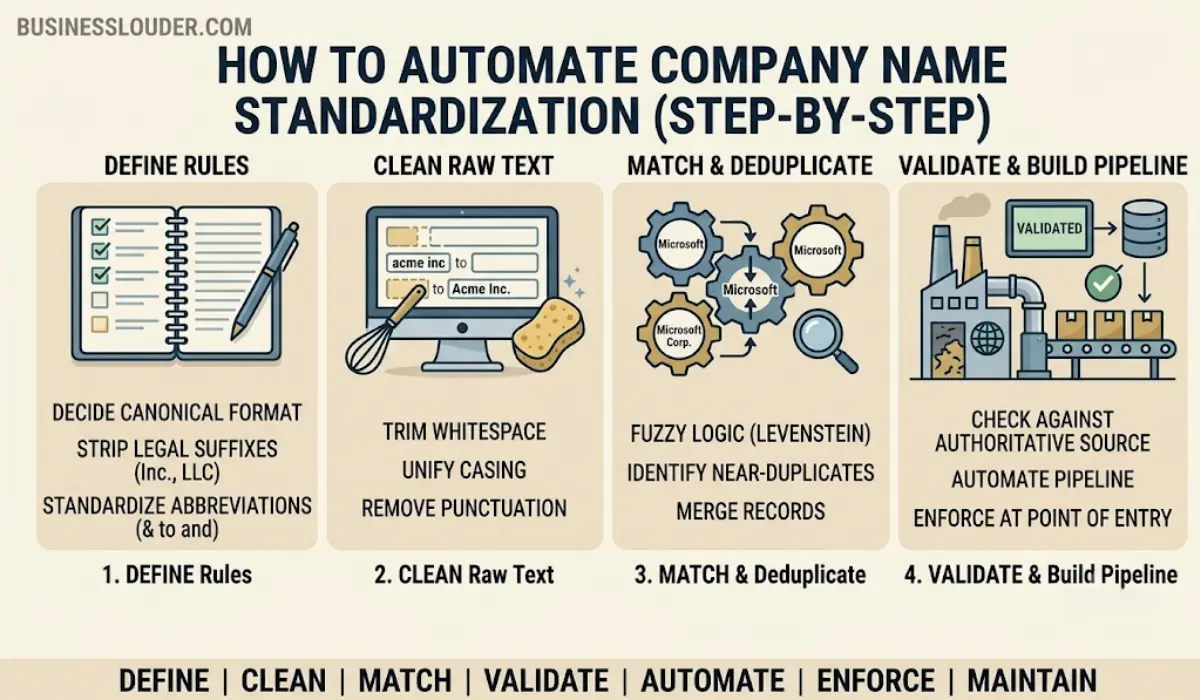
- Define your standardization rules. Decide the canonical format up front: Do you keep or strip legal suffixes (Inc., LLC, Ltd., GmbH)? Title case or uppercase? Expand abbreviations (“Intl” to “International”, “&” to “and”)? Write these rules down — they’re the backbone of everything that follows.
- Clean and normalise the raw text. Automate the mechanical fixes: trim extra whitespace, standardise capitalisation, remove or standardise punctuation and special characters, normalise accented characters, and strip or unify legal suffixes. A mix of simple scripts and lookup tables handles most of this.
- Match and deduplicate with fuzzy logic. Exact matching won’t catch “Microsoft” vs “Microsft” vs “Microsoft Corporation.” Fuzzy matching algorithms — like Levenshtein distance or Jaro-Winkler — score how similar two names are, so near-duplicates get merged into one record.
- Validate against an authoritative source. Check names against a reliable reference — an official business registry or a data-enrichment provider — so your standardised name matches the company’s real, registered identity, not just an internally consistent guess.
- Build it into an automated pipeline. Wire the rules into a repeatable process — a scheduled data-quality job, an ETL workflow, or a dedicated platform — so records get cleaned continuously, not in a one-off scramble every year.
- Enforce standards at the point of entry. The best cleanup is the one you never have to do. Add validation and autocomplete to your forms and CRM so bad, inconsistent names never enter the system in the first place.
- Monitor and maintain. New variants and edge cases will always appear. Track match quality, review exceptions, and refine your rules over time. Standardization is a habit, not a one-time project.
Tools and Approaches
There’s a spectrum of ways to automate this, from cheap-and-simple to enterprise-grade:
- Rule-based scripts — regular expressions and lookup tables (in Python, SQL, or a spreadsheet macro) handle the predictable fixes cheaply. A great starting point.
- Fuzzy-matching libraries — open-source tools built for record linkage and deduplication do the heavy lifting on near-duplicates.
- Data-quality platforms — dedicated software cleans, matches, and monitors data at scale, with less hand-coding.
- AI entity resolution — increasingly, machine learning and large language models resolve tricky cases that rigid rules miss, part of how AI in business is transforming data work.
- Enrichment APIs — services that take a messy name and return the verified, canonical company record, matched to a global database.
Most teams end up combining a few: rules for the easy 80%, fuzzy matching and AI for the tricky 20%, and an enrichment source to validate the result.
Best Practices and Pitfalls to Avoid
- Keep a master reference table. Maintain one “golden record” of canonical names that every system points to.
- Don’t over-merge. “Delta Air Lines” and “Delta Faucet” are different companies. Aggressive matching that fuses distinct businesses is worse than a few duplicates.
- Log every change. Keep an audit trail of what was merged and why, so you can reverse mistakes and trust the results.
- Keep a human in the loop. Route low-confidence matches to a person instead of auto-merging. Automation handles the obvious; judgment handles the edge cases.
Treated properly, clean company data becomes an asset that sharpens every decision-making process that depends on it.
Frequently Asked Questions
What is company name standardization?
It’s the process of converting every variation of a company’s name — different spellings, cases, punctuation, and legal suffixes — into one consistent, canonical form, so each business appears the same way across all your systems.
What’s the difference between standardization and normalization?
They overlap. Normalization is the broad process of making data consistent and structured; standardization is applying a specific agreed format — here, one canonical version of each company name. In practice, standardizing names is one part of normalizing your data.
Can AI automate company name matching?
Yes. Machine learning and large language models are increasingly used for entity resolution — matching messy name variants to a single company — and they handle ambiguous cases that fixed rules struggle with. Best results usually combine AI with rule-based cleaning.
What is the best way to remove duplicate company records?
Standardise the names first, then run fuzzy matching to catch near-duplicates, validate against an authoritative source, and route low-confidence matches to a human before merging. Automating this pipeline keeps duplicates from returning.
Clean Data, Compounding Returns
Company name standardization sounds like a tiny, technical chore. It isn’t. It’s the quiet foundation under every report you trust, every campaign you target, and every sales rep who isn’t wasting a morning chasing a duplicate.
So don’t clean it once and move on. Build the rules, automate the pipeline, enforce it at the door, and keep a human on the tricky calls. Do that, and you turn one of the most annoying problems in your data into one of its quietest advantages — the kind that pays off a little more every single day.